|
This Week's Contents
(scroll to see the full content of each article; you can click the cup to compensate the writers)
| | |
"Six Scenes from Our Future"
| |
David Fertig,
"Paintings and Pastels"
|
| Please consider our sponsoring venues |
| |
"Six Scenes from Our Future"
by Donna Tennant
| | |
Contemporary Arts Museum, Houston (CAMH), Houston, Texas
Continuing through March 17, 2024
When a museum invites six very different artists to respond to a historic show on the occasion of the institution’s 75th anniversary, the results are bound to be disparate. Such is the case with “Six Scenes from Our Future.” Upon entering the expansive main gallery, one is struck by how open the space looks.
| | |
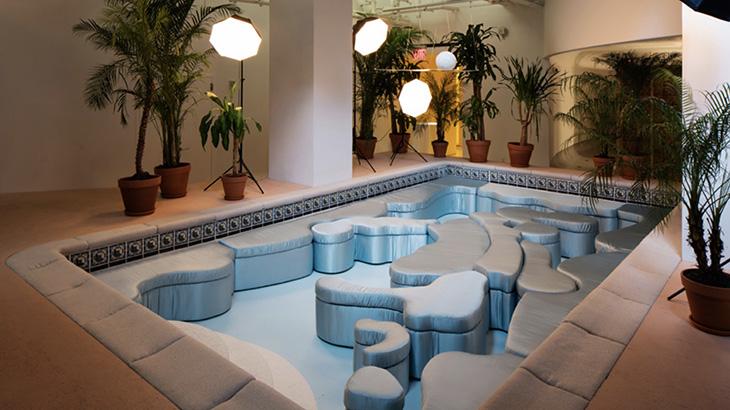
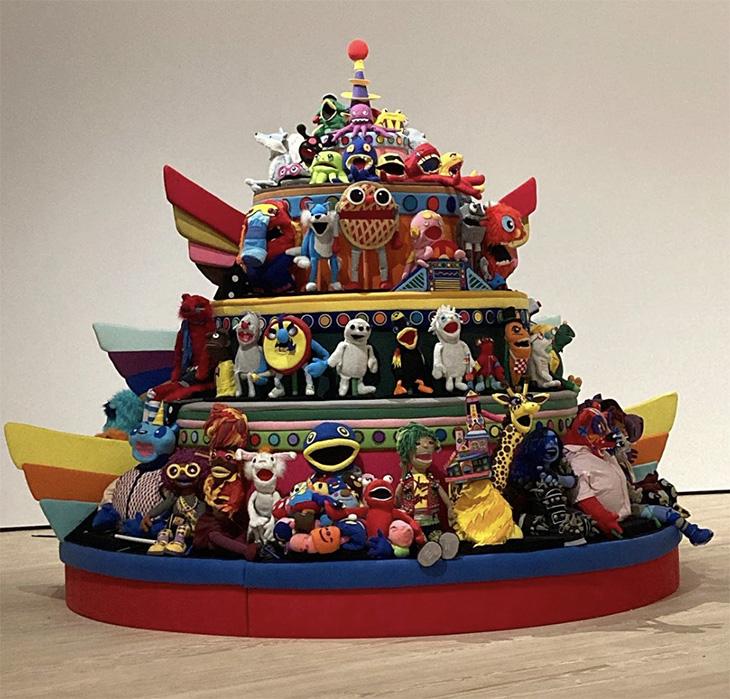
The center is dominated by Mel Chin’s “Convo Pool” (2016/2023), a replica of the apartment pool featured in the 1990s television soap opera, “Melrose Place.” To the left is JooYoung Choi’s “birthday cake,” a multi-tiered series of circular platforms displaying her signature puppets. In a far corner is Lisa Lipinski’s homage to Sakowitz, one of Houston’s eponymous department stores. In another corner is a video by Jill Magid documenting the exhumation of architect Luis Barragán’s remains in order to transform them into a diamond ring. Various other artworks hang on the walls or from the ceiling. It soon becomes apparent that to appreciate the show, one needs to examine the organizing thesis.
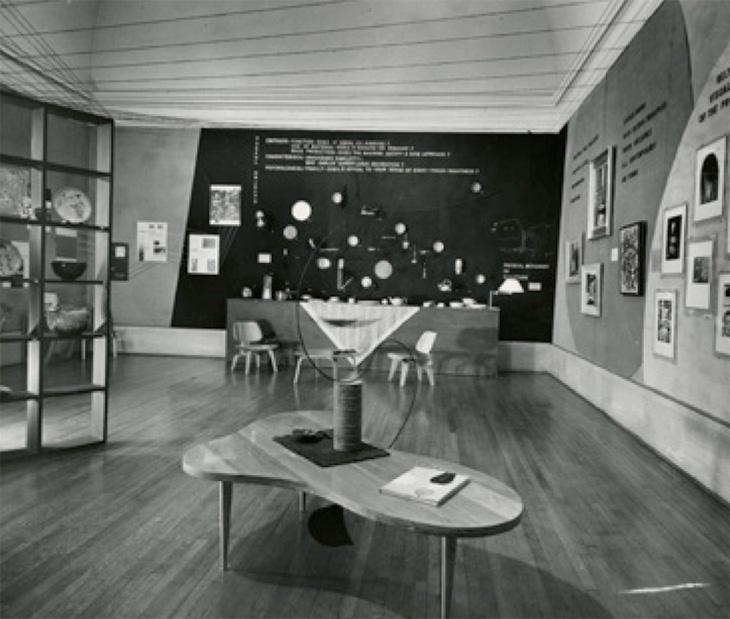
To celebrate the diamond anniversary of the CAMH, six artists were invited to respond to its inaugural exhibition, “This is Contemporary Art,” which took place in late 1948. At that time, the fledgling organization presenting the show was called the Contemporary Arts Association of Houston. The exhibition took place at the Museum of Fine Arts, Houston, because the institution had no permanent space. Paintings, sculpture, photography, architecture, jewelry, wallpaper, graphic art, and industrial design by more than fifty artists were displayed alongside some 150 functional household objects. According to the catalogue’s introductory essay, “This exhibition illustrates the influence of contemporary arts in a number of fields and tries to show the interrelation of the various arts.”
| |
Installation view of “This Is Contemporary Art” organized by Contemporary Arts Museum Houston (then Contemporary Arts Association) at the Museum of Fine Arts Houston, 1948. Photo: Frank Dolejska. Image courtesy Woodson Research Center Special Collections & Archives, Fondren Library at Rice University | | Artists featured in the exhibition included such now familiar modernists as Georges Braque, Alexander Calder, Stuart Davis, Charles Eames, Lyonel Feininger, Walter Gropius and Marcel Breuer, Wassily Kandinsky, Jacob Lawrence, Fernand Léger, John Marin, Joan Miró, Henry Moore, Edward Weston, and Frank Lloyd Wright. Thus, the original curators established the CAMH as a “place for experimentation and play,” as well as a “forward-thinking space centered around a belief in the transformational power of art and artists.” They believed that art and life should be inseparable, writing, “Here, you will see examples of good design showing what an important contribution contemporary art makes to modern living. Art has a place in the daily life of every family.” | | |
Mel Chin, “Convo Pool,” 2016/2023, wood, upholstery fabric, hardware, vinyl, lights, and plants. Installation view of TOTAL PROOF:
The GALA Committee 1995-1997 at Red Bull Arts New York, 2016. Photo by Lance Brewer. Image and work courtesy the artist
| | That six artists are included in this anniversary exhibition reflects the fact that the original institution was founded by six artists and architects. Each of these artists have mined the curatorial framework of the original show to extrapolate various ways in which contemporary life and art may collide. | | JooYoung Choi, “Nova Trekkers and the Vehicle for Change,” 2023, multi-tiered puppet installation | | In Houston-born Chin’s replica of the Melrose Place swimming pool, movable cushions upholstered in the same pattern as the original pool’s tile are stand-ins for water, and visitors are invited to step into the pool and rearrange the cushions. With this piece, the artist draws attention to a project titled “In the Name of the Place,” which Chin participated in from 1992 to 1998 as the leader of a scholarly group known as the GALA Committee. The group surreptitiously incorporated over 150 works of art into the popular television show. The concept was to include the artwork in the show for a period of years, after which they would be sold and the proceeds donated to charity. Many pieces were subversive, such as a Chinese takeout box with Chinese characters that translated to “Human Rights” and “Turmoil and Chaos.” The GALA project epitomized the concept behind the 1948 exhibition, which was that art and life should be inseparable. | | |
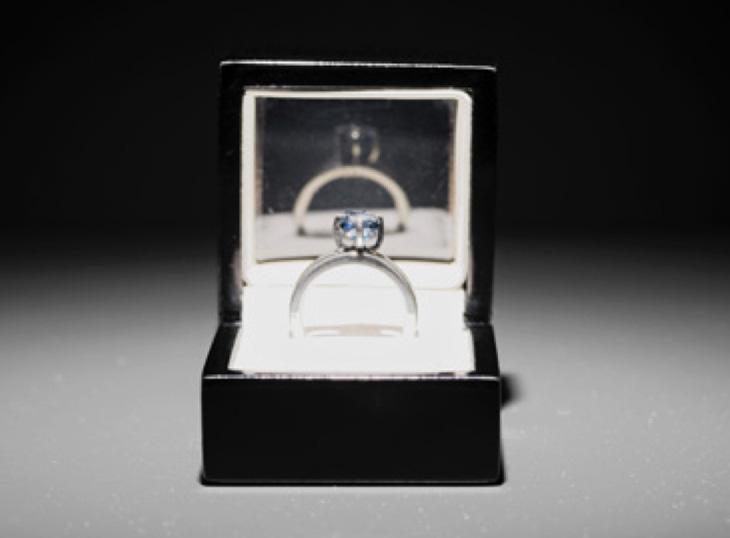
Jill Magid, “The Proposal,” 2016, 2.02 carat, blue, uncut diamond with the micro-laser inscription “i am whole heartedly yours,” silver ring set, ring box, and documents. Image and work courtesy the artist and Labor | | |
Likewise, Lapinski’s “The Younger Set Seating” uses sculpture and collage to create an environment that harkens back to Sakowitz, one of Houston’s seminal department stores, which opened in 1951. While researching, Lipinski encountered photographs of the store and was inspired to imagine how a children’s shoe department might have looked at the time. Shoes are displayed amid geometric modular seating and original wallpaper. The shoes include classic Mary Janes, ballet flats, and lace-ups in pairs consisting of one white shoe and one black shoe presented against a backdrop of yellow curtains tied back with black bows. Lapinski merges art and design to create an intriguing tableau.
For Choi, life and art are inseparable. She has created an imaginary universe called “The Cosmic Womb” from which all her work derives. The installation here, “Nova Trekkers and the Vehicle for Change,” is part of this larger project. Choi perceives the circular structure that supports her puppets as both a birthday cake for the host institution and a spaceship capable of teleportation. Her research into the inaugural show revealed that only three of the fifty-seven artists were people of color. Jacob Lawrence, the only Black artist in the show, was banned from attending the opening. Choi imagines her sculpture as a “magical teleporting spaceship fueled by truth,” with the power to crush racism and oppression.
| | |
Magid’s “The Proposal” is centered on a 2.02-carat, blue uncut diamond in a silver setting that is part of an extended project she launched in 2013. A six-minute video, “The Exhumation” (2016), along with its meticulous documentation, explains her attempt to recover the legacy and archives of the celebrated Mexican architect Luis Barragán, who died in 1988. As part of her ongoing investigations that challenge power and control, she questions the fact that the architect’s professional archives were sold to a Swiss corporation. Her video documents the exhumation of the architect's remains, one-quarter of which Magid had transformed into a diamond ring that she offered to the Swiss corporation in return for public access to the archive.
A second, new series by Magid titled “Study for The Living Room” was made by aggregating numerous photographs by visitors to Barragán's home and studio (now a museum) of facsimiles of Josef Albers long series of paintings, “Homage to the Square,” a selection of which the architect had displayed in his home. Magid sourced the images online and used them to create the JPEGS on display, which reference artwork in a domestic setting.
| | |
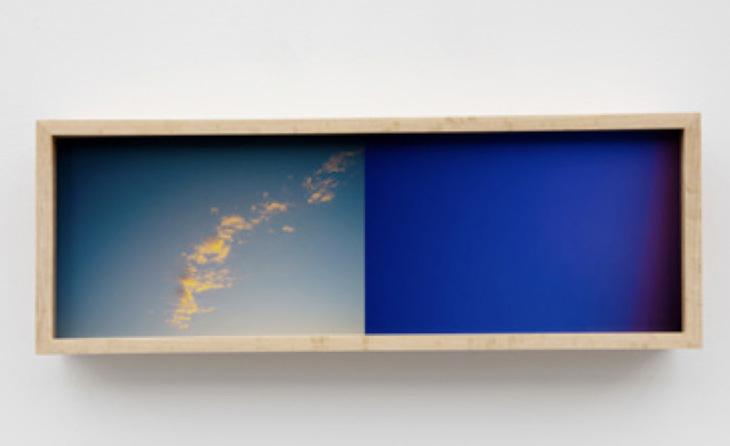
Leslie Hewitt, “Daylight/Daylong 010,” 2022, digital chromogenic print, 1/3 edition, 7 1/2 x 20 3/8 x 3”.
Image courtesy Guillaume Ziccarelli. Artwork courtesy the Artist and Perrotin
| | |
Leslie Hewitt presents “Daylight/Daylong,” a series of four photographic diptychs based on research she conducted at the Chinati Foundation in Marfa, Texas. The left side depicts different sunrises, while the right “frames her sensory experience” of Dan Flavin’s major light installations at Chinati. Leslie Martinez contributes three hanging sculptures resembling lamps constructed with wooden dowel rods, tea towels, and LED bulbs. Having previously worked in the fashion and design industry, she tapped into her past to “think beyond the frame” and create these unusual sculptures from objects found in the home.
Just as the CAMH’s inaugural exhibition presented works of art alongside functional objects to explore interdisciplinary relationships and affinities, the current show’s most successful pieces are those inspired by the world outside the realm of art yet fully capable of existing within the museum or gallery context. After 75 years, “Six Scenes from Our Future” reconfirms that the CAMH remains true to its founding principles as an experimental space fueled by the transformational power of artists to address contemporary issues and possibilities.
| | | |
Donna Tennant is a Houston-based art writer who writes reviews for various publications. Over the past 40 years, she has written about art for local and national publications, including Visual Art Source, Houston Chronicle, ARTnews, Southwest Art, Artlies, and the Houston Press. She has a bachelor of arts in art history from the University of Rochester and a master of arts in art history from the University of New Mexico. | | |
David Fertig, "Paintings and Pastels”
by DeWitt Cheng
| | |
Paul Thiebaud Gallery, San Francisco, California
Continuing through January 27, 2024
The new Ridley Scott epic movie, “Napoleon,” has been criticized for its narrative incoherence, its preference for spectacle over historic fact, and its ‘woke’ demotion of the white European male subject to a pathetic, whining mess. Despite this, the Napoleonic era remains relevant due to current ultra-nationalism, expansionist wars, clashes not so much of civilizations but of paranoid monocultures and dwindling resources.
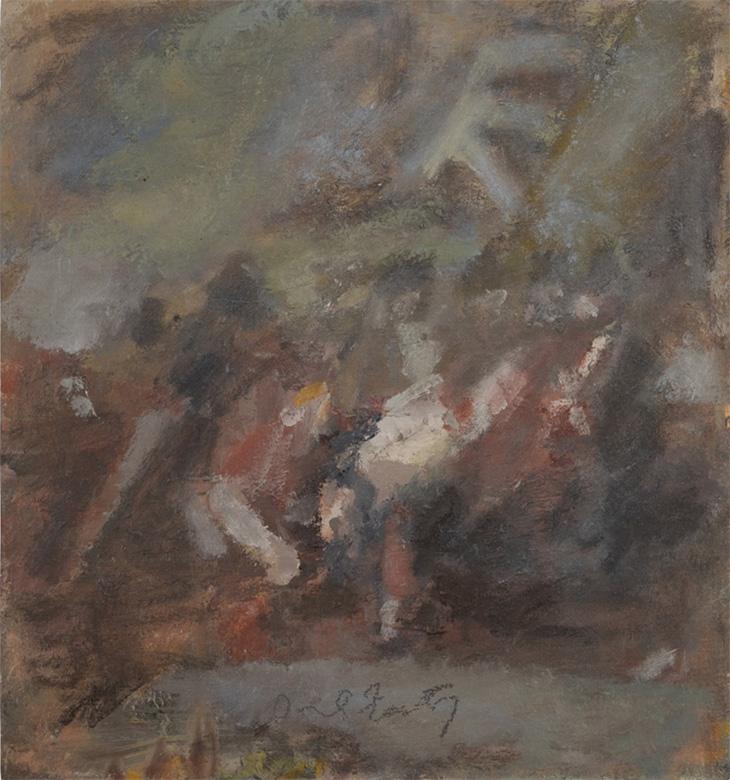
David Fertig’s “Paintings and Pastels” features seventeen new oils on canvas panel or Masonite and three mixed-media works on paper, nearly all of them based on the Napoleonic wars of 1803-1815. Unlike the empty spectacle of blockbuster epic movies, or their nineteenth-century equivalents, i.e., huge, chauvinistic battle paintings, Fertig’s works are small, intimate, and even poetic. In Alex Cohen’s 2021 film, “David, It’s Not About You,” the artist professes himself an inveterate bibliophile who shelves his art books as a hostess seats her guests, according to compatibility. He is also an iconophile, “suffering from art heroin.” His Philadelphia studio, an image bank of clippings and copies, as well as boxes of more source material, evidences the artist’s obsessional immersion in his subject matter. Says Fertig, “I don’t live in the present … I could never imagine using contemporary images to say what I want to say.”
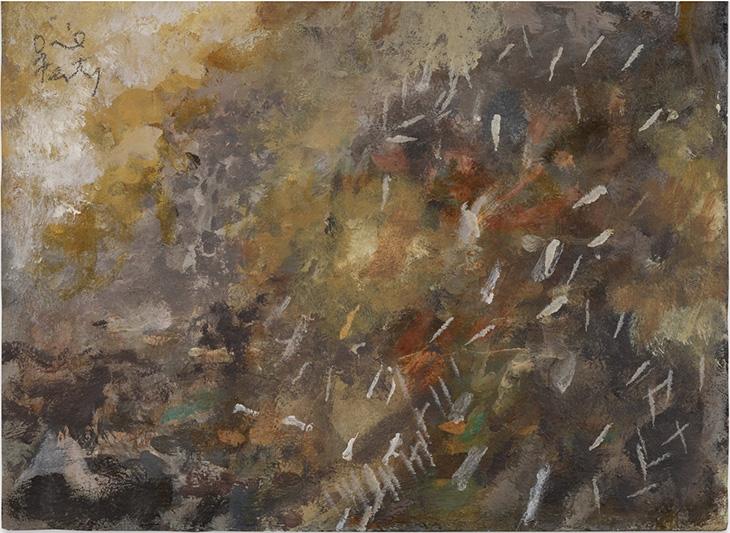
The paintings may derive from paintings or prints of Napoleonic battles, or details of larger works, but the artist’s loose, painterly, approach suggests the marine paintings of J.M.W. Turner, or the crowd paintings of Goya and the American satirist Jack Levine. They are by no means commemorations of military glory, but evocations of fire, mist, dust, and smoke — military mayhem — occasionally punctuated by flecks of bright color.
| | |
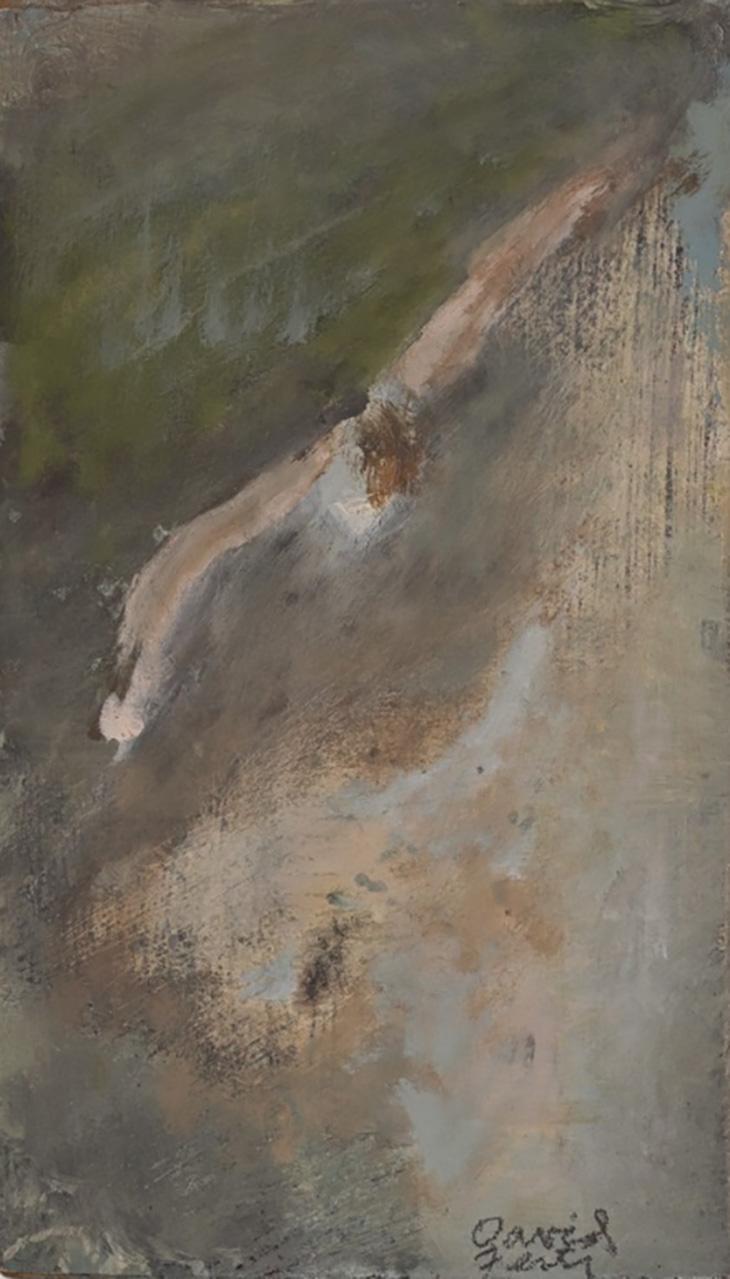
David Fertig, “Seabird or the Loss of the ‘Droit’s
de L’Homme,’” 2023, oil on panel, 10 7/8 x 6 1/4”.
All images courtesy of Paul Thiebaud Gallery, San Francisco
| | The parade-ground uniforms of pre-industrial warfare, are visualized by the artist as declarations of courageous risk-taking, as opposed to today’s guerrilla camp gear. The paintings for all their looseness are realistic depictions of the fog of war rather than idealized, noble tableaux. They feel like a kind of dream, or hallucination, sharing the blurry facticity of early photography, with its large cameras and slow shutter speeds, far from the ultra-sharpness of contemporary photography or the exhaustively researched commemorative paintings of the Romantic era. | David Fertig, “The Shannon and the Chesapeake,” 2023, oil on Masonite, 23 x 24 1/4” | | History buffs will be attracted to the subject matter of these works but should be prepared for a degree of artistic license. “Décret,” for example, a small painting based on one of Napoleon’s printed decrees, contains an anachronistic and logically inexplicable name scrawled in pencil: Jacques le Moyne, a 16th-century cartographer and artist who documented the New World. “Seabird, or the loss of the ‘Droits’ de l’Homme’” depicts, almost abstractly, an albatross hovering above a distant patch of foam in which an apparently foundering French frigate (named after one of the founding documents of the French Revolution) bobs precariously. It was to be sunk by the British in 1797 during the attempted French invasion of Ireland. | | |
David Fertig, “After the Death of Major Pierson by
J.S. Copley,” 2023, oil on Masonite, 11 1/8 x 10 3/8”
| | |
David Fertig, “Daughter of France after J.L. David,”
2023, oil on Masonite, 12 x 12 15/16”
| | |
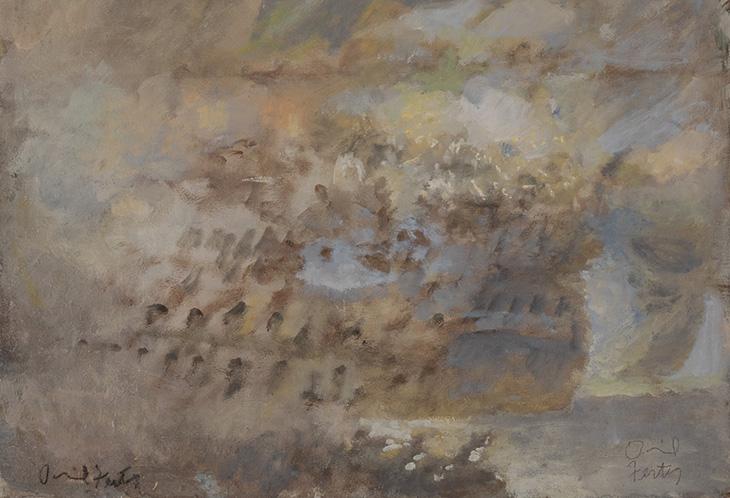
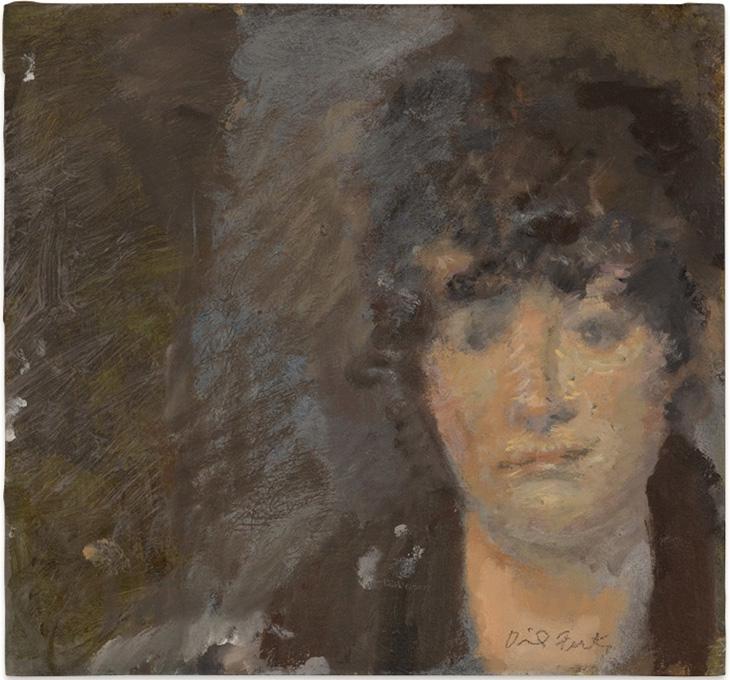
“After a portrait by Géricault or ‘Irrsinnig Kleptomane’” (insane kleptomania) is a cropped, loosely rendered reworking of one of Theodore Géricault’s ten 1822 diagnostic portraits of patients from the asylum of Salpétrière, in Paris. “After the Death of Major Peirson by J.S. Copley” revisits the central portion of that colonial American painter’s 1783 painting of the heroic death in 1781 of Major Frances Peirson, who saved St. Heller, an island off the English coast, from a French attack at the cost of his life, becoming an English national hero through Copley’s careful reconstruction of the event and engravings made from it. “The Shannon and the Chesapeake” and “Ciudad Rodrigo” are based on a naval battle and siege, respectively, both from 1812. Finally, “Daughter of France after J.L. David” is a pastel portrait based on the neoclassicist’s 1804 Napoleonic-era portrait of the young Suzanne Le Pelletier de Saint-Fargeau. She was the daughter of the revolutionary Michel Le Pelletier, assassinated by Royalists, whom David idealized in 1793, dying in Greco-Roman draped nudity, a secular martyr, with the sword wound in his abdomen clearly visible, and a cross-like sword hovering above. The French state adopted Suzanne as a “daughter of the state.”
| | David Fertig, “Ciudad Rodrigo,” 2023, oil on Masonite, 12 7/8 x 12 3/4” | | Viewers may not require the historical subtexts (or pretexts) to admire these paintings, which stand on their own aesthetically, but familiarity with the artist’s mental landscape enriches the understanding. Fertig, quoted again from the film, ” I deal specifically with legends … I read history for the art, not the facts.” | | | |
DeWitt Cheng is an art writer/critic based in the San Francisco Bay Area. He has written for more than twenty years for regional and national publications, in print and online, He has written dozens of catalogue essays for artists, galleries and museums, and is the author of “Inside Out: The Paintings of William Harsh.” In addition, he served as the curator at Stanford Art Spaces from 2013 to 2016, and later Peninsula Museum of Art, from 2017 to 2020. | | |
Jónsi, “Vox”
by Jody Zellen
| | |
Tanya Bonakdar Gallery, Los Angeles, California
Continuing through February 3, 2024
Though best known as the lead vocalist for the Icelandic post-rock band Sigur Rós, artist/musician Jón Þór "Jónsi" Birgisson is also an accomplished visual artist. His current show, “Vox,” is comprised of three pieces in which he combines speakers, LEDs and sounds in different ways. Although each work occupies its own space, they are interrelated, investigating not only how sound can envelope a space, but also its visual qualities. While sound on its own is not visual per se, its method of display (as arrays or canopies of speakers) can be. Both “Var (safespace)” and “Silent sigh (dark)” share affinities with the work of Alan Rath (1959-2020) whose sculptures often combined numerous speakers that undulated like animated entities pulsating up and down and emitting softs sounds produced by Rath's computer algorithms.
| | Jónsi, “Var (safespace).” All installation views courtesy of Tanya Bonakdar Gallery, Los Angeles | | |
Like Rath and San Francisco-based artist Jim Campbell (known for his LED installations), Jónsi's works rely on sophisticated electronics and programming. “Var” (the Icelandic word for shelter) hangs overhead and consists of hundreds of small speakers wired together to form a canopy or tent-like enclosure. According to Jónsi, it is supposed to evoke a "safe space" filled with calming sounds (a six-minute loop) and the scent of cis-3-hexenol (one of the components in freshly cut grass). Yet while the suspended canopy offers refuge in some ways, its wing-like shape also calls to mind the body of a bat in flight.
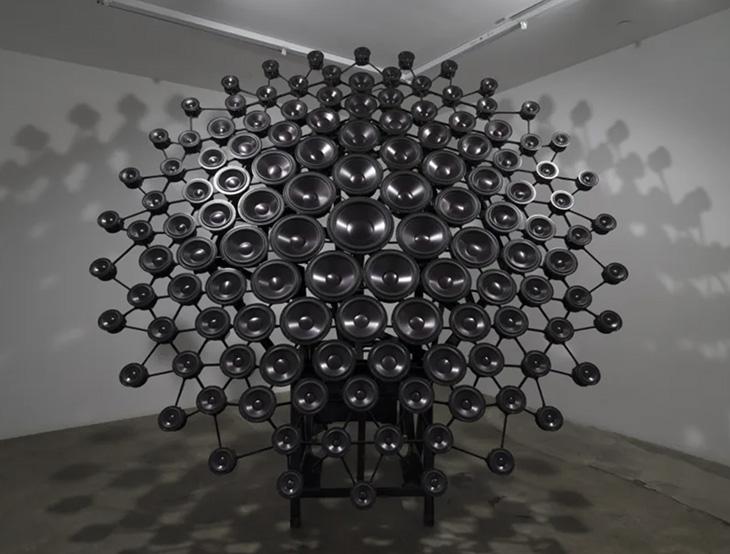
“Silent sigh (dark)” is a free-standing sculpture that fills a small, dimly illuminated space. The work is arranged in an array, something of a mechanical snowflake, where the larger speakers are in the center and the smaller ones extend out toward the edges. Jónsi uses computers (nested in the base of the sculpture) to control direct currents that change the physical state of the different speakers. This causes them to ripple and emit breath-like sounds that allude to the perception that they could be "alive."
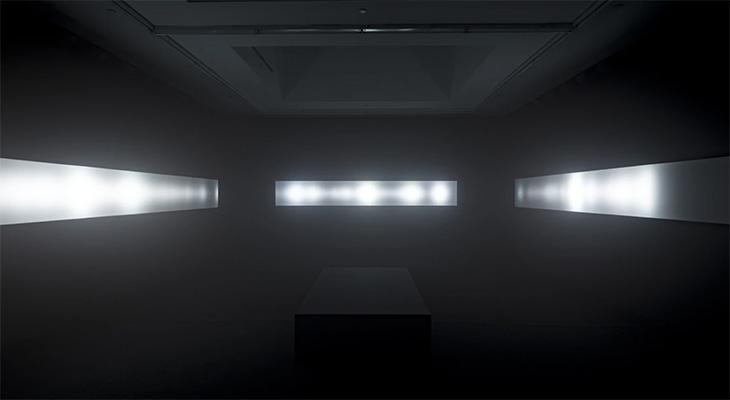
| | Jónsi, “Silent sigh (dark)” | | Filling the darkened main gallery space is the eight-channel sound and LED installation “Vox.” With a duration of twenty-five minutes, Vox visualizes the human voice. It intertwines Jónsi's own voice with those generated by an AI to create an eerie and ambiguous audio environment that syncs with choreographed bursts and flashes of light on approximately two-foot-high LED screens encircling but not filling the four walls of the gallery. While it is difficult to make out actual words or sentences, the work evokes a sense of awe and mystery due to the visually palpable sound. We enter the space through a curtain and as your eyes adjust to the darkness you might notice a single bench that appears to be floating in the middle of the space like a horizontal version of the monolith from “2001: A Space Odyssey,” its black surface reflecting aspects of the pulsating light. This bench beckons. It is an indicator that to experience the piece in full, one might want to sit. As the tonalities begin to ebb and flow the LEDs follow suit to become a visual and aural soundscape that is both soothing and other worldly simultaneously. | | Jónsi's sound-works are subtle and not meant to overpower the space or the viewer. Though electronically created, they reference the subtleties of the natural as well as the built world. The pieces are seductive, contemplative and inviting. As a musician, Jónsi has performed in different arenas, as well as worked with visual artists such as Doug Aitken and Olafur Eliasson, so he is familiar with the power of immersing audiences within seemingly empty spaces. Once filled with both frenetic and soothing sounds, these spaces become a visual field to project your own imagination. | | | |
Jody Zellen is a LA based writer and artist who creates interactive installations, mobile apps, net art, animations, drawings, paintings, photographs, public art, and artist’s books. Zellen received a BA from Wesleyan University (1983), a MFA from CalArts (1989) and a MPS from NYU's Interactive Telecommunications Program (2009). She has exhibited nationally and internationally since 1989. For more information please visit www.jodyzellen.com | | | |
Visual Art Source is a nonprofit platform, our mission to further the discourse of both visual art, the the Visual Art eNewsletter, and social, political and cultural issues as seen through an art critical lens, The Democracy Chain eJournal.
You are invited to support the writers who make it all possible. Please click the any of the cups. Please forward the eNewsletter and while you are at it follow us on social media.
| | | | | |
© 2024 TDC/VAS
Contact Information:
231 Cedar Heights Dr., Thousand Oaks, CA 91360
Ph: (213) 482-4724
| | | | | |