Currently, the Constant Contact platform causes some versions of Outlook to display incorrectly. If you are having trouble viewing this email, please click the above View as Webpage. |
|
New Director of Clinical Services
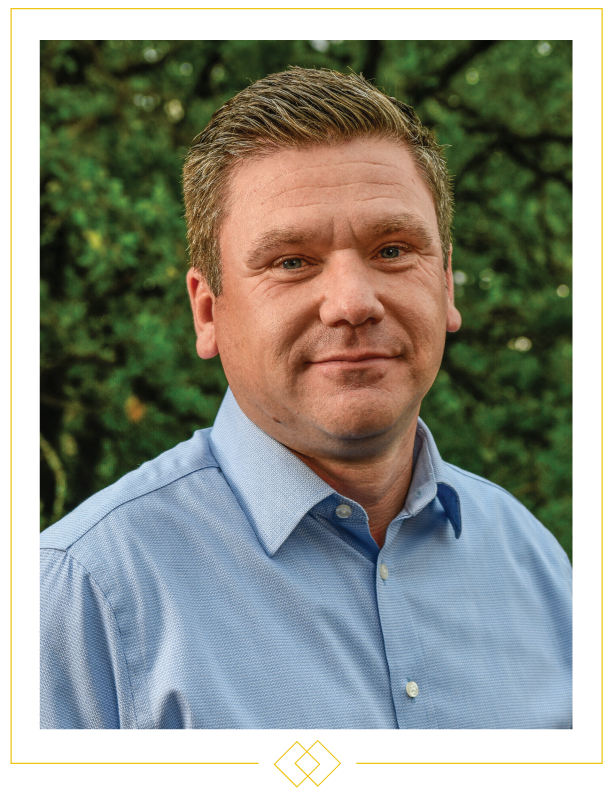
Adam Karazuba, MSW, LMSW, is the new Director of Clinical Services, over Residential and Outpatient services at Santé. "Like many of us here, Adam has served in a variety of roles at Santé, bringing his passion to serve those struggling with the disease of addiction, mental health issues, and trauma. I am confident that Adam will continue to exemplify our values, to serve others well, and help guide Santé clinical programming in our efforts to provide long-term recovery and wellness for our patients," said Santé's CEO, Sam Slaton, M.ED., LPC-S, MBA, MHSM.
About Adam: A leading authority on addiction treatment therapies, program implementation and “people development”, Adam has orchestrated several key programmatic transformations during his 20-year career, including the Daytime Intensive Outpatient Program and Virtual Intensive Outpatient Program at Santé Center for Healing, where he’s been making impact since 2018. As the Director of Clinical Services for Santé, an internationally renowned addiction continuum of care for individuals seeking long-term recovery from addictive substances and behaviors with a focus on dual diagnosis and trauma resolution, he helps provide the long-term vision, clinical methods and system processes to provide long-term recovery for Santé clients and their families. With a collaborative style and a penchant for humor, Adam draws on his extensive experience as a Santé Residential Case Manager/Primary Therapist, Santé Director of Intensive Outpatient Services and more than two decades of working in quality inpatient and residential facilities working with children, adolescents, adults and their families. He’s an avid proponent for dual diagnosis and trauma informed care, which addresses the core issues often related to chronic relapse. Although he hasn’t fully adopted a Texas drawl, he comes to Santé via New York, attaining his Masters of Social Work from Syracuse University and a Bachelor’s degree in Psychology from Le Moyne College, Syracuse, NY. In his time away from Santé, Adam enjoys time with his family and friends, golfing, and Syracuse basketball. |
|
July 29, 2022 12:00 p.m. - 1:00 p.m. CST 1 CE Hour Zoom |
|
"A Hero’s Journey: Utilizing Posttraumatic Growth in the Treatment of Addictions"
Speaker: Ashley Whitted, M.S., LPC, CSAT Candidate |
| |
Presentation Objectives: - Learn the basic concepts of Joseph Campbell’s “Hero’s Journey.”
- Practice applying these concepts to the addiction recovery process.
- Discuss how utilizing these concepts can assist in instilling hope in early recovery.
Click here or the button below for the speaker's bio and to register. |
|
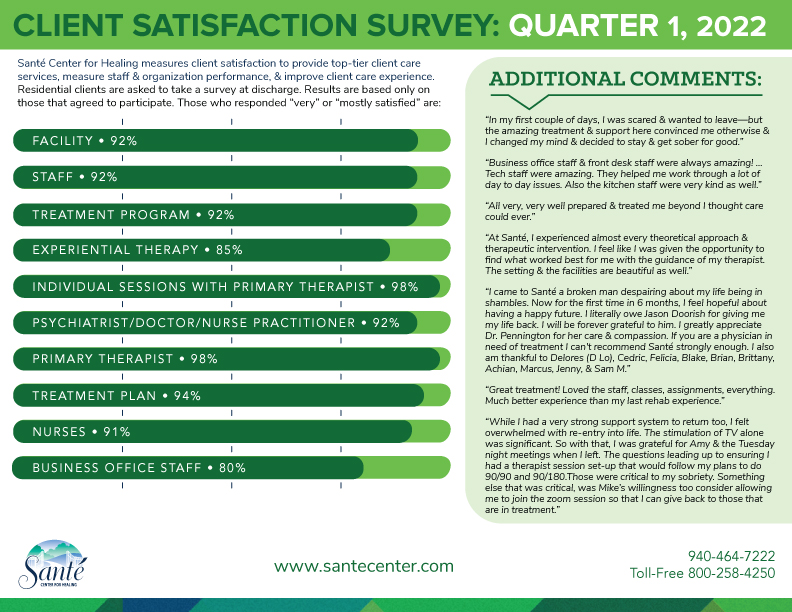
Santé Center for Healing measures client satisfaction to provide top-tier client care services, measure staff and organization performance, and improve client care experience. Residential clients are asked to take a survey at discharge. Results are based only on those that agreed to participate. Those who responded "very" or "mostly satisfied" are: (click here or see below image) |
|
Santé’s Transitional Living (TL) program provides a highly-structured, therapeutic apartment-style living for adult men and women, who are in search of additional daily living support while in the early stages of recovery. Several research studies by NIDA (National Institute on Drug Abuse) find that the longer an individual is involved in a continuum of care and receiving treatment, they have significantly better outcomes including decrease in relapse rates. As with the national trend, this program has also seen a rise in adult children who were previously living at home. Santé’s TL residents receive the environmental, therapeutic and social support needed to meet goals and succeed.
A recent Public Health Institute study showed that individuals in TL-type programs recorded lower incidences of drug use, arrests and harmful psychiatric symptoms, 18 months after leaving treatment. Results also showed that residents who stayed longer in this level of care were less likely to relapse as compared to those who did not stay long. As individuals continue to deepen their recovery, at this level of care, staff and residents alike identify and address missing life skills, including but not limited to: financial planning, budgeting, meal planning, educational guidance, career development and life skills education. Employment, community service, 12 step work, and higher education and continuing education are important components for the Transitional Living Program.
In addition to a safe, chemical-free environment, TL residents experience: separate men’s and women’s programs; master’s level therapist on site Monday - Saturday; daily group therapy and house meetings; random drug screens; 12-Step Recovery model; individual and group counseling; employment and volunteer opportunities; and more.
“As a treatment team, we’re honored to help people new in recovery use Santé’s Transitional Living as the foundation for the relationships, connections and decision making essential for sustained, long term recovery,” says Santé's Director of Clinical Services, Adam Karazuba, MSW, LMSW. For any questions regarding our Transitional Living program, please contact Meredith Sims, MS, NCC, LPC-Associate at 940.464.7222 or MeredithS@santecenter.com. |
|
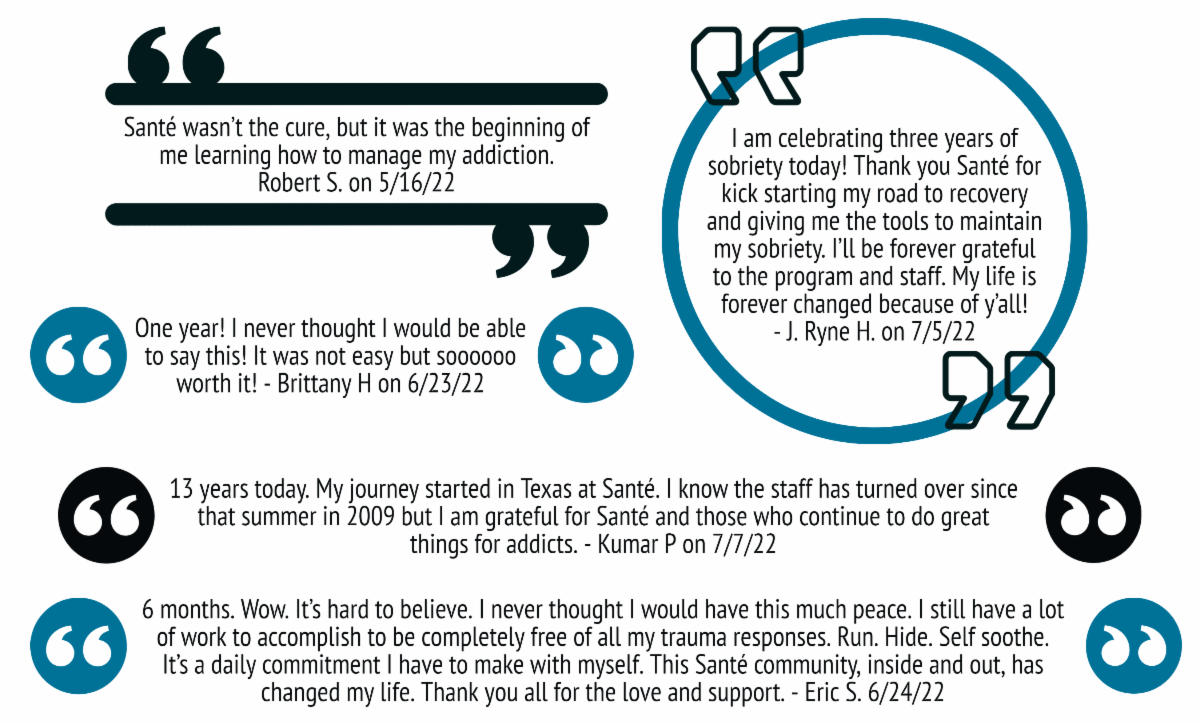
We love the relationship we have with our Alumni. It is an honor and joy to celebrate in their successes and to stand by them in hardships. Here is some of what they have recently shared. |
|
Step 7 “Humbly asked Him to remove our shortcomings.”
Many of us have come to believe that being successful means being strong, independent individuals who are profoundly self-reliant. This type of thinking can lead to shame or guilt when we need to ask for help or to admit to shortcomings. An unintended consequence of this can be a barrier to self-growth. How can we overcome this barrier? Humility.
If we can use the same inward strength and humility during the process of Step 7 that was used to admit to being “powerless over alcohol – that our lives had become unmanageable (Step 1),” we will be able to face any shortcoming and problem that arises. “If that degree of humility could enable us to find the grace by which such a deadly obsession could be banished, then there must be hope of the same result respecting any other problem we could possibly have.”¹ We must be humble within ourselves and know when to seek help, in our recovery, responsibilities, and relationships. When asking a Higher Power to remove our shortcomings, we begin to let go and accept the flaws as small facts and not the totality of who we are. It is important to recognize and remove our shortcomings to continue to become the best individual we can be.
Humility is an equal opportunity, one we can all practice, whether in recovery and working the 12 Steps or not.
1. Twelve Steps and Twelve Traditions |
|
Every Tuesday Night Alumni Online All Inclusive Recovery Meeting at 8 PM CST
July 29, 2022 SIPER (Santé Institute for Professional Education and Research) CE Event - 1 CE Hour 12:00 p.m. - 1:00 p.m. CST, Via Zoom "A Hero’s Journey: Utilizing Posttraumatic Growth in the Treatment of Addictions" Ashley Whitted, M.S., LPC, CSAT Candidate
August 26, 2022 Trauma Education Association - 1 CE Hour 11:30 AM - 1 PM CST, Via Zoom "5 Shadows of Shame" Shane Adamson LCSW-S, EFT, CSAT
|
|
You are mission-inspired and results-driven. You chose your profession and calling for all the right reasons. Your work helps people in their most hidden and painful problems every day.
The importance of your work is underscored by how incredibly hard it is. Any given day might bring massive challenges with your clients or patients. Who else is in it for all the right reasons? Who can you trust to work alongside you, providing evidence-based and trauma-resolution care? Who provides the best opportunity for long-term recovery?
Google provides 350,000,000 results when searching “addiction treatment.” This is an overwhelming number of options that you can ascertain for quality, but can your clients or patients?
They look to you to: - Distinguish clinical experience and expertise from nonessential amenities and impersonal call centers;
- Connect them to higher levels of care ready for the increasing complexity of their problems and to discover and begin to heal from the root issues underneath, therefore decreasing the likelihood of relapse;
- Recognize other facilities may dress the part but lack integrity.
They look to you. And you look to Santé Center for Healing for expertise, integrity and long-term recovery…for all the right reasons.
Santé Center for Healing: What We Treat…
|
|
When you submit the "Santé Connections" form, your information is accessible to Santé's intake counselors, aftercare coordinator, and family therapists for referral purposes. |
|
Santé provides quality care and programs for long-term recovery. If there is anything we can do to improve, please reach out to us. When you reflect on our continued collaboration and/or our shared clients who are doing well, share the experience on Facebook or Google. |
|
Jesse Cordova Regional Marketing Coordinator Denton Co., Tarrant Co., W. TX 214.592.3799 |
| Paul M. Scott, Jr. Regional Marketing Coordinator Dallas Co., Collin Co., E. TX 469.771.7880 |
| McKensey Coit Regional Marketing Coordinator OK, AR, MO, KS 940.395.8311 |
| Elizabeth Bradshaw National Marketing Coordinator West Coast, Central US, East Coast 214.934.9377 |
|
|
|
|
|
|
|