In a summer of headlines about losses of life and losses of rights, there is some good news. The new 988 Suicide and Crisis Lifeline is now available nationwide, 7 days a week, 24 hours a day.
Dialing or texting 988 gives people a direct connection to trained professionals who can provide assistance and compassionate care for anyone experiencing mental health related distress, including family, friends and caregivers.
As with 911, the three digit 988 makes it easier for people to call for appropriate help in a time of crisis. Frequently, people in a mental health crisis do not receive a mental health response; often their first contact is with law enforcement, which is not well equipped to provide the service or support needed.
Please visit 988lifeline.org to learn more. Share this information widely. Help make this new resource the beginning of a more accessible and comprehensive system for mental health care in our country.
According to initial data, the 988 number received more than 96,000 calls, texts and online chats during the first week it launched. The 988 Lifeline is a life-changing example of our nation working together to connect speakers, listeners and systems.
It strikes me that this is what our country needs more of right now–more people who are speaking up about what they want, more elected officials who are listening, and a structure that can put things in place. All of it must come together in an atmosphere of communication and compromise–so we can find common ground.
The same lesson can be applied to so much of what we need to accomplish in our lives. Who is speaking? Who is listening? Are we communicating? What is our common ground? How can we move forward together?
Let’s continue to rise to the occasion and find our common ground. |
|
President League of Women Voters of Illinois |
|
Look beyond the summer of 2022. |
|
Summer 2022 will become known as the summer of lost rights.
- A summer when photos of American flags amidst the carnage of a deadly rampage in Highland Park became the symbol of our distinctly American reality. In America, the prevalence of gun violence threatens our right to live free from the fear of random gunshots. Americans are alone in this. Americans own the most guns and experience the most gun-related deaths per capita than citizens in any other developed nation.
- A summer when a ten-year-old victim of child abuse had to cross state lines because she was pregnant and could no longer get an abortion legally in her state. With the Supreme Court's June 24 decision, people in some states lost the right to make private decisions about their health care. Likewise, some doctors lost the right to save the lives of their patients without fear of being prosecuted.
Summer 2022 must also become known as the summer of insistence.
Insistence on rights for all Americans, as we work to reclaim rights lost and establish firmly those promised but never received.
Poll after poll shows that the majority of Americans want to be free of gun violence. Poll after poll shows that the majority of Americans want the right to abortion care. Poll after poll shows that the majority of Americans want voting rights protected. And yet, legislators struggle to pass laws that represent the will of the majority. |
|
Democracy works when people insist on their right to be represented. |
|
Active civic engagement is the heartbeat of our democracy. Our constitution binds elected officials by an oath–to represent the will of the people. It is imperative that we use our voices, both in the ballot box and beyond, to make our will known. In the next few months, people in Illinois have an opportunity to use their voice: - to weigh in on legislation currently being considered
- to elect candidates who will work for the Illinois voters want
In this issue of News You Can Use, learn how Illinois legislators might take action between now and election day, and learn ways to use your voice for issues that matter to you. |
|
Protect our democracy. Use your voice. |
|
Let your legislators know what you want. |
| Insist on your right to be represented. Contact your representatives by phone or email regularly! |
|
The basics: how laws get passed in Illinois. |
|
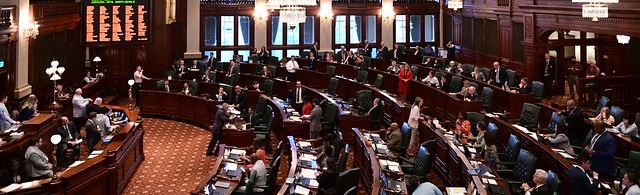
It's all about ILGA The Illinois General Assembly (ILGA) is made up of two chambers, the House and the Senate. Illinois has 59 legislative districts each electing one senator for either two- or four-year terms. Each of those districts is divided into two representative districts. The House is made up of 118 representatives, who serve two-year terms. Find your district.
Most bills pass by a simple 51% majority vote: 60 votes in the House and 30 in the Senate. Bills that pass both chambers are sent to the governor for signing. The governor has 60 days to either veto a bill or sign it into law. If the governor does nothing for 60 days, the bill becomes a law. See the detailed path of a bill.
Each General Assembly conducts business during a two-year term beginning when new House members are elected. The 102nd General Assembly began in January, 2021.
ILGA conducts business during specific Sessions Regular Session convenes each year in January and usually adjourns the last day of May. This year, the Regular Session was adjourned early, on April 9, to allow for a delayed Primary Election. The Primary was delayed to allow time for district maps to be drawn based on 2020 Census data that was delayed due to Covid shutdowns.
Veto Session is when ILGA reconvenes for two weeks in the fall. This year the Veto Session is scheduled for November 15–17 and November 29–December 1. This session is used to address any bills the governor has vetoed, and can also be used to pass other legislation.
Lame Duck Session can be convened at the end of ILGAs two-year term, after elections. This term, that would be in January, before the 103rd General Assembly takes office on January 11, 2023. A simple majority (51%) is required to pass legislation in a Lame Duck Session.
Special Sessions may be called by the Governor or by a joint proclamation of the presiding officers of both chambers. After the events of this summer, it is expected that lawmakers may call for a Special Session this fall, to address gun legislation and reproductive healthcare legislation. |
|
Bills passed before May 31 of a calendar year go into effect on January 1 of the next calendar year, unless otherwise stated in the bill.
Bills passed after May 31 of a calendar year go into effect June 1 of the next calendar year unless the General Assembly approves an earlier date, written into the bill, by a three-fifths majority.
Bills passed during either the Veto Session or a Special Session, if one is called in fall, will need to meet this three-fifths majority threshold if they are written with an immediate effective date.
Bills passed during a Lame Duck Session in January only need a simple majority to pass, whether or not they are written with an immediate effective date. |
| Timing may be everything for Illinois legislation this fall. |
|
The mass shooting on July Fourth in Highland Park was horrifying. What is even more horrifying is that there were more gun deaths that weekend outside of Highland Park than within it. Gun violence devastates families, destroys dreams, and shatters communities in Illinois every single day. And yet, it doesn’t result in mass outrage. It should. Gun violence in the United States has become so normalized that mass shootings garner attention far outweighing the sheer impact of their numbers. According to data from the Gun Violence Archive, there have been a total of 24,659 deaths due to guns in the US so far this year. Of those, 357 have been the result of mass shootings. It is important to take note of these numbers. Horrified? Take action. |
|
Reach out to our US senators and representatives. Yes, you can thank Senators Durbin and Duckworth again. More importantly, they need to know what you want. Universal background checks? National ban on civilian ownership of assault style weapons? Let them know. Advocacy never stops.
Advocate for Illinois legislation. - HB5522 would make it a felony to buy or sell assault-style rifles and high-capacity magazines in Illinois. This bill had exactly one sponsor when the Illinois General Assembly adjourned in April. Since July 4, more than 50 members of the Illinois House have signed on as sponsors. In addition, the Governor has called for a ban on military-style assault rifles and high-capacity magazines.
- HB5766, a “White Flag law,” would strengthen Firearms Owner ID Card (FOID) regulations. The bill would create a mental health reporting system for adolescents applying for a FOID card. All legal gun owners in Illinois must carry a FOID card. The cards cost $10 and are valid for ten years. There is no age limit, although applicants under age 21 must be sponsored by a parent or guardian, and any minor must be able to sign their application. If they are unable to sign, a birth certificate may be provided instead.
Talk about the Red Flag Law. In Illinois, our Red Flag Law is called the Firearms Restraining Order (FRO) Act, which became law in 2019. The FRO Act gives family members the right to request that gun ownership be temporarily prohibited for someone who is in danger of harming themselves or others. Help increase public awareness of life-saving FROs. Find information to share on the Speak for Safety website.
- Advocate for Illinois legislation. HB5374 would expand the list of people who can petition for an FRO to include mental health professionals and school administrators.
|
|
With the US Supreme Court's decision repealing the rights established by Roe v Wade and Planned Parenthood v Casey, Illinois became one of the only states in the midwest where abortion is safe and legal.
The impact on Illinois care providers was immediate. In the first 19 days after the Court's decision, the wait for abortion care at some clinics went from three days to three weeks. During that same time period, care coordination centers report going from 30 callers a week to more than 200. Providers are expanding hours, working overtime, and training volunteers in order to provide timely reproductive care.
Reproductive rights are safe in Illinois, but only as long as our legislators safeguard them. |
|
Reach out to our US senators and representatives. Tell our senators and your representatives that we need laws to make abortion and gender affirming care legal, no matter what state you live in. Then tell them again.
Advocate for Illinois legislation. HB1464, which was passed by the House this spring, needs to pass in the Senate. This bill protects the licenses of Illinois reproductive healthcare providers caring for out-of-state patients. Watch for legislation being developed to: - Expand service capacity by facilitating the licensing of abortion providers coming to Illinois from other states, and expanding abortion care licensing to physician assistants and other qualified providers.
- Protect anyone assisting reproductive health patients against actions taken by other states
- Strengthen data privacy protections around things like location notices, Google searches and period trackers.
Talk about reproductive justice often. Say the words “abortion is healthcare.” All people deserve the right to determine the course of their own healthcare, in privacy, with their doctor. |
|
These organizations have systems (and some funds) in place to help people in other states find care. Over the years, they have developed a network of vetted counselors, caregivers and drivers trained to work with people in need of reproductive healthcare. |
|
Voting rights and abortion rights are essential to a democracy where all people can participate equally. Brennan Center |
|
What about climate change? Jobs, racial justice, community investment? What issues are important to you? |
|
Election season starts NOW. |
|
Resolve to take your voice from the streets to the ballot box. Make sure that everyone, Everyone, EVERYONE you know does the same. Unless the majority of people vote, only a few voices will be heard. |
|
Illinois has more than 8 million registered voters. |
| Not all registered voters actually vote.
Only 1.7 million registered voters voted in last month’s midterm primary election. That means 6.3 million Illinois voters allowed their neighbors to choose the candidates for US Senate, Congress, Governor, Illinois General Assembly, County Officials and Judges. |
|
Historically, weak primary turnout has been followed by weak election turnout.
2022 Primary Election 21% (Midterm)
2021 Consolidated Election 15% (local offices) 2020 General Election 73% (US Presidential) 2020 Primary Election 28% (US Presidential)
2019 Consolidated Election 19% (local offices) 2018 General Election 57% (Midterm) 2018 Primary Election 26% (Midterm) |
| Low voter turnout means only a small percentage of voices are making all the decisions. |
|
| Find out what candidates plan to do about issues that are important to you. Make sure you vote accordingly. |
|
Many Illinois districts changed with the remapping done after the 2020 Census. Voters can find out if they have a new voting district using the Illinois State Board of Elections interactive map. Type in an address for a list of current legislators, as well as 2022 representative districts. |
| Same residence, different district? |
|
| Your one stop shop for nonpartisan voting information. - Check your voter registration
- Register to vote
- Find your voting district
- Sign up to be notified when ballot and candidate information becomes available. IllinoisVoterGuide.org.
|
|
Thank you for supporting our work to defend democracy and empower voters. |
|
|
|
|
|
|