|
New Research Confirms What Families Have Known—
Adoption-Competent Mental Health Care Changes Lives
| | Two New Reports from the Center for Adoption Support and Education Underscore the Urgent Need for Specialized Mental Health Support for the Adoption, Foster, and Kinship Community | | |
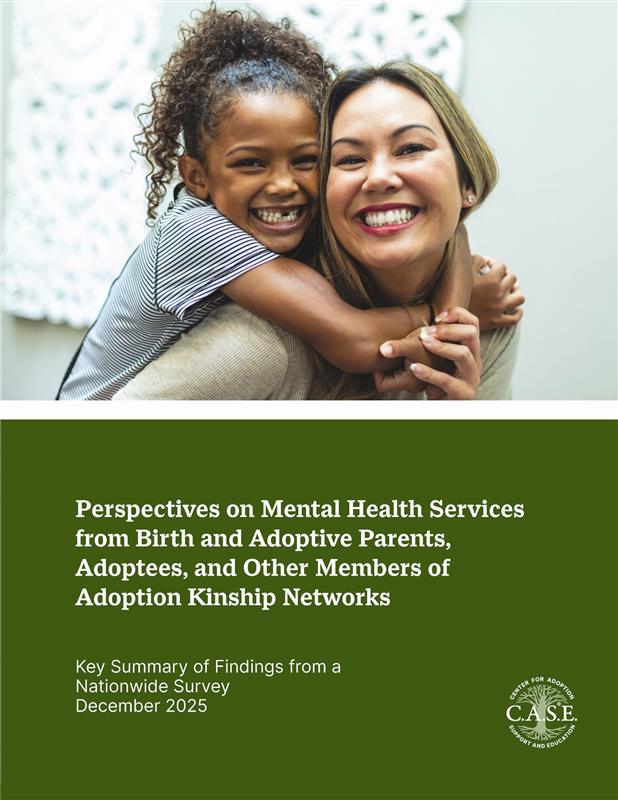
WASHINGTON, D.C. — The Center for Adoption Support and Education (C.A.S.E.), the nation’s leading expert in adoption-competent mental health care, today released two landmark research reports that provide the strongest evidence to date that adoption-competent mental health services deliver measurably better outcomes for adoptive families—and that far too few families can access them.
The new data, collected through a nationwide survey and a multi-state effectiveness study, show that families who engaged with TAC-trained clinicians—clinicians who have completed C.A.S.E.’s rigorous evidence-based, accredited Training for Adoption Competency (TAC) program—report stronger therapeutic alliances, higher satisfaction across all dimensions of treatment, more adoption-relevant care, and improved family outcomes.
At the same time, the national survey reveals that families across the adoption kinship network—including birth parents, adoptive parents, adoptees, and kinship caregivers—engage in mental health services at rates 2.5 to 3 times higher than the general U.S. population, but face significant barriers to adoption-competent care. Just 21.84% of respondents rated their clinicians as adoption competent, with adoptees facing the steepest access challenges.
| |
“This is more than a study—it’s a call to action. After more than 25 years of pioneering this critical body of work, we now have the data to prove what adoptees, families, and clinicians have been telling us: when mental health care reflects the lived realities of adoption, it changes lives. The nation cannot afford to overlook this as a subspecialty any longer.”
- Debbie Riley, LCMFT
C.A.S.E. CEO
| |
- Only 1 in 5 reported their clinician was adoption competent.
- The therapist’s specialized training with adoptive families was rated the single most critical factor in selecting a mental health provider.
| | |
"Families are asking for what research and ethics demand: adoption-competent, trauma-informed, culturally responsive care. The data demonstrate that families experience better outcomes and stronger bonds when mental health professionals have the knowledge and skills gained through
specialized training.”
- Anne Atkinson, Ph.D., Lead Author and Principal Investigator
President & CEO, PolicyWorks
| | |
The second report, Training for Adoption Competency Effectiveness Study, synthesizes findings from two studies across five states and 302 families. Results show:
- Families who saw TAC-trained clinicians attended nearly three times as many sessions on average (19.37 vs. 6.96), remained in treatment longer, and were more likely to engage consistently—with fewer dropouts and stronger continuity of care.
| | |
-
TAC-trained clinicians outperformed non-TAC-trained peers across every measure of client experience and outcomes, including:
-
98.5% of clients rated services from TAC-trained clinicians positively, compared to just 22.7% for non-TAC-trained providers.
- Over 86% of clients receiving care from TAC-trained clinicians reported meaningful improvement in child and family outcomes, 13x higher than those working with non-TAC-trained clinicians (6.4%).
- Overall, families reported stronger bonds, improved parenting strategies, and better behavioral, emotional, and academic functioning for their children.
| | Across all indicators, effect sizes ranged from large to very large (Hedges’ g = 1.97 to 5.50), confirming the practical and clinical significance of the TAC training. | | |
“The commitment of C.A.S.E to provide evidence-based adoption-competent mental health care to children and families is life-changing and validates what the Dave Thomas Foundation for Adoption has long known – that placing children into permanent homes is just the beginning of the journey; supporting them with quality, accessible care long after the adoption is finalized is essential. The findings released today should prompt all involved, from policy makers to funders, to prioritize and scale this essential service.”
- Rita Soronen, President & CEO,
Dave Thomas Foundation for Adoption
| | |
C.A.S.E. is calling on policy makers, states, systems, and providers to adopt national standards for adoption-competent mental health care, invest in training and credentialing, and expand public access to directories of qualified clinicians.
Full copies of both reports are available at: adoptionsupport.org/stateofpractice
###
| |
|
The Center for Adoption Support and Education (C.A.S.E.) is a national leader in mental health, ensuring the well-being and permanence of children, families, and individuals connected to adoption, foster, and kinship care. We work across every level of the permanence ecosystem—delivering direct services, training professionals, and driving systems change—to ensure families stay together and thrive. Our approach is rooted in Adoption Competence: a deep understanding of the unique experiences shaped by loss, identity, trauma, belonging, and more.
Founded by families in this community, C.A.S.E. has been advancing this mission since 1998. We believe every child deserves lasting connection, and every family deserves the support to make it possible.
Learn more: adoptionsupport.org.
Did a friend forward you this email? Sign up for our emails today!
| | | | | | |