|
Helping Local Road Leaders
In the midst of this holiday season, work continues at the Upper Great Plains Transportation Institute (UGPTI) at NDSU where researchers and staff are analyzing data, conducting outreach activities, and helping local agencies better manage their roadway assets.
In this issue of the newsletter, you'll learn about UGPTI's ND Local Technical Assistance Program's efforts to help counties inspect, repair, and rehab the bridges that serve as vital links in our transportation system. You'll also learn about the Geographic Roadway Information Tool (GRIT), an online tool that helps county engineers and road superintendents make decisions about how best to manage, maintain and upgrade roads, culverts, signs, and other parts of our roadway infrastructure. Finally, UGPTI research is helping the ND State Patrol reduce winter truck crashes and limit the impact of those that do occur.
In the past few months, UGPTI's 19-member advisory council has been meeting to develop a strategic plan. This group of leaders provides guidance to the Institute related to the development of transportation in North Dakota. The strategic plan will clarify the advisory council's mission and provide continuity as membership changes. The strategic plan will also guide the advisory council's deliberations and discussions as it provides input into UGPTI's efforts so it can better address the transportation needs of North Dakota and its citizens.
If you missed the last issue of this newsletter, take a few minutes to take a look. The articles in these newsletters are only a small portion of the work going on at UGPTI. For even more information, visit the webpages of UGPTI's programs and learn about the Institute's efforts across the state and beyond.
If you have any questions about UGPTI and its programs, please contact me, UGPTI Director Denver Tolliver, or any of the UGPTI staff.
Best regards and warmest wishes for the holiday season!
| |
Sheri Haugen-Hoffart
ND Public Service Commissioner
UGPTI Advisory Council Chair
| | | | NDLTAP Provides Bridge Training to Local Agencies | | |
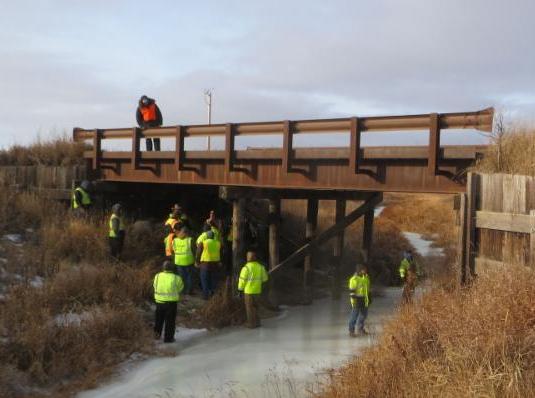
Local agencies across North Dakota are making sure bridges are safe and keeping them in service longer thanks to training provided by UGPTI’s ND Local Technical Assistance Program.
Currently, counties, cities and townships in North Dakota own 2,954 bridges that are longer than 20 feet. Of those, 3.7% are closed and another 23.3% are load restricted, resulting in costs and delays for farmers, energy producers and other road users. ND LTAP helps local agencies learn how to properly inspect, maintain and repair bridges to assure safety and maximize their service life and safety.
Training sessions involve site visits to various bridges to help attendees understand bridge inspection reports that identify problem areas and maintenance needs, says NDLTAP Director Bryon Fuchs. Some of those maintenance items may look challenging to local agencies. However, NDLTAP offers solutions and technical advice on how to maintain those structures with their existing personnel.
“You want a bridge to stay in the good or fair range as long as possible, preferably always in or near the good range,” Fuchs says. “Consequently, NDLTAP helps local agencies identify preservation and maintenance activities and techniques that need to be completed based on the bridge type. Those activities keep bridges in better condition for a much longer time reducing annual capital improvement costs across that agency.”
Read more.
| | GRIT Provides Decision Support for Local Road Leaders | | |
From road signs and culverts to pavements and roadbeds, North Dakota’s county road superintendents and engineers must make complex decisions about how to use scarce dollars to manage, maintain, and upgrade millions of dollars of transportation assets that are critical to area residents' livelihood and quality of life. Over the last decade, UGPTI, with support from the ND Department of Transportation and the ND Legislature, has developed an online tool to help guide those decisions.
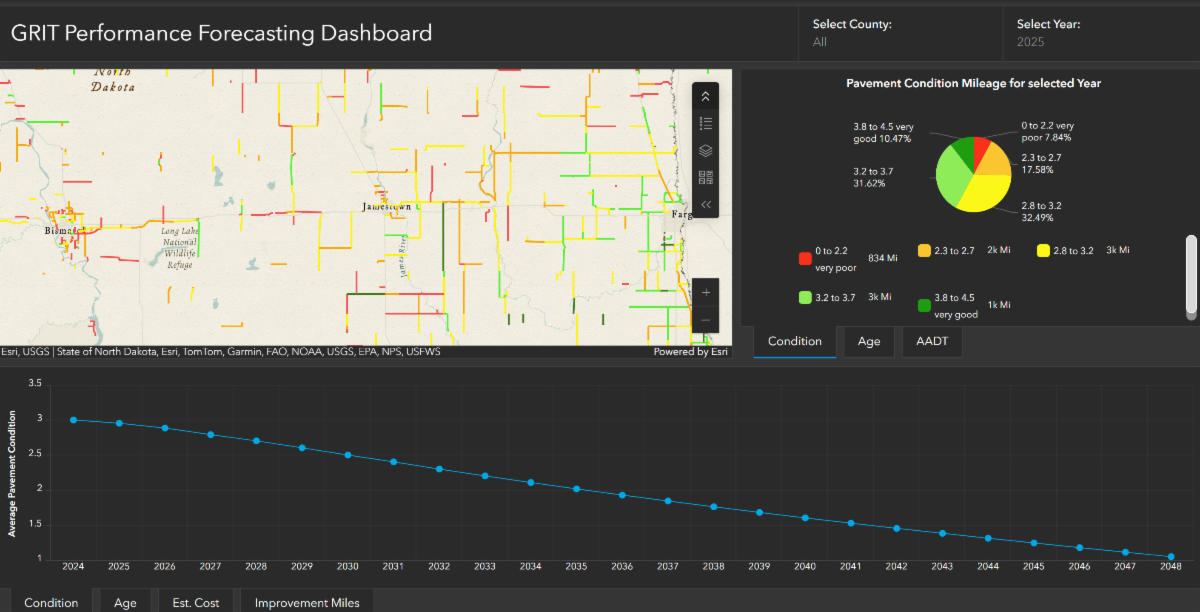
The Geographic Roadway Information Tool (GRIT) is an easy-to-use online system designed for roadway managers. “It helps them spend the right amount at the right time on work that makes the most sense,” said Brad Wentz, the UGPTI researcher who led GRIT’s development.
Counties using GRIT can track detailed conditions of roadways, pavement, bridges, signs, and minor structures like culverts, box culverts, and bridges under 20 feet in length. County staffers input data from their construction and maintenance records and UGPTI augments that information with its own roughness and road condition surveys. A map-based interface makes it intuitive and easy to use.
“GRIT puts all that information at their fingertips and keeps it secure in an off-site server,” noted Kelly Bengtson, a UGPTI bridge and pavement engineer. “Without it, that information, if it exists, is probably stuffed in a file cabinet or a box in the closet where you can’t find what you need when you need it.”
It's ease of use makes GRIT an excellent tool for illustrating improvements and investment needs with county commissioners and the public. “With photos and data, it makes it very easy for them to sit down and look at something in detail,” said Todd Miller, Stark County Superintendent.
Read more.
| | Keeping Highways Safer for Trucks and Other Motorists During Winter Storms | | |
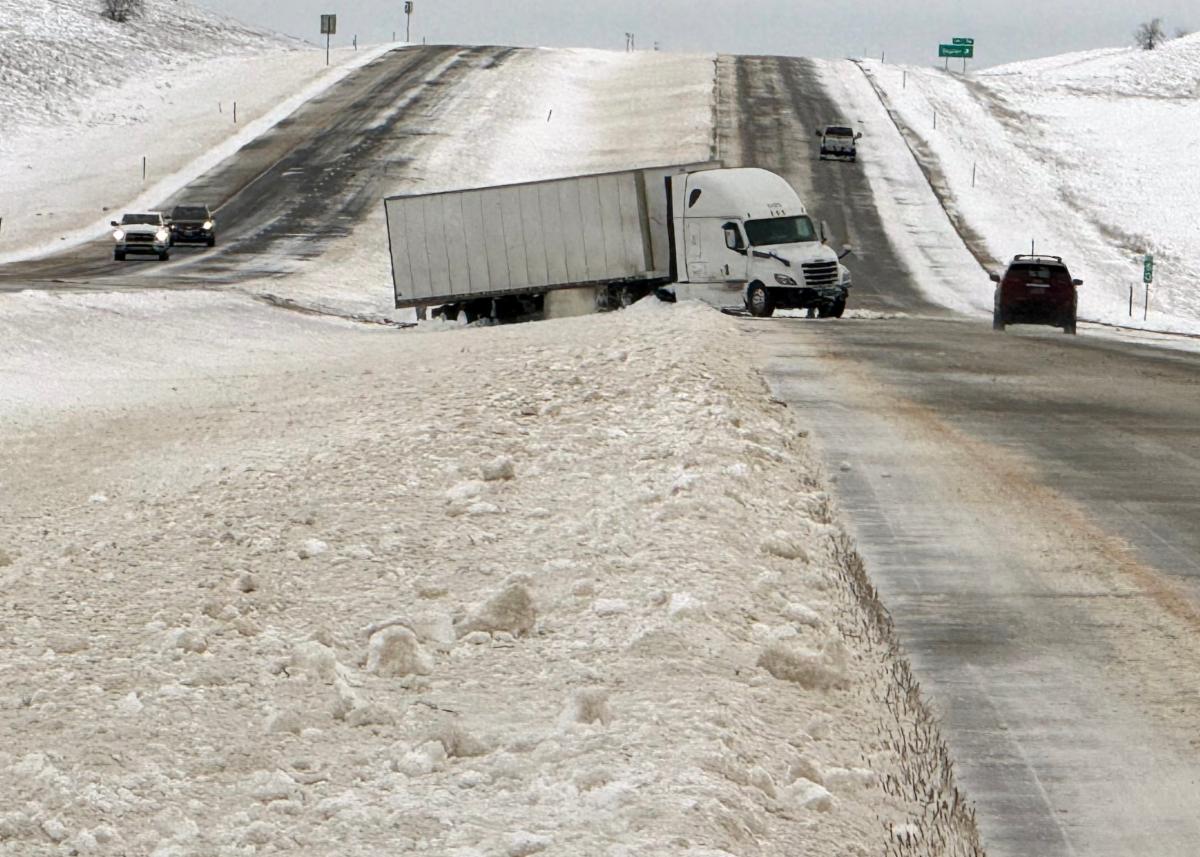
A closer look at truck crashes during severe winter weather in North Dakota is yielding clues on how to reduce risks and travel disruptions on the state’s interstate highways.
“We looked at preparations and policies governing truck safety during winter weather, including government regulations, industry standards and best practices to prevent weather-related truck crashes,” said UGPTI researcher Kimberly Vachal. “Our goal was to provide evidence-based recommendations for enhancing strategies to prevent truck crashes during winter storm events.”
Vachal, director of UGPTI’s Rural Transportation Safety and Security Center, noted that truck crashes can become particularly disruptive with jackknifed or overturned trailers blocking travel lanes and disrupting winter weather maintenance and travel recovery activities. Researchers analyzed 594 truck-involved crashes among 2,104 crashes during the winter months from 2019 to 2024. They conducted case studies of crashes to learn the sequence and nature of truck-involved crashes during a severe winter storm that involved an interstate highway closure. They also gathered information from surrounding states on winter road management processes, enforcement practices, road closure decisions, education programs, and communication practices.
As a result of the study, the North Dakota Highway Patrol is examining several strategies to reduce winter crash risks and improve after-storm recovery.
Read more.
(Photo Courtesy of NDDOT)
| |
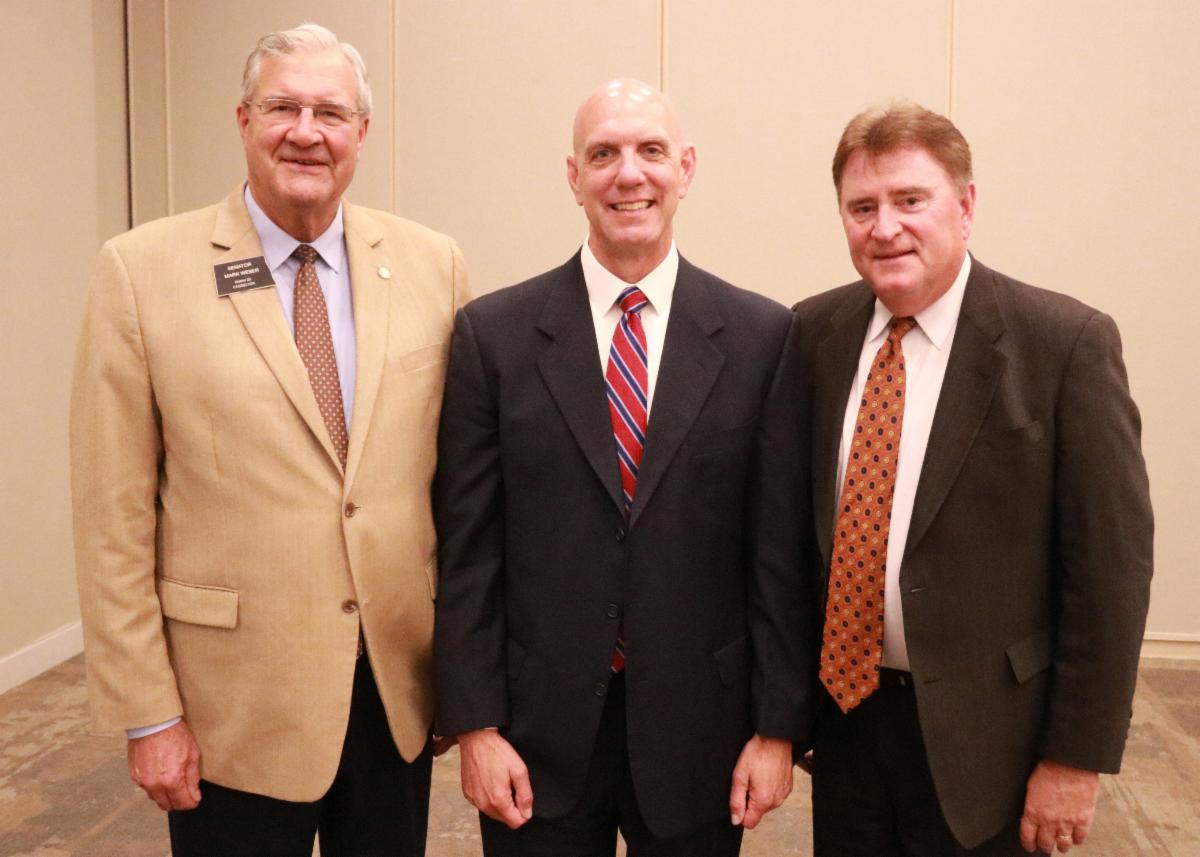
UGPTI honored three transportation leaders at its Annual Awards Banquet held October 2 in Fargo.
-
Shawn Dobberstein, Fargo Hector International Airport Executive Director, received the John M. Agrey Award in recognition of his long-term service and leadership at the airport.
-
Mark Weber, ND State Senator, received the Chairman's Award in in recognition of his work to address rural transportation infrastructure issues on behalf of counties and townships as a state senator and agricultural leader.
-
Jason Benson, Metro Flood Diversion Authority Executive Director, received the Lifetime Achievement Award for his long-term service to transportation as Cass County engineer and a leader in the N.D. Association of County Engineers.
More than 150 people attended the 29th Annual Awards Banquet, which is held to celebrate individuals who have made significant and lasting contributions to transportation in the state. A number of scholarships are also awarded at the banquet.
Learn more about the awards, this year's winners and previous winners.
Photo, from left: Mark Weber, Jason Benson, Shawn Dobberstein
| | The Upper Great Plains Transportation Institute (UGPTI) is a research, education, and outreach center at North Dakota State University which provides innovative transportation research, education, and outreach that promote the safe and efficient movement of people and goods. UGPTI is guided, in part, by an Advisory Council composed of representatives of various organizations, industries and agencies affecting or affected by transportation. | | North Dakota State University does not discriminate in its programs and activities on the basis of age, color, gender expression/identity, genetic information, marital status, national origin, participation in lawful off-campus activity, physical or mental disability, pregnancy, public assistance status, race, religion, sex, sexual orientation, spousal relationship to current employee, or veteran status, as applicable. Direct inquiries to Vice Provost, Title IX/ADA Coordinator, Old Main 100, 701-231-7708, ndsu.eoaa@ndsu.edu. | | | | |