The content in this preview is based on the last saved version of your email - any changes made to your email that have not been saved will not be shown in this preview.
 

The California Asphalt Pavement Association

Vol. 19, Issue 1 || Jan. 5, 2026

Greetings!

This weekly report contains news and information of interest to the asphalt pavement industry, customers and agency partners in California. Please feel free to distribute this newsletter to others who may be interested in asphalt pavements. To subscribe to the newsletter click HERE. To provide feedback or story ideas click HERE. Having difficulty viewing this newsletter? View as Webpage

A look ahead: Our predictions for the Top 10 news stories that will impact the asphalt pavement industry in California in 2026

Editor's Note: Last week we offered our completely subjective Top 10 news stories of 2025 that impacted the asphalt industry in California. You can read the story HERE. This week we’re back with our fearless prognostications for 2026. If you would like to see how we did with our predictions a year ago, you can read that story HERE. For more detailed information and economic analysis, CalAPA members should refer to the “2026 Asphalt Market Forecast for California” report that was sent to members on Dec. 8. Another source of insight, the annual forecast issue of CalAPA’s official magazine, “California Asphalt,” will is due to hit mailboxes later this month.


---[

1. Getting EVs to pay more for roads is the first step toward a long-term funding solution

The state tax on motor fuels, which has been the backbone of road funding for a century, will continue to decline as more EVs take to California roads in the coming year. EV owners, who currently pay a nominal fee at registration for road maintenance, will be asked to pay more in the form of higher fees to bring them more in line with what vehicles powered by fossil fuels pay. The legislation to bring about this change will be a significant step in transitioning California to a new funding model to pay for road repairs.


2. Washington turmoil continues through 2026; voters will punish the party in power and the federal highway bill will be a casualty

Voters weary of continuing chaos in Washington will punish the party in power in mid-term elections, officially cementing Donald Trump’s status as a lame-duck president heading into the last two years of his tenure in the White House.  Meanwhile, his administration will continue to target the bloat in the federal government and needless regulations utilizing executive authority not constrained by courts. Buoyed by a partisan remap of Congressional Districts, California’s largest-in-the nation congressional delegation of 52 members will grow by a handful of seats, and position Democrats to wrest the chairmanship of all House Committees in 2027, including Transportation and the Subcommittee that oversees highways. The power play will divert needed attention away from the complex and difficult policy work of renewing a federal surface transportation bill, which will not be passed by the end of the federal fiscal year on Sept. 30 and limp along on a series of short-term extensions well into 2027.


3. The economy will continue to defy gloomy predictions and power through 2026

Ominous predictions in 2024 of massive state budget deficits, repeated in 2025, largely never materialized and the state avoided the most draconian budget scenarios. 2026 will continue on much the same trajectory, and Gov. Gavin Newsom will unveil a state budget that once again largely avoids severe austerity measures. Transportation funding will remain relatively flat, resulting in fewer projects, owing to higher costs for materials and funds diverted to non-traditional, alternative transportation projects, a continuing source of consternation in the asphalt pavement industry and other pro-road advocates.


4. Polymer-modified asphalt pavements gain traction in CA

Coming on the heels of impressive performance in punishing conditions on Utah interstates and elsewhere, a special “hi-mod” asphalt pavement design gains renewed attention in California as a way to design longer-life asphalt pavements that can stand up to heavy truck traffic and extreme temperatures while preserving asphalt’s other attributes of fast and cost-effective construction, 100% recyclability and a smooth and quiet ride. Case studies of field evaluations of the use of polymer-modified asphalt binder, building on the foundation of successful long-life asphalt pavement projects in California, will provide designers with an attractive and cost-effective alternative to traditional pavement designs.


5. Caltrans management shuffling continues

A wave of departures within the ranks of Caltrans’ top management, which accelerated in 2025, will continue into 2026 as the Newsom Administration winds down. Caltrans managers in acting capacities will continue to be commonplace. In Q1, a key position in the asphalt pavement area, the Chief of the Materials Engineering & Testing Services (METS) will be filled. State political appointees will spend the year updating resumes and refining exit strategies in preparation for a new administration in 2027.


6. Gov. Newsom will continue to focus on national issues to boost his presidential aspirations

Gov. Gavin Newsom, heading into the final year of his two-term stint as the state’s chief executive, will ramp-up his focus on national issues to raise his profile in preparation for an expected run for president in 2028. The self-styled leader of the resistance to the Trump administration will continue to tout his work to create more affordable housing in the state and other pocketbook issues, but California’s Byzantine system of planning and powerful NIMBY interest groups will slow progress to a crawl.


7. Stability takes hold at national organizations that intersect with the local asphalt industry

After a number of high-profile leadership changes among national organizations in the past year, a period of stability will become the norm in 2026 as new leaders at the Asphalt Institute, the CalAPA-supported Asphalt Pavement Alliance and the National Stone, Sand & Gravel Association (NSSGA) begin to put their imprint on their organizations, ushering in a new era of cooperation at the national level by construction materials associations on areas of mutual interest.


8. Fuel prices, and prices for asphalt, will remain relatively stable despite foreign turmoil, local disruption

Once again defying logic and economic convention, fuel prices and asphalt prices will remain fairly stable in 2026, much like they were in 2024 and 2025, despite continuing conflict in the Middle East, Ukraine, Venezuela and elsewhere. This is largely due to the United States continuing to produce a record amount of oil, more than it consumes, creating an element of stability at home and abroad.


9. CA refinery situation casts a cloud over markets

The relentless attacks by politicians and regulators on the oil industry in California, especially refineries, will remain in the news in 2026 even as high-profile announcements of companies outlining their intentions to exit the market persist, triggering renewed worries of price spikes and other market disruptions. Despite its highest-in-the-nation number of EVs on the road, California will continue to reign supreme as the nation's largest market for fuel and liquid asphalt binder.


10. High-speed rail project enters zombie era

After experiencing head-snapping cost overruns and design and construction delays, California’s troubled high-speed rail project suffered a loss of billions of dollars worth of federal funding in 2025. In 2026 it will enter a “zombie phase” as rail backers try, and fail, to seek private funding to keep the project on track even as timelines continue to be pushed off further and a privately funded project to connect Southern California to Las Vegas plows ahead.


Honorable mention: California’s lack of a coherent energy strategy, and soaring energy prices, will continue to dominate the news in 2026. Continuing consolidation in the asphalt industry also will make headlines in 2026, continuing a long-term trend.


Jeremy Peterson-Self named acting chief of Caltrans Construction Division through Feb.

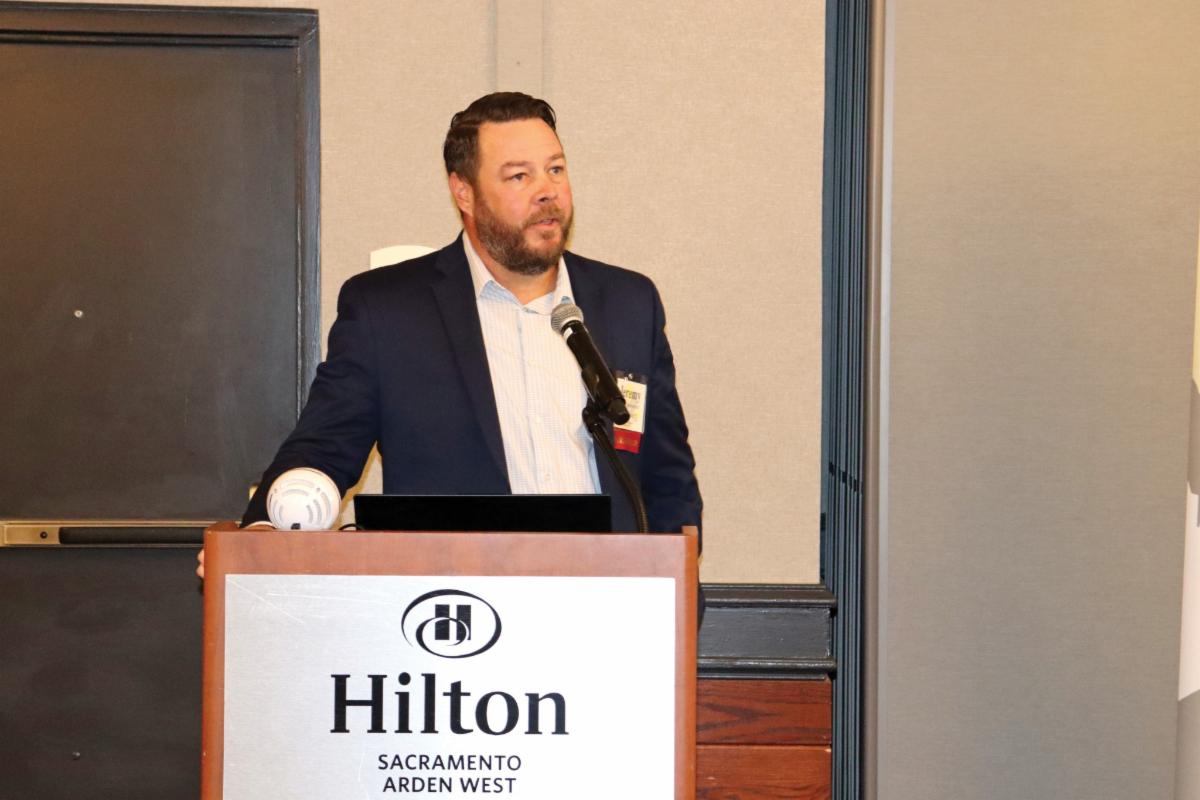
Jeremy Peterson-Self has been named acting chief of the Caltrans Division of Construction through February as current Chief Ray Hopkins will be on extended vacation, the department announced. Peterson-Self (pictured at a CalAPA event) is a familiar name to the asphalt pavement industry, having previously worked in the Materials Engineering & Testing Services (METS) branch and played a prominent role in overseeing the Caltrans-industry Joint Training & Certification Program.


"I am pleased to announce the temporary assignment of Jeremy Peterson-Self as Division Chief for the Headquarters Division of Construction," Caltrans Chief Engineer Donna Berry announced in a Dec. 29 internal e-mail.


She noted that Peterson-Self joined Caltrans in 2008 following several years working with a commercial and residential engineering design firm in Sacramento.


"His extensive experience in construction administration and materials includes serving as a 'METS Representative' for multiple districts, overseeing foundation testing on the Gerald Desmond Bridge Replacement project, and being an active member of the Pavement and Materials Partnering Committee (PMPC). He also played a pivotal role in the initial implementation of the Caltrans/Industry Joint Training and Certification Program and subsequently led teams responsible for delivering the Department's Independent Assurance Program."


Most recently, Peterson-Self has been Deputy Division Chief for the Division of Construction since 2023, where, Berry noted, "he collaborates with districts and industry professionals to support and oversee statewide construction activities." A previous Asphalt Insider story about Peterson-Self's move to the Division of Construction is HERE.


Caltrans currently oversees a $15.3 billion construction program with 866 active construction projects. The Caltrans Division of Construction website is HERE.


Work Zone Safety measures among new laws that take effect in 2026

Two bills intended to enhance work zone safety, supported by CalAPA, became law on Jan. 1.


Assembly Bill 390, authored by Assemblywoman Lori Wilson, D-Suisun City, chair of the Assembly Transportation Committee, expands the existing "slow down and move over" law to include any highway maintenance vehicle or stationary vehicle with flashing hazard lights or warning devices, such as cones and road flares. Drivers approaching the vehicles must move into a lane that is not next to the stopped vehicle o, if that is not possible, slow down to a safe speed. Details on the bill can be found HERE.


In its letter of support for the bill in the Legislature, CalAPA wrote: "Your common-sense bill aligns California with 24 other states and the District of Columbia that require highway drivers approaching stationary vehicles to move into an adjacent lane, or if impracticable, to slow to a prudent speed." The bill was signed into law July 28 by the governor. Wilson thanked CalAPA for supporting her legislation.


Also becoming law on Jan. 1 was Assembly Bill 289, authored by Assemblyman Matt Haney, D-San Francisco, which authorizes Caltrans to launch an automated work zone speed safety system pilot program. The program will use a fixed or mobile radar or laser system to detect speeding violations and capture a photo of the offending vehicle's license plate. Citations will be issued to the vehicle's registered owner. The pilot program, which has been shown to reduce speeds and crashes in work zones in other states, will include procedures on how citations will be issued, as well as a review and appeal process.


In its support letter, CalAPA wrote, "AB289 is an important step forward to save lives and ensure that our vast transportation network continues to safety and efficiently move people, goods and services across our great state. It will lead to the implementation of technology to protect workers, and motorists, via a wider implementation of an Automated Speed Enforcement (ACE) system in active work zones. This system has proven its effectiveness in enhancing safety."


The bill was signed into law Oct. 13 by the governor. Details on the bill can be found HERE.


Information on other public safety bills that became law on Jan. 1, compiled by the California Highway Patrol, can be found HERE.

Tech term of the week

Each week we highlight a word, acronym or other term commonly used in the asphalt pavement industry in California.


COARSE GRADED AGGREGATE: An aggregate having a continuous grading in size of particles from coarse through fine with a predominance of coarse sizes.


Paving Pointer of the Week

Each week we highlight a key point or best practice of interest to asphalt paving crews, inspectors and others working in the field. We welcome suggestions. More tips can be found in our "Asphalt Parking Lot Construction Checklist" HERE. Information on the CalAPA "Quality Paving Certificate" program is HERE.


TONNAGE CALCULATION: Ask yourself: Are there enough trucks on the run to haul the mix needed to complete the job? If you have five trucks on the round each carrying 25 tons = 125 tons per round. If each round takes one hour to make, then the production rate is 125 tons per hour. If the job requires 1,000 tons at 125 tons per hour = eight hours to get the mix to the job.

Climate Term of the Week

Each week we highlight a term that is specific to climate-change issues related to the asphalt pavement industry. This feature is intended to raise awareness of the asphalt industry's climate-change initiatives and the specialized terminology that goes with them. More information on "The Road Forward" asphalt industry climate initiative can be found HERE. A recent CalAPA magazine story on the topic is HERE.


RECLAIMED ASPHALT PAVEMENT: Reprocessed pavement containing asphalt and aggregate.

Caltrans Statewide Crude Oil Price Index

Editor's Note: As a convenience to our readers, Asphalt Insider reports the most current Caltrans "Statewide Crude Oil Price Index" posting. The department posts this monthly on its public website HERE. The index is used to calculate payment adjustments for paving asphalt under special provisions section "Payment Adjustments for Price Index Fluctuations" in those projects containing the section. The department posts the index on or about the first business day of the month using the daily Brent crude oil prices from the previous month as reported by Business Insider. Inquiries about the index should be directed to Caltrans at: Oil.Index@dot.ca.gov .


January 2026: $331.5 ($/ton)

Quote of the Week

"Write in your heart that every day is the best day of the year."


– Ralph Waldo Emerson

CALAPA CALENDAR:


View all CalAPA events HERE.


*

REGISTRATION OPEN:

Asphalt Pavement Workshop (combining two popular classes, 'Asphalt Pavement 101' and 'Asphalt Forensics')

Wednesday, Jan. 14, 8 a.m. to 5 p.m.

County of San Diego Operations Center, 5560 Overland Ave., Room 171, San Diego

Registration is HERE.


*

RESERVE YOUR SPOT NOW:

Annual Dinner, Awards & Installation of Officers

Thursday, Jan. 15, 2026

The Jonathan Club, 545 S. Figueroa St., Los Angeles

Details HERE.


*

REGISTRATION OPEN:

'Asphalt Pavement 101' class, Wednesday, Feb. 11, 2026

CalAPA Offices, 1550 Harbor Blvd., Suite 120, West Sacramento, CA

Registration is HERE.


business_handshake_men.jpg

There's never been a better time to join the California Asphalt Pavement Association! Members receive insight and advanced notice on critical issues that impact every company's bottom line. CalAPA members also receive invitations to exclusive member-only events, in-depth "Member Alerts," our comprehensive asphalt market forecast for California, discounts and industry-specific networking opportunities not available anywhere else. CalAPA's new searchable on-line membership directory helps connect potential customers with member companies. A brief video about CalAPA is HERE. Click HERE to download our Member Service brochure. Click HERE to view Vol. 1 of recent testimonials. Not convinced? Click HERE to view Vol. 2 of recent testimonials. With so much changing in the asphalt pavement industry, what you don't know can cost you! Click HERE to send us an e-mail inquiry, or contact Russell Snyder with CalAPA at (916) 791-5044.

Facebook  Instagram  LinkedIn  Pinterest  X

We hope you enjoy CalAPA's Asphalt Insider newsletter. We are committed to providing you with the most up-to-date information on technical issues, regulation, news, analysis, people, events and trends in California that is of interest to the asphalt pavement industry and our various agency partners. Please note: This publication is 100% human-produced with 100% original content, and is only possible due to the generous support of CalAPA members. To subscribe to the newsletter, click HERE. For comments, questions or to suggest a story idea, click HERE. We are committed to promptly notifying our readers of any errors in this publication. Please click on the comment link above to alert the editor of any errors or omissions.


Sincerely,


Russell W. Snyder, CAE

Executive Director

The California Asphalt Pavement Association (CalAPA)®


The "Asphalt Insider" is an official publication of the California Asphalt Pavement Association. For more information or to inquire about membership, call (916) 791-5044, or click HERE to contact us. Copyright © 2025 California Asphalt Pavement Association -- All Rights Reserved. The CalAPA name (No. 5,621,794) and logo (No. 5,621,795) are registered trademarks with the U.S. Patent & Trademark Office.

The California Asphalt Pavement Association ®

P.O. Box 981300, West Sacramento, CA 95798

1550 Harbor Blvd., Suite 120, West Sacramento, CA 95691

PHONE: (916) 791-5044 WEB: www.calapa.net

Est. 1953 <> Code of Ethics

 
Facebook  Twitter  Pinterest  Linkedin  Instagram