|
Meditation June 4, 2026
Excerpt from Helena Guzik’s “What is A Pilgrimage?”
A pilgrimage is a devotional practice consisting of a prolonged journey, often undertaken on foot or on horseback, toward a specific destination of significance. It is an inherently transient experience, removing the participant from his or her home environment and identity. The means or motivations in undertaking a pilgrimage might vary, but the act, however performed, blends the physical and the spiritual into a unified experience. The origins of pilgrimage are difficult to determine, but deliberately visiting powerful sites is a practice that predates antiquity. Pilgrimages have long been a common feature of many world religions, including Christianity, Judaism, Islam, Buddhism, Hinduism, and Shinto. A believer might undertake a pilgrimage in fulfilment of a vow, as atonement for sins, as a gesture of thanks for positive events, or as a means of intercession, among other reasons. Prior to the age of exploration in Europe, pilgrimage was a primary impetus for travel, especially among non-elites, and played a significant role in local economies and the transmission of culture. In the Christian pilgrimage tradition, the practice revolves around visiting either sites significant in the Bible – particularly those concerning the life of Christ – or in the lives of saints, or paying reverence to holy relics.
Meditation-Rebecca Northington
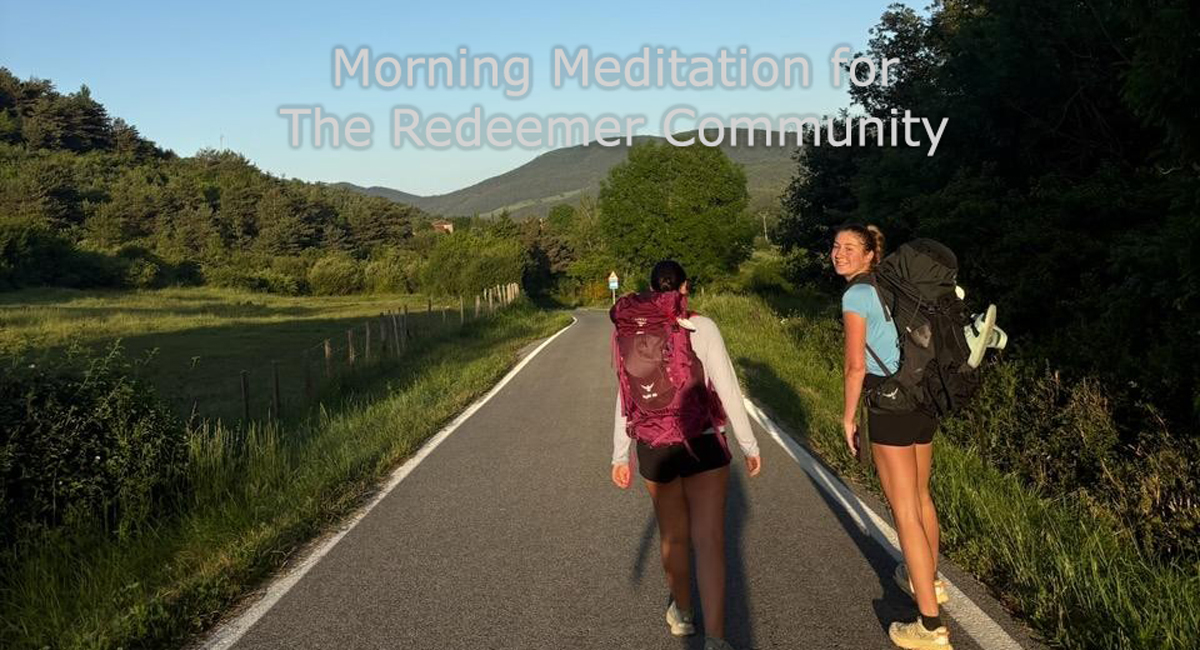
I have been ruminating on pilgrimages quite a bit for the past month; mostly because our oldest daughter has embarked on The Camino de Santiago - The Way of Saint James. This pilgrimage collects people from all over the world, as she has found, and includes a variety of routes that ultimately lead to the Cathedral of Santiago de Compostela in Northwestern Spain. Here the remains of the Apostle Saint James are traditionally believed to be buried.
“Buen Camino” is heard in the background each time we speak with our daughter on the trail, and she has met and broken bread with a variety of pilgrims: young, old, new to the Camino, returning visitors, grieving pilgrims, celebrating couples, discerning people of all shapes, colors, and stripes. Today she heads to Cruz de Ferro where tradition has each pilgrim leave a rock that they may have brought from home or picked up along their travels. This rock can represent the burdens that have weighed them down, or perhaps can honor a loved one lost or left behind. For many on the Camino, this milestone represents a critical part of their spiritual journey, and the physical mound of rocks beside this ancient iron cross reminds each traveler of their connection to one another: past, present and future.
Joy is the word that captures the energy I feel from our daughter. Light, effortless, hopeful joy. She carries on her back one set of hiking clothes, and wears the other. She has one sweatshirt and one towel, and one pair of flip flops, for a month. I asked her today if she has picked up anything along the way. She has not. She grew up on the main line, a land of abundance. I sense a metamorphosis that comes with a “transient experience”.
This meditation will be one of three on this subject and I hope you will bear with me as I continue to consider pilgrimages in all their many renderings. My colleague Glenn Beamer recently sent me a Ted talk by George Greenia who runs the Institute for Pilgrimage Studies at William and Mary. In it, Greenia reminds us that we all endeavor to be pilgrims. Sometimes in large ways (the Camino), and often in small ways such as a trip to a museum, or a summer family reunion. These activities are opportunities to be changed. In the coming weeks I hope to explore with you the ways in which we pursue change in our own lives, and how it impacts us and those around us.
I suspect our daughter, a rising university junior, is seeking understanding and purpose. Why are we here and what am I for? The Ancient Desert Fathers left their communities to ask these questions without the distractions of the world. The folks who braved the Atlantic in 1620, leaving England for an unknown land also strove for a deeper freedom to pursue these same questions, at the expense of a people who also engaged in pilgrimages for thousands of years, celebrating creation and divine wisdom.
My own adventure on the Appalachian Trail, with its remote and isolating setting, provides fertile ground for awakening and renewal. It is physically humbling, and eliminates the distractions of a world that pretends technology and convenience are more important than God. As you ascend the highest peaks on the AT you can understand why Peter thought it was a good idea to settle with Jesus on the mountain top. God is everywhere. It is hard to see this so clearly in our day to day. Interrupting our lives with an experience that asks us to reset our perspective is transformative. It can be uncomfortable. It can be humbling. It can help clear away the fog that has prevented us from seeing the Light.
Buen Camino!
|