|
Morning Meditation
November 14, 2025
Selection from Raymond Barnett on John Muir
In one of his most oft-quoted journal entries, in 1890 Muir generalizes the healing power of the wilderness, and calls it the great hope of the (human) world: “In God‘s wildness lies the hope of the world—the great fresh unblighted, unredeemed wilderness. The galling harness of civilization drops off, and the wounds heal ere we are aware.”
God‘s wilderness is “unredeemed” precisely because it has never fallen and required the redemption needed by humans.
John Muir was by no means the first or most prominent espouser of mountains as restorers of health and vitality. In the summer of 1985 my mountaineer friend Kyle and I were trudging up steep stone steps cut a thousand years ago into the granite of Huang Shan (Yellow Mountain)....Our company on Huang Shan resulted from mountains having been considered sources of health and vitality for several millennia in China, cosmic pillars where the qi of earth connects with the qi of heaven, and thus nodes of power. Being on a mountain permits you to connect with this qi energy, restoring vitality and health. While this is a somewhat different explanation than Muir offered, the essentials are the same: you connect with something powerful on the mountain, and you are healed and revitalized.
Meditation-Rebecca Northington
I have written about John Muir in past meditations, as he is celebrated in the Episcopal lectionary as a man whose spirituality and stewardship of nature honor our creator God. I thought about him a lot last week as I walked another 50 miles on my Appalachian Trail section-hiking adventure. Muir was famously drawn to the mountains and found extraordinary solace and spiritual renewal among them. He wrote beautifully of nature's ability to restore itself and to restore us. Raymond Barnett is a biologist from California State University who wrote about Muir’s love of nature, and his unprecedented call to action: not only for us to immerse ourselves in nature, but also for our very human responsibility to protect it.
Muir and Barnett reflect the experience so many of us have when we surrender to the great outdoors. It can happen in degrees, from a quiet walk through the Church yard, to a full escape into the wilderness that Muir talks about. The level of liberation that attends us depends on the degree to which we step away from civilization; the very human constructs, innovations, conveniences, and straight up noise of mankind. The further we remove ourselves from these, the more we experience the prefall view of creation, with all of its majesty.
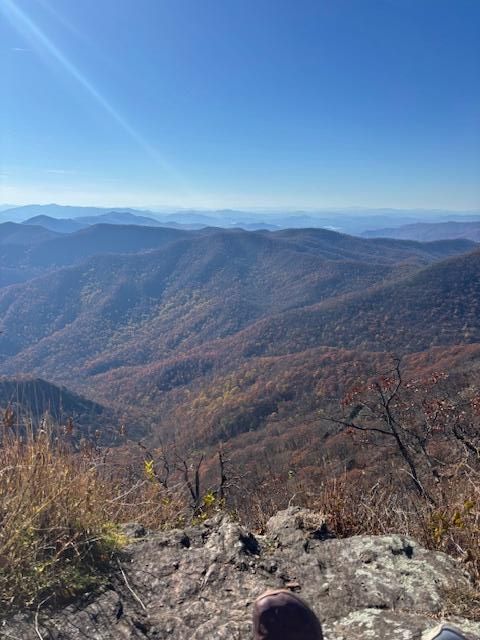
When I am out on the trail and in the wilderness, the trappings of the material world fade away. Food, water, and shelter are the main concerns. And it is with this lens that I see the natural world, and it is breathtaking. Many people refer to the Appalachian Trail as the long green tunnel, because the foliage is so healthy and dense you really can’t see beyond the single track trail you walk, a trail you must walk with vigilance to protect your ankles and to avoid a stumble. But in November, even in Georgia and North Carolina, the leaves have mostly fallen and the great expanse of those mountains is more visible than ever. And it is spectacular.
Barnett’s experience in the Chinese mountains is curious to me. How did those traditions of energy develop, or the belief that one’s health and vitality could be restored by the pillars of the earth? Mountains in general have played a key role in our Biblical stories as well. Moses went up the mountain to talk to God. Jesus taught from the mountain. In modern day life mountains fascinate us. Mt.Everest, Kilimanjaro, and Machu Picchu have beckoned climbers for centuries, and increasingly over the last 100 years humans have developed greater access to higher peaks for all, with cable cars and gondolas, sherpas and ski lifts. Why, I wonder? Is it to feel closer to God?
For me it is impossible to divorce the profound effect that accompanies a final ascent to any peak- from God. When I look out on the countless mountains, and the lakes and gorges that nestle between them, it is in wonder and gratitude. The physical efforts of these treks effectively walk out the complications that interrupt our day to day living, like a walking meditation, cleansing our hearts and minds. Additionally, science tells us that doing hard physical work heightens our endorphins and decreases our stress. Perhaps all of these factors contribute to a kind of elation found at the end of a climb. But I do not believe I am trying to reach God, like the people building the Tower of Babel. I believe I am trying to escape the burdens of our post fallen world. The higher I climb, the further behind it feels I have left so much that entraps us, and I find myself prioritizing and viewing the world with a new lens.
In RYG Bible Breakfast this fall we have been talking a lot about Faith First versus Works Righteousness. As Episcopalians I hope we all know which theological stance is ours, but it occurred to me on this “walk in the woods”, that what we really need to do as people, is to get our own hearts right with God, before we can be sure that the work that we do to serve him is coming from the right place. Taking a moment, or several moments, away from all the distractions of this material, consumer driven world, is a great way to figure out where your heart is-with yourself-with your loved ones-with the kind of community you cultivate-and most importantly, with God. The mountain tops force this kind of clarity. I don't know if they “heal” us, as the Chinese tradition suggests. But I do think it is our duty to search for God's presence in our lives, and sometimes the top of the mountain gives us the greatest view.
"I only went out for a walk and finally concluded to stay out until sundown, for going out I found, was really going in." John Muir
|