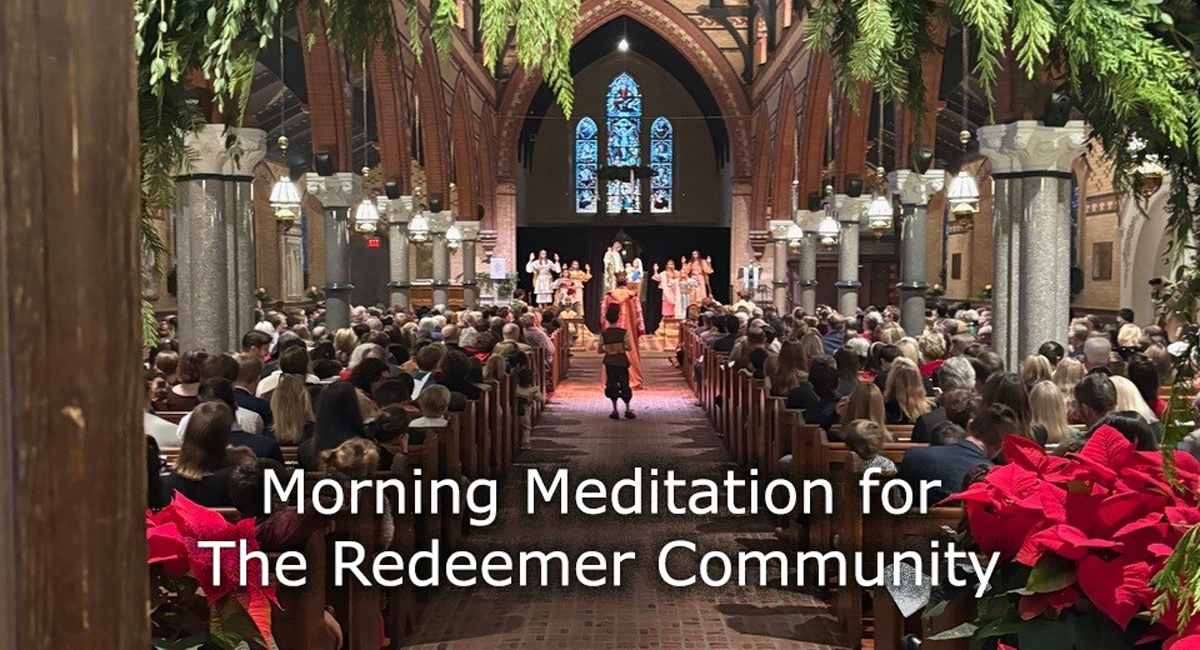
Morning Meditation for the Season of Christmastide
January 6, 2026
The Feast of the Epiphany
Reading: Matthew 2:1-12
In the time of King Herod, after Jesus was born in Bethlehem of Judea, wise men from the East came to Jerusalem, asking, ‘Where is the child who has been born king of the Jews? For we observed his star at its rising, and have come to pay him homage.’ When King Herod heard this, he was frightened, and all Jerusalem with him; and calling together all the chief priests and scribes of the people, he inquired of them where the Messiah was to be born. They told him, ‘In Bethlehem of Judea; for so it has been written by the prophet:
“And you, Bethlehem, in the land of Judah,
are by no means least among the rulers of Judah;
for from you shall come a ruler
who is to shepherd my people Israel.” ’
Then Herod secretly called for the wise men and learned from them the exact time when the star had appeared. Then he sent them to Bethlehem, saying, ‘Go and search diligently for the child; and when you have found him, bring me word so that I may also go and pay him homage.’ When they had heard the king, they set out; and there, ahead of them, went the star that they had seen at its rising, until it stopped over the place where the child was. When they saw that the star had stopped, they were overwhelmed with joy. On entering the house, they saw the child with Mary his mother; and they knelt down and paid him homage. Then, opening their treasure-chests, they offered him gifts of gold, frankincense, and myrrh. And having been warned in a dream not to return to Herod, they left for their own country by another road.
Meditation by Jeremy O’Neill
There are many names for the individuals who traverse afar to worship the newborn baby Jesus: Wise Men, Magi, Kings. On this day, the Feast of the Epiphany, we remember their arrival into Bethlehem and worship of Jesus in the manger. Though the general arc of the story is probably familiar to us, it is worth noting how much comes from the Gospel text itself and how much comes to us from interpretation and other practices.
Matthew’s Gospel is the only one of the four accounts that mentions this event at all, and it seems a bit out of place here at first glance. Matthew’s Gospel was written for a primarily Jewish audience and emphasizes Jesus’s status as one who is the Messiah and was born into a line of notable and unlikely people. The social conditions and specific details surrounding Jesus’s birth are given more attention in Luke’s Gospel, so this addition may have felt more at home as a part of a different narrative.
Then there is all that we don’t know about this event if we just read the text. First of all, we don’t actually know how long their journey took. Second, we don’t know that there were three of them. The text only notes three categories of gifts, which represent the wide reaching nature of Jesus’s ministry: he is both King of Kings (so receives Gold) and his story includes being “sealed in a stone cold tomb,” as the hymn says, and receives myrrh, traditionally used at burials. Presumably, however, multiple people could have brought gifts in these categories, so the numbering of three persons is merely a symbolic convenience.
Finally, we don’t really know who these figures were. The desire to call them kings comes from Isaiah and the Psalms and emphasises that Christ will be one who comes to save all people and be worshiped by kings. Old testament prophecies state that the Messiah would be worshipped by kings, but Jesus is also surrounded by shepherds who occupy the opposite end of the spectrum in terms of wealth and power.
The term “Magi” comes from the same root as our word “magic,” which may be included to suggest that the individuals were priests in an ancient Persian religious tradition. Some Biblical scholars favor the term “astronomers,” as they were people who studied the stars and likely gave the stars religious and spiritual significance. But even if we call them kings, the fact is they were outsiders, and their arrival begins a pattern of Jesus showing up in unlikely places with unlikely people. His life often involves an inclusion and solidarity with those on the margins, from the Canaanite woman to the criminals on each side of him at his crucifixion. Therefore, Epiphany reminds us that God is with us in all of our circumstances
Prayer
O God, by the leading of a star you manifested your only Son
to the Peoples of the earth: Lead us, who know you now by
faith, to your presence, where we may see your glory face to
face; through Jesus Christ our Lord, who lives and reigns
with you and the Holy Spirit, one God, now and for ever.
Amen.
|