|
October 1, 2026 Morning Meditation Excerpt from
Therese of Lisieux’s L'histoire d'une âme, The Story of a Soul
I often asked myself why God had preferences, why all souls did not receive an equal measure of grace. I was filled with wonder when I saw extraordinary favours showered on great sinners like St. Paul, St. Augustine, St. Mary Magdalen, and many others, whom He forced, so to speak, to receive His grace….And again it puzzled me why so many poor savages should die without having even heard the name of God.
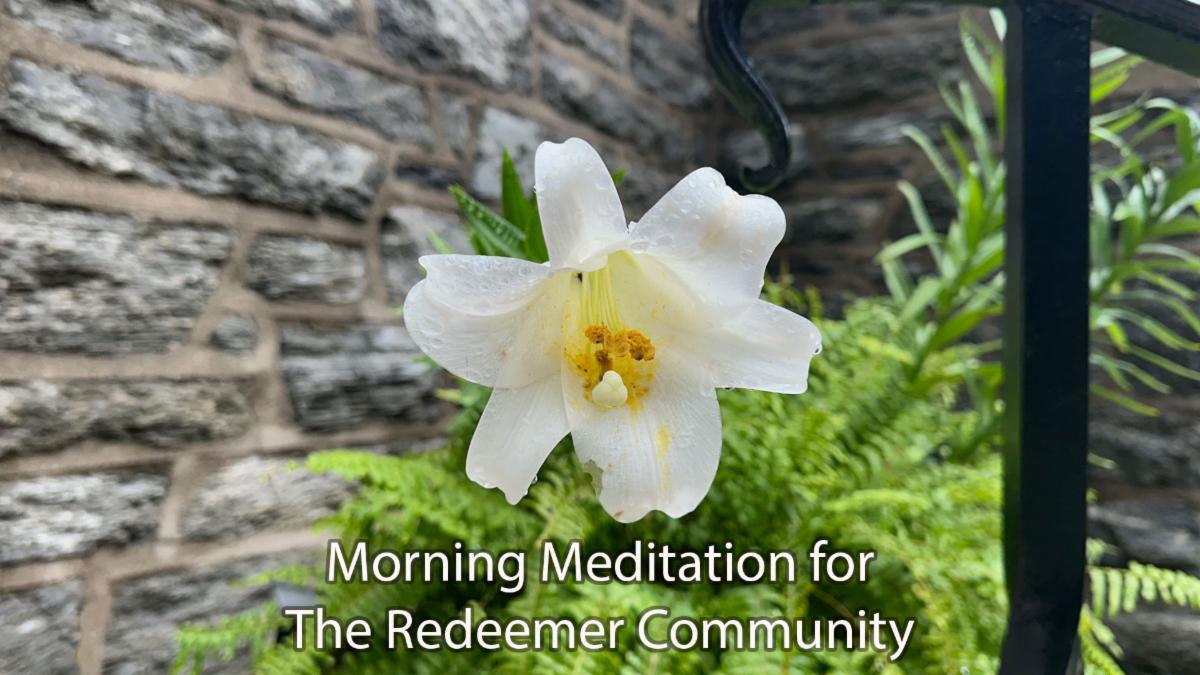
Our Lord has deigned to explain this mystery to me. He showed me the book of nature, and I understood that every flower created by Him is beautiful, that the brilliance of the rose and the whiteness of the lily do not lessen the perfume of the violet or the sweet simplicity of the daisy. I understood that if all the lowly flowers wished to be roses, nature would lose its springtide beauty, and the fields would no longer be enamelled with lovely hues.
And so it is in the world of souls, Our Lord's living garden. He has been pleased to create great Saints who may be compared to the lily and the rose, but He has also created lesser ones, who must be content to be daisies or simple violets flowering at His Feet, and whose mission it is to gladden His Divine Eyes when He deigns to look down on them... In fact, the characteristic of love being self-abasement, if all souls resembled the holy Doctors who have illuminated the Church, it seems that God in coming to them would not stoop low enough. But He has created the little child, who knows nothing and can but utter feeble cries, and the poor savage who has only the natural law to guide him, and it is to their hearts that He deigns to stoop. These are the field flowers whose simplicity charms Him; and by His condescension to them Our Saviour shows His infinite greatness. As the sun shines both on the cedar and on the floweret, so the Divine Sun illumines every soul, great and small, and all correspond to His care—just as in nature the seasons are so disposed that on the appointed day the humblest daisy shall unfold its petals.
Meditation-Rebecca Northington
Today we celebrate St. Therese of Lisieux, otherwise known as “The Little Flower of Jesus”, or just “Little Flower.” Therese entered the cloistered Carmelitte community at just 15 years old in 1888, and her memoir The Story of a Soul is widely venerated for its simplicity and accessibility. Therese died of TB at 24 having written a large collection of poems, letters, and essays beautifully expressing her theology. Her core spiritual teaching is called the "Little Way", which celebrates simple tasks rather than grand deeds and the orientation of our hearts towards God’s love. Our holiness comes from this love rather than achievement. She famously concluded that love was her “vocation.”
I chose this rather lengthy excerpt because it so clearly expresses two distinct points that I have been trying to communicate to the youth group this fall. One, we have so much to learn from nature. The seasons, the variety, and the resilience of our natural world all contribute to a deep understanding of hope, which is our theme for this academic year. When all feels lost, we can be assured that the sun will rise again, the flowers will bloom once more in spring, and the birds will continue to sing. The awe we feel on the edge of the Grand Canyon or looking out on a beautiful summer sunrise, or a dramatic winter sunset, remind us that God is present, and we are but specks.
This leads to point number two: while we may not all be getting into Harvard, or working towards a future of curing cancer, we all have a role to play in the tapestry of humanity. We can be the “humble daisy”, knowing that God loves us and we have something to contribute to this world. In a society (the Main Line) that demands so much of our teenagers, this message cannot be communicated enough. It is critical that our teenagers contemplate the kind of person they want to become, and to be diligent and deliberate in pursuing a life that reflects dignity and respect for all of God’s flowers. What is inside our hearts is what makes us holy, not what grades we get, what schools we get into, how many goals we score, or what kind of car we drive. St. Therese communicated this understanding with an undeniable metaphor. Searching for God’s purpose in our lives may lead us, through love and humility, to do great things. Being a vehicle for that purpose is the work of a lifetime, whether we live 24 years, or 100.
In Prayer please consider these lines from St. Therese:
You know well enough that Our Lord does not look so much at the greatness of our actions, nor even at their difficulty, but at the love with which we do them.
Miss no single opportunity of making some small sacrifice, here by a smiling look, there by a kindly word; always doing the smallest right and doing it all for love.
We who run in the way of love shouldn’t be thinking of sufferings that can take place in the future: it’s a lack of confidence, it’s like meddling in the work of creation.
When one loves, one does not calculate.
I’m not relying on my own merits, as I have none, but I put my hope in Him who is goodness and holiness Himself.
Amen
|