Providing science-based information to serve Hawaiʻi's Farming Community | | |
Sustainable & Organic Research &
Outreach News
News from Hawaiʻi's Researchers and Extension Professionals
| | |
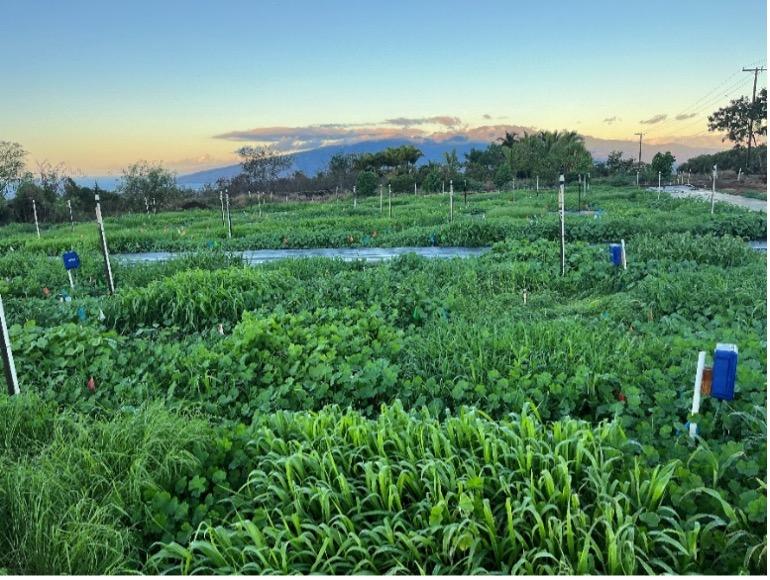
Cover Crops Adaptability to Water Stress
KJacqueline Jamison, Rosemary Gutierrez-Coarite and Hannah Lutgen
Department of Tropical Plant and Soil Sciences2, University of Hawaii at Mānoa.
Reduced water availability poses a significant threat to agricultural food sustainability in Hawaii, making efficient soil moisture management essential for long-term crop viability. Cover crops are increasingly recognized for their capacity to improve soil health, increase organic matter, and enhance water retention. Extension agents at the University of Hawai'i are investigating how the integration of cover crops with conservation management practices can enhance on-farm water efficiency. You can read more about the adaptability of cover crops to Water Stress can be read here.
FMI: Jacqueline Jamison
| | |
Chickens Eating Kalo Leaves? A Fowl-Tastic Superfood
University of Hawaiʻi at Mānoa, College of Tropical Agriculture and Human Resiliance
Yunuen Bustamante¹, Melelani Oshiro¹
¹Assistant Livestock Extension Agent, Human Nutrition Food and Animal Science
Taro (Colocasia esculenta), commonly referred to as kalo in Hawaiʻi, is a tropical plant that serves as a viable alternative feed source for poultry. Research indicates that incorporating kalo leaves into chicken diets can enhance nutrient composition, digestibility, and meat quality while simultaneously reducing feed costs. A study conducted in Ethiopia (Temesgen, Retta & Tesfaye, 2017) found that kalo leaves, which are rich in proteins, carotene, and trace minerals, can replace up to 7% of soybean meal in chicken feed, thereby improving growth performance and cost efficiency. This alternative feed source is particularly significant in Hawaiʻi, where livestock producers are confronted with high feed costs and food security challenges. Read the full "Chickens Eating Kalo Leaves? A Fowl-Tastic Superfood" article.
FMI: Yunuen Bustamante
| | |
Deep, Raised Beds to Advance Ergonomics and Food Access
Parker Kilkenny and Jari Sugano University of Hawaiʻi at Mānoa, College of Tropical Agriculture and Human Resilience
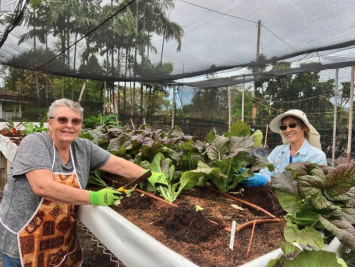
In vegetable production, much of the manual labor requires workers to maintain awkward postures, often sitting, squatting, or bending for extended periods while performing various tasks such as harvesting, weeding, seeding, and transplanting. Adverse working conditions can elevate the occupational risk factors associated with agriculture, leading to discomfort and negative physiological effects, including chronic back issues. Therefore, the use of raised garden beds as an ergonomic intervention can mitigate these risks by promoting improved workplace efficiency and reducing physical overexertion. Elevated raised beds also facilitate increased food production and access in areas where land is limited, such as schools, backyards, abandoned lots, parks, and community centers. Read the full "Deep, Raised Beds to Advance Ergonomics and Food Access" article.
FMI: Parker Kilkenny
| |
Other CTAHR Publications & Programs
for sustainable and organic production systems
| | Organic Corner + University of Hawai'i Organic Transition (UHOT) | | |
The University of Hawai’i Helps Interested Farmers Transition to Organic
U.H.O.T. (University of Hawai’i at Mānoa Organic Transition Program) is a TOPP partner program dedicated to fostering organic workforce development, providing organic transfer and certification guidance, mentoring services, technical assistance, and community building in Hawaii. Learn more at UHOT.org
The TOPP (Transition to Organic Partnership Program) is a 5-year collaborative partnership network covering six regions. The University of Hawai’i at Mānoa Sustainable and Organic Agriculture Program, in partnership with CCOF as the Western Region lead, Hawai’i Farmers Union United and Ma’o Farms to provide mentoring services, technical assistance, community building, and organic workforce development for transitioning and exciting organic farmers.
Defunded: Organic Certification Cost Share Program (OCCSP)
The USDA FSA Organic Certification Cost Share Program (OCCSP), has been defunded in the latest Farm Bill extension. This program, which covered up to 75% of certification costs (up to $750 per category), has helped smaller and mid-size operations manage the financial burden of obtaining and maintaining organic certification. The National Organic Coalition and other advocacy groups are urging Congress to rectify this situation by allocating necessary funding to support these essential programs.
The National Organic Standards Board
In the United States, the National Organic Standards Board (NOSB) plays a pivotal role in maintaining the integrity of organic products. Established under the Organic Foods Production Act of 1990, the NOSB advises the U.S. Department of Agriculture (USDA) on organic standards, ensuring that consumers can trust the products they purchase.
Membership and Composition
The NOSB is a diverse 15-member board, comprising representatives from various sectors of the organic community. Members include farmers, environmentalists, consumers, food processors, retailers, scientists, and certifying agents. This diverse composition ensures that a wide range of perspectives is considered in decision-making processes, promoting a balanced approach to organic standards.
Recent appointments to the NOSB include Kathryn Deschenes and Amanda Felder in the Handler seats, Andrea Hatziyannis as the Retailer, Cathleen McCluskey for Environmental Protection and Resource Conservation, and Corie Pierce representing farmers. These appointments reflect the board's commitment to maintaining a broad base of expertise and experience.
Responsibilities
The NOSB's primary responsibilities include reviewing and recommending substances for use in organic farming and processing. This involves evaluating synthetic substances to ensure they do not compromise the organic integrity of food products. The board also sets guidelines for organic farming practices, labeling requirements, and certification processes.
One of the NOSB's most critical duties is managing the National List of Approved and Prohibited Substances. This list is reviewed every five years to ensure that substances used in organic production meet strict criteria: they must not harm human health or the environment, be necessary due to the lack of natural substitutes, and align with organic farming principles.
Upcoming Meeting
The NOSB's spring meeting, originally scheduled for April 29 – May 1, 2025, in Tempe, Arizona, has been indefinitely postponed. However, public participation remains a cornerstone of the NOSB's operations. When meetings resume, stakeholders will have opportunities to provide input through public comments and webinars.
For those interested in participating or learning more about the NOSB's activities, the USDA National Organic Program provides detailed information on meeting agendas, public comment procedures, and how to engage with the board. You can visit the USDA National Organic Program for updates on future meetings and how to submit comments.
Additionally, organizations like Beyond Pesticides offer resources and guidance on submitting effective comments to the NOSB, ensuring that public voices are heard in shaping organic standards.
For more information on the NOSB and its activities, you can visit the National Organic Coalition or the USDA National Organic Program. These resources provide insights into the board's work and how you can contribute to the development of organic standards.
| | |
HFUU is looking for both interested farmer participants and for experienced mentors. It has been decided to roll out the program statewide and HFUU is seeking applicants from all islands! There has been a lot of interest in the program and we thought it would be best to roll things out as quickly as possible.
Please reach out to organictransitions@hfuu.org and we will get you an application! Once you are signed up as an interested farmer, the Project Coordinator will get you the application form. Once it has been returned, there will be an initial interview to learn more about your farming operation before being paired with a mentor to begin your journey to becoming an organic farming operation!
| | |
Pakini Loan Fund for Small Businesses
The new Pakini loan fund program offers loans from $1,000 to $30,000 for small businesses in Hawaiʻi. While the Pakini fund prioritizes serving Native Hawaiians living and working in the Waiʻanae Moku on Oʻahu, the program fund is open to all eligible small businesses in Hawai'i. Visit their website for more information.
Solution Focused
- Provide financial products and services, including loans and financial/business education.
- Collaborate with other financial institutions and financial service providers to support our participants.
- Provide 1:1 business consulting to prepare our participants and strengthen their ability to secure traditional funding.
- Support our participants through the process by being a Hawaiian-culture-based model and reinforcing the inherent strengths of our community.
|
Malama Da Farmer Grants
Food Basket is excited to announce our new funding opportunity for Hawaiʻi Island food producers called Malama Da Farmer Grants! These grants aim to support economic recovery of small food producers whose businesses were financially impacted by the COVID-19 pandemic.
Funding for this program was provided by the County of Hawai‘i and originated from the U.S. Department of the Treasury’s State and Local Fiscal Recovery Funds (SLFRF) Program authorized by the 2021 American Rescue Plan Act (ARPA). The Food Basket Inc. is the sub-recipient.
The SLFRF Program was authorized by the American Rescue Plan Act. The County of Hawaiʻi awarded SLFRF funds to The Food Basket, through a competitive process, to administer a Local Food Producer Expansion Program (LFPEP). The primary goal of LFPEP is to drive a significant increase in local food production by providing essential support to eligible small businesses and nonprofits interested in expanding their operations.
Deadline to apply: April 7, 2025 by 11:59 PM HST
Total Program Funding: $710,000
Range of Grant Awards: $5,000-$25,000
Contact:
or call 808-437-3044
| |
2025 Carbon Smart Land Management Assistance Pilot Program
The Department of Land and Natural Resources seeks to provide financial incentive payments to owners and lessees of eligible lands for eligible projects to promote soil health and carbon sequestration benefits (see Section 5). Eligible entities include (but are not limited to) private landowners and lessees or those with documented access and rights to land management, community organizations, hui, networks and hubs, schools and businesses. Multiple awards will be made under this request for proposals. Final awards are subject to the availability of funds or State budget restrictions and procedures
| |
April 10: Where Should I Market My Products?
Join experts online from the Center for Farm Financial Management at the University of Minnesota for a free weekly webinar series designed to enhance business management skills. The series will run every Thursday at 10 a.m. HST through May 1st with a different topic each week:
- March 20: How much does it cost to grow? (Part I)
- March 27: How much does it cost to grow? (Part II)
- April 3: No Webinar
- April 10: Where should I market my products?
- April 17: How much did that market make?
- April 24: FSA Programs, Farm Answers, and USDA Beginning Farmer Programs
- May 1: Putting it all together
| |
The Office of Economic Revitalization (OER) was created to drive the City and County of Honolulu's economic development strategy.
OER works with partners to create an economy for Oʻahu that is more resilient, diverse, equitable, and filled with good jobs that care for our people and our place. OER provides information and opportunities for small business owners, job-seekers, farmers, innovators, community-based organizations, and everyone who is doing their part to improve the quality of life on Oʻahu.
| | |
Regenerative Beekeeping in Hawaii with Jenny Bach
Join the Laupāhoehoe P&S Library, the Honeybee Education Program and the Laupāhoehoe Train Museum as they present the first in a five-part series with a focus on animal homesteading.
| |
AI Essentials for Busy Entrepreneurs: How to Streamline, Scale, Succeed
A two-part webinar designed to help entrepreneurs harness the power of AI for efficient operations by learning easy-to-use tools that free up your time. Automate tasks, make informed choices based on data, and streamline the way you run your business. We’ll show you how to save time, reduce costs, and lay the foundation for long-term growth.
Session Topics:
- Discover how AI can simplify daily tasks and free you up for strategic thinking.
- Streamline operations, reduce costs, and plan for long-term growth.
- Explore user-friendly apps and processes that automate everything from marketing to customer interactions.
- Learn to interpret key insights and use data to make fact-based decisions that strengthen your business.
Session Dates & Times:
- Thursday, March 27th, 2025 -- 11:00 - 12:30p
- Thursday, April 3rd, 2025 -- 11:00 - 12:30p
Facilitated By:
Nicole Cacal, Business Strategy & Technology Advisor
Advanced registration is required.
This workshop is hosted online via Zoom.
Fee: No Cost
| | |
Livestock Wala'au: Livestock Podcast
Livestock Wala'au podcast presented by the University of Hawaiʻi College of Tropical Agriculture and Human Resources. This podcast serves as a way for the livestock community to connect, talk story, and learn.
Listen to the Podcast
| | |
U.H.O.T. Podcast: Why Organic in Hawai'i?
U.H.O.T. Podcast explores why local producers choose certified organic production. Local producers hearing from local producers.
Listen to Episode 1
| |
Western Region Sustainable Agriculture and Education Program (WSARE)
| | |
SARE is a program of the U.S. Department of Agriculture's National Institute for Food and Agriculture that provides competitive grants and educational materials. Our grants programs are conducted cooperatively by farmers, ranchers, researchers, and ag professionals to advance farm and ranch systems that are profitable, environmentally sound, and good for communities.
The SARE grant program mission is to advance innovations that improve profitability, stewardship, and quality of life in American agriculture by investing in groundbreaking research and education. To achieve that, Western SARE believes that our programs must include the involvement of agricultural producers from inception to finish, and therefore we require producer involvement in the planning, design, implementation, and educational outreach of any funded project.
Western SARE Goals
• Promote good stewardship of the nation’s natural resources by providing site-specific, regional, and profitable sustainable farming and ranching methods that strengthen agricultural competitiveness; satisfy human food and fiber needs; maintain and enhance the quality and productivity of soil; conserve soil,
water, energy, natural resources, and fish and wildlife habitat; and maintain and improve the quality of surface and ground water.
• Enhance the quality of life of farmers and ranchers and ensure the viability of rural communities, for example, by increasing income and employment, especially profitable self-employment and innovative marketing opportunities in agricultural and rural communities.
• Protect the health and safety of those involved in food and farm systems by reducing, where feasible and practical, the use of toxic materials in agricultural production, and by optimizing on-farm resources and integrating, where appropriate, biological cycles
and controls.
• Promote crop, livestock, and enterprise diversification.
• Examine the regional, economic, social, and environmental implications of adopting sustainable agriculture practices and systems.
| |
This e-publication is supported through the United States Department of Agriculture (USDA) Transition to Organic Partnership Program (TOPP). TOPP is a program of the USDA Organic Transition Initiative and is administered by the USDA Agricultural Marketing Service (AMS) National Organic Program (NOP).
This e-publication has been prepared by CTAHR research scientists and extension staff to deliver science-based information about sustainable and organic production systems to serve Hawaiʻi's farming community.
-
To continue receiving this newsletter, please confirm your interest by subscribing or updating your profile/email address.
- If this publication has been valuable, please forward it to others
- Send in your suggestions for what you want to read about in our articles
- Tell us about your research needs.
Mahalo nui loa,
Eric Collier Education Specialist and Managing Editor
Amjad Ahmad, Kylie Tavares & Emilie Kirk Co-Reviewers
Sharon Wages & Jensen Uyeda WSARE Content Reviewers
Theodor Radovich Editor-in-Chief
Sustainable and Organic Agriculture Program
Cooperative Extension Service
College of Tropical Agriculture and Human Resources
On-line version of newsletter as well as archived issues available at:
http://www.ctahr.hawaii.edu/sustainag/news/
Hawai‘i Cooperative Extension is an equal opportunity/affirmative action institution providing programs and services to the people of Hawai‘i without regard to race, sex, gender identity and expression, age, religion, color, national origin, ancestry, disability, marital status, arrest and court record, sexual orientation, or status as a covered veteran.
Eric Collier | Education Specialist, Social Media & Web Manager | colliere@hawaii.edu
Copyright ©2013 University of Hawai‘i - College of Tropical Agriculture and Human Resources. Updated 4 Nov, 2021
| | | | |