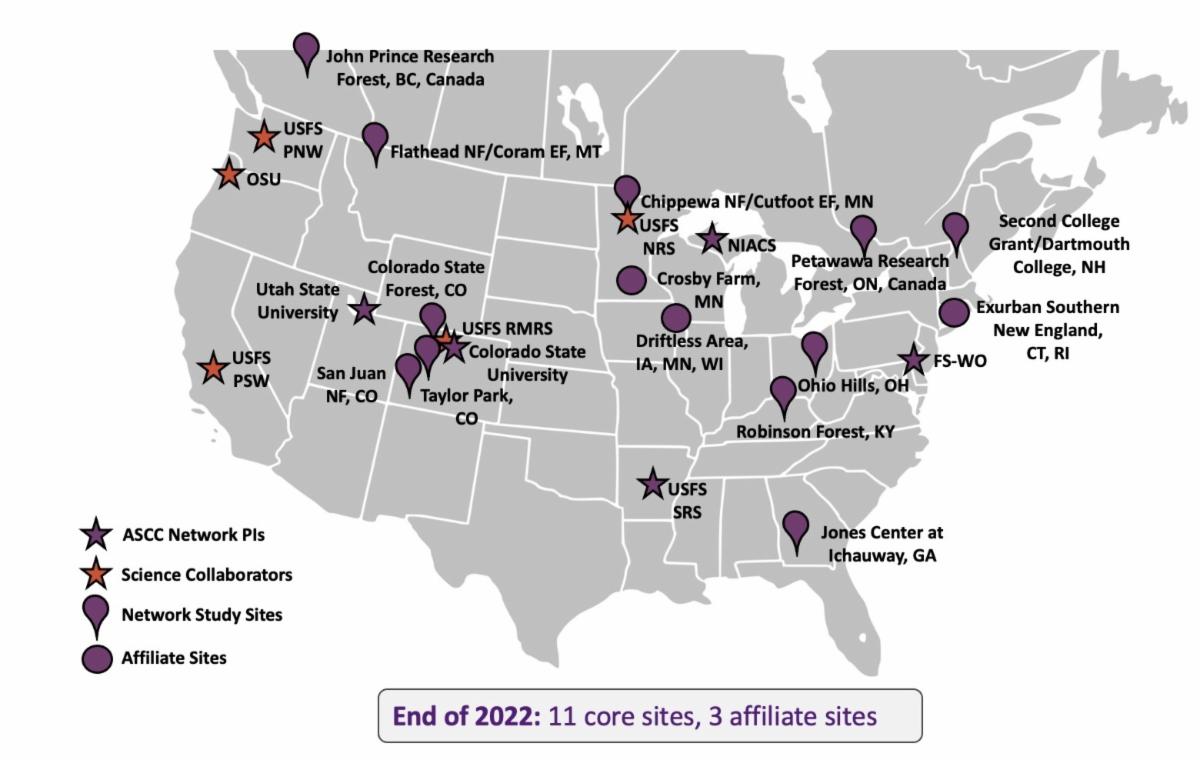
Since its inception in 2012, the Adaptive Silviculture for Climate Change (ASCC) Network has grown to include fourteen sites across the U.S. and Canada creating the need for us to find new ways to stay connected across the Network. In the ASCC Newsletter, we provide updates from the ASCC Network Leads and each ASCC site. We look forward to staying connected with you as we continue to work on climate change adaptation. | | The ASCC Network is Hiring! | | |
Join us! We are hiring a Climate Adaptation Specialist to help coordinate the Adaptive Silviculture for Climate Change (ASCC) Network (based at Colorado State University in Fort Collins, CO). This position will focus on climate adaptation planning and implementation, climate science delivery, and applied research and program support for the ASCC Network through technical assistance and trainings with managers.
To apply and view a full position announcement, please visit https://jobs.colostate.edu/postings/124668 by July 24 for full consideration.
| | Message from ASCC Network Leads | | |
The Adaptive Silviculture for Climate Change (ASCC) Network emerged over twelve years ago in direct response to a critical need from forest managers to implement, monitor, and understand climate-adaptive forest management strategies across different forest types. An initial development grant of $250,000 in 2009 launched what is now the ASCC Network, with initial goals of designing 3-5 silvicultural projects featuring a range of management options for responding to climate change. The project engaged climate change thought-leaders from across the US and built a robust experimental and science delivery framework to develop, evaluate, and demonstrate adaptation strategies. The ASCC Network fosters manager-scientist collaboration to cross-pollinate research ideas and cross-site questions, explore tech transfer communications (i.e. papers), and identify future Network initiatives. Treatments implemented are demonstrations of adaptation actions that encompass resistance, resilience, and transition related to climate change and a no-action control. The ASCC Network now provides climate-informed silviculture planning, implementation, and monitoring, and engages a wide variety of managers, partners, and teams of scientists from across the US and Canada. There are currently 14 installations in a variety of forest conditions, with the newest site developed during a workshop in November 2022 on the Robinson Forest led by the University of Kentucky.
As our Network has grown, we have been strategizing around how to build capacity and dedicate our time and energy to the success of our existing ASCC Network members to maintain a highly engaged community of practice on adaptive silviculture. We are thrilled that for Fiscal Year 2023, the ASCC Network has received funding from the Bipartisan Infrastructure Law (BIL) through the USDA Forest Service. This funding is part of a Forest Service-led effort to leverage the ASCC Network to scale-up implementation and development of climate-informed management practices for NFS lands. Moving forward, we will be prioritizing actions to accelerate implementation and monitoring of existing ASCC sites to generate information regarding climate-informed practices and developing regional climate-adaptive silviculture and natural resource trainings for managers utilizing data and lessons from ASCC installations to inform intentional adaptation planning.
Finally, a huge thank you to Emma Halaburt, our ASCC Network summer intern at Colorado State University! Emma has been instrumental in updating the ASCC website, creating outreach and engagement materials for your ASCC sites and the Network, and compiling this Newsletter. Emma is working on her Bachelor of Science degree in Rangeland and Forest Management with a minor in Global Environmental Sustainability at Colorado State University. Thank you for all of your work on climate adaptation science delivery and outreach this summer, Emma!
| | |
Thanks, everyone, for your dedication,
innovation, and commitment to the ASCC Network!
| | News from Around the Network | | Robinson Forest ASCC Site | | |
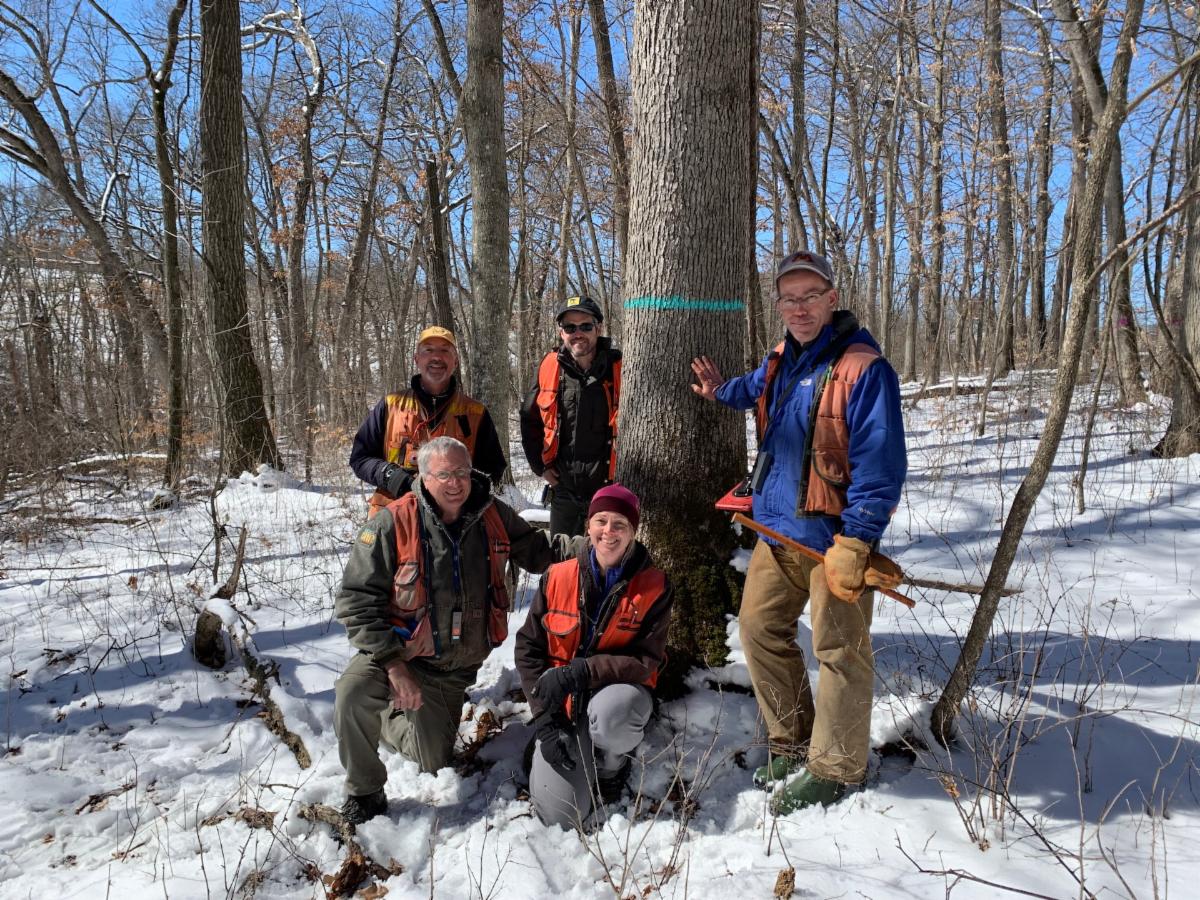
Robinson Forest, Kentucky is home to the newest ASCC site. The 15,000 acre teaching and research forest is located on a pristine, unfragmented, mature mixed-mesophytic oak forest on the Appalachian Cumberland Plateau. As the climate continues to change in the region, intense storms, flash floods and droughts, invasive pests, and wildfires are becoming more common and intense. By establishing and monitoring adaptation treatments on this important oak forest, the Robinson Forest ASCC site will be at the forefront of climate-adapted forest management, facilitating partnerships between scientists, managers, and private landowners in the region.
The team is currently in the process of collecting a robust pre-treatment dataset for the Robinson Forest ASCC location. The data collection will be completed this fall, and treatment installation will begin Spring 2024 which will include timber marking and sales prep work prior to a 2024 timber sale. Currently, they are coordinating the installation of 30 microclimate stations across the 16 treatment units to gather pre- and post-treatment data. This will enable researchers the ability to better understand growing conditions for natural and artificial regeneration.
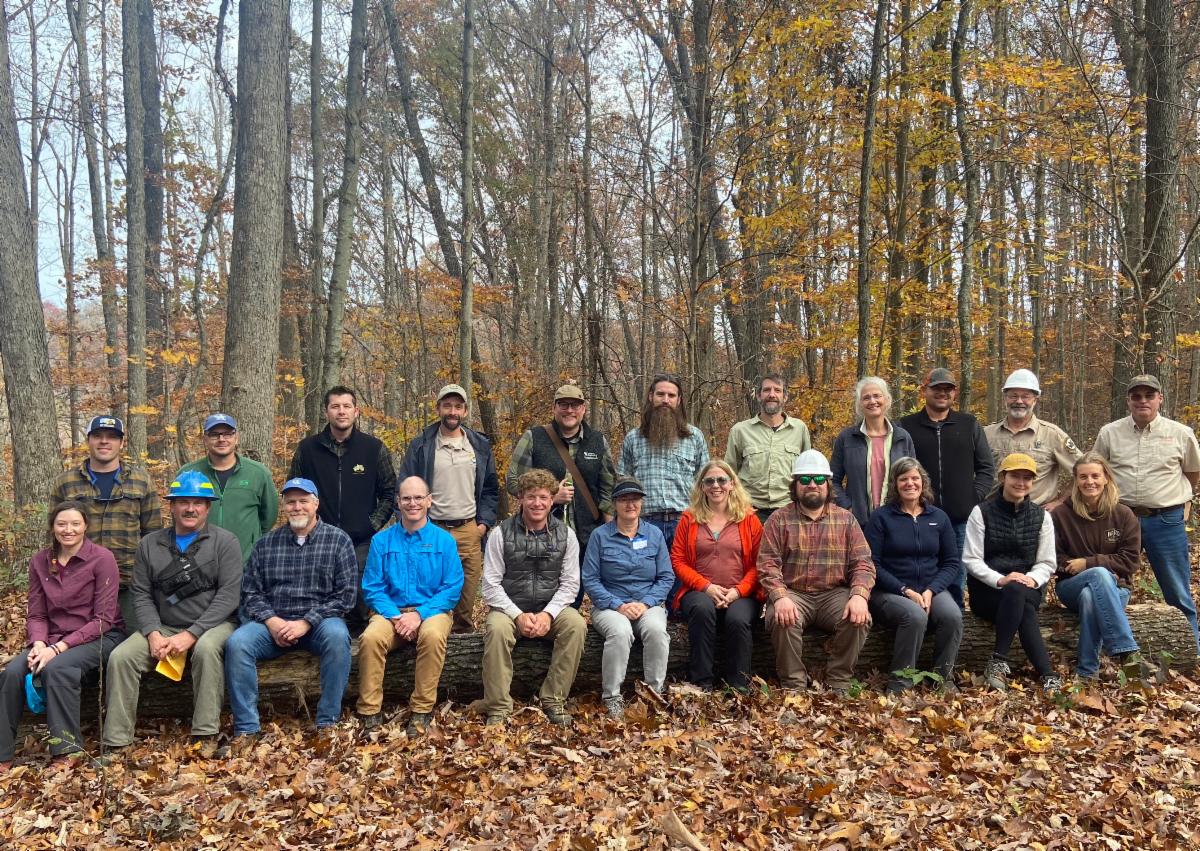
Photo: Robinson Forest ASCC Workshop November 2022. Photo by a Robinson Forest staff member.
| | |
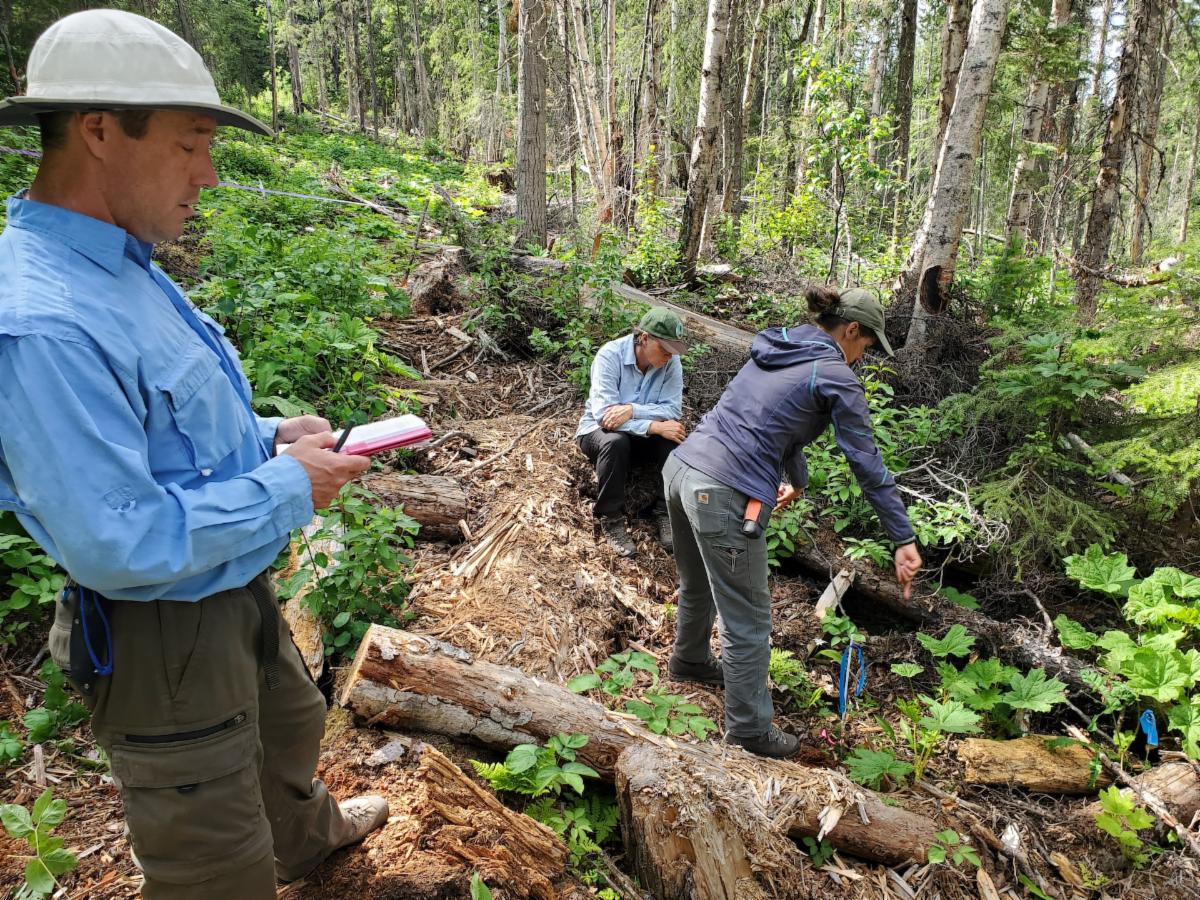
After hosting their workshop in 2022, the Taylor Park ASCC site on the Gunnison National Forest is continuing to collect pre-treatment baseline data on forest conditions. This pre-treatment data is crucial for refining treatment plans and assessing the impacts of the study. Once data collection is wrapped up, the team can add any final touches to their prescriptions and implementation is anticipated to begin as early as 2024!
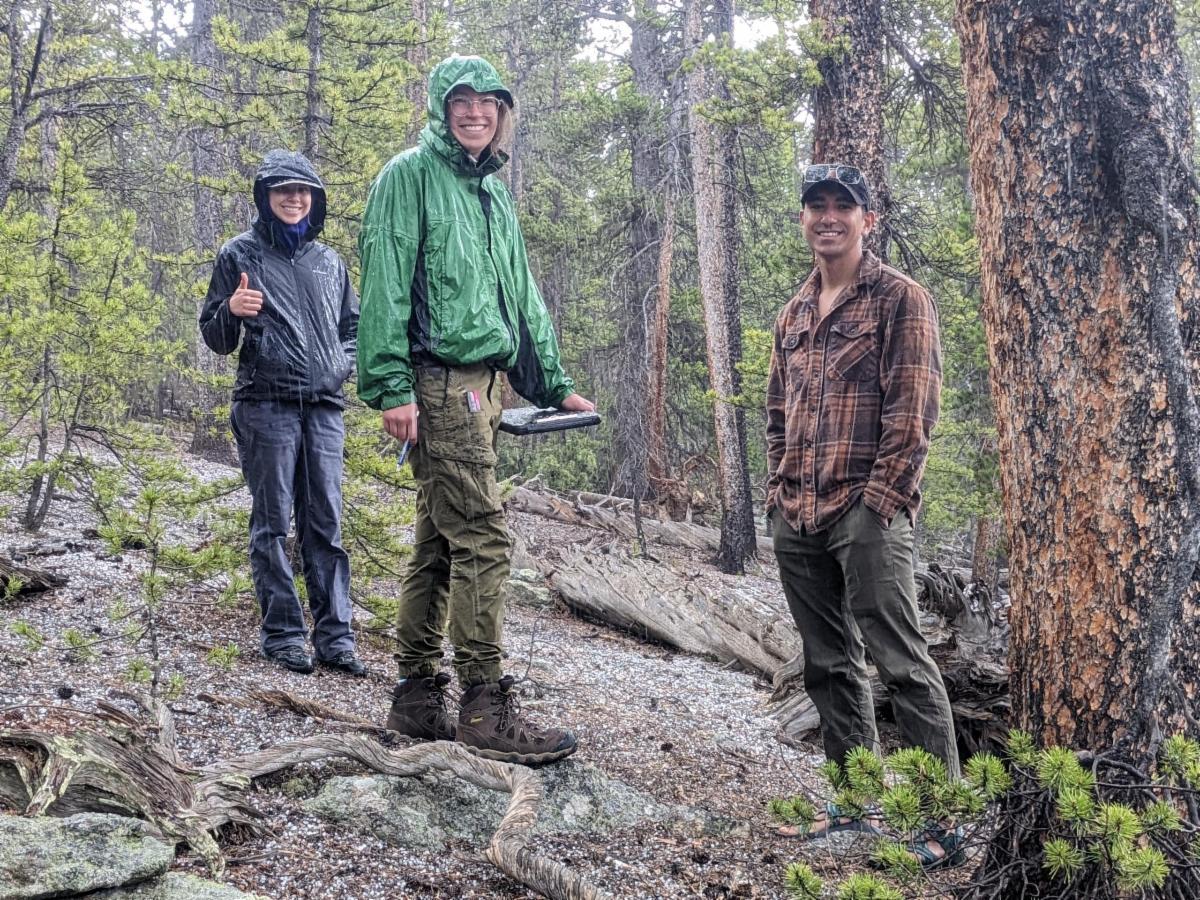
Photo: Amelia Maier, Courtney King, and Andres Villa on standby from data collection during a summer hailstorm at the Taylor Park ASCC site, June 2023. Photo by Jonathan Coop, Western Colorado University.
| | |
The Ohio Hills team is in the pre-treatment data collection phase. This past spring they collected data on bird communities with Ohio State University. The team is currently collecting ground layer data and initiating a seed bank study this summer. This coming fall and winter, they will be collecting detailed topography data, and treatment implementation is expected to begin winter 2023-24.
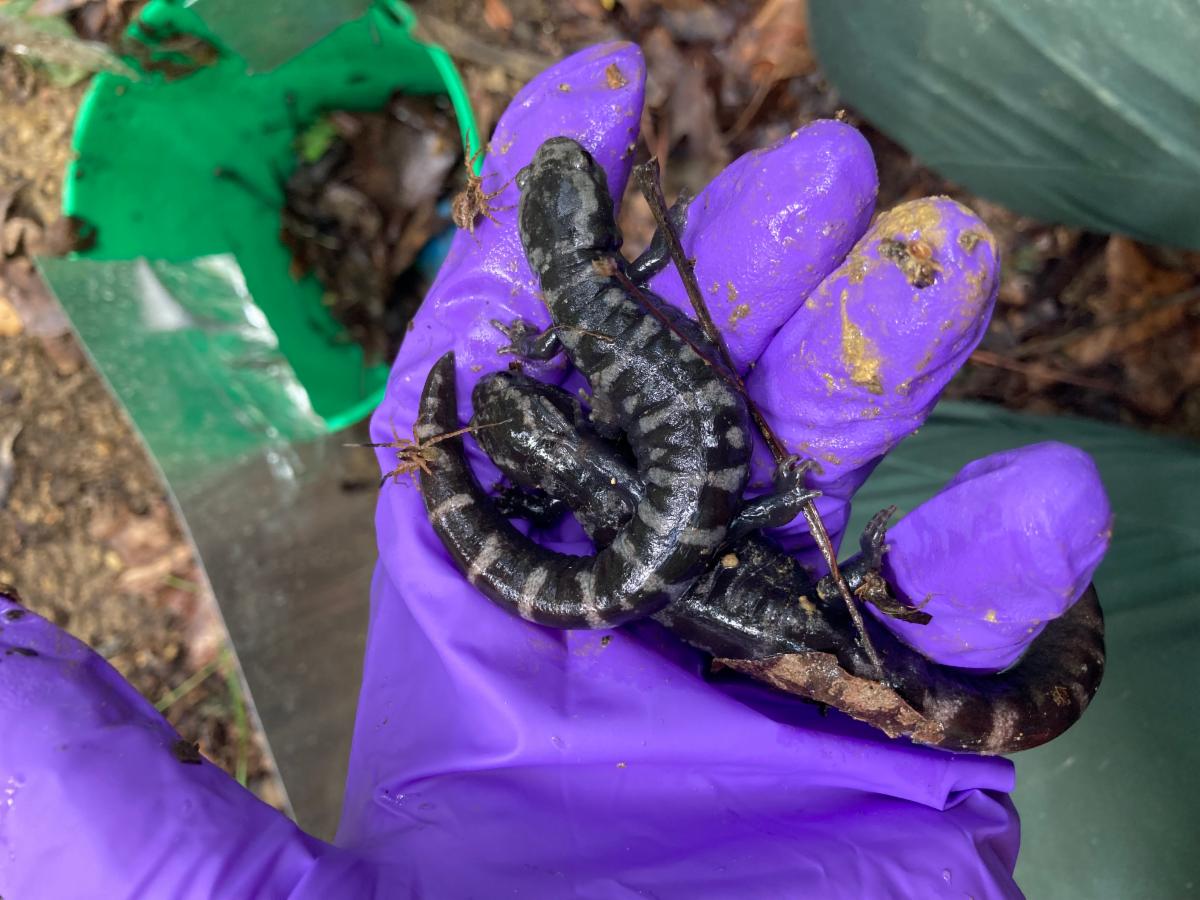
Ohio Hills has recently initiated a salamander study to examine how amphibian communities respond to ASCC treatments. Woodland salamanders are key indicators of ecosystem health and help to regulate forest pests. In spring 2023, the Ohio Hills team installed 40 drift fence and pitfall trap arrays to begin collecting pre-treatment data on the salamander community. Key objectives of this study are to understand how diversity, community composition, and salamander health is influenced by the Ohio Hills study. Long-term monitoring data will also help to elucidate potential impacts of climate change on woodland salamanders.
Photo: Marbled salamanders in pitfall traps on the Ohio Hills site (USFS IACUC #2023-011). Photo Credit: William Borovicka, Northern Research Station.
| | Driftless Area Affiliate ASCC Site | | |
Treatment implementation started at the Driftless ASCC site this spring with the underplanting of about 15,000 seedlings across the study. Stands in Iowa and Wisconsin were marked for harvest and will be sent out for bid in the next round of timber sales. Pre-treatment vegetation sampling was also completed in Iowa and Wisconsin. First-year survival of underplanted seedlings across a variety of conditions will soon be assessed in the resilience and transition treatments. The team had to delay treatments to the Minnesota stands because of the potential for species of concern. Hopefully, the team can proceed with them in the coming year, and this highlights the importance of the habitat these forests provide in the region!
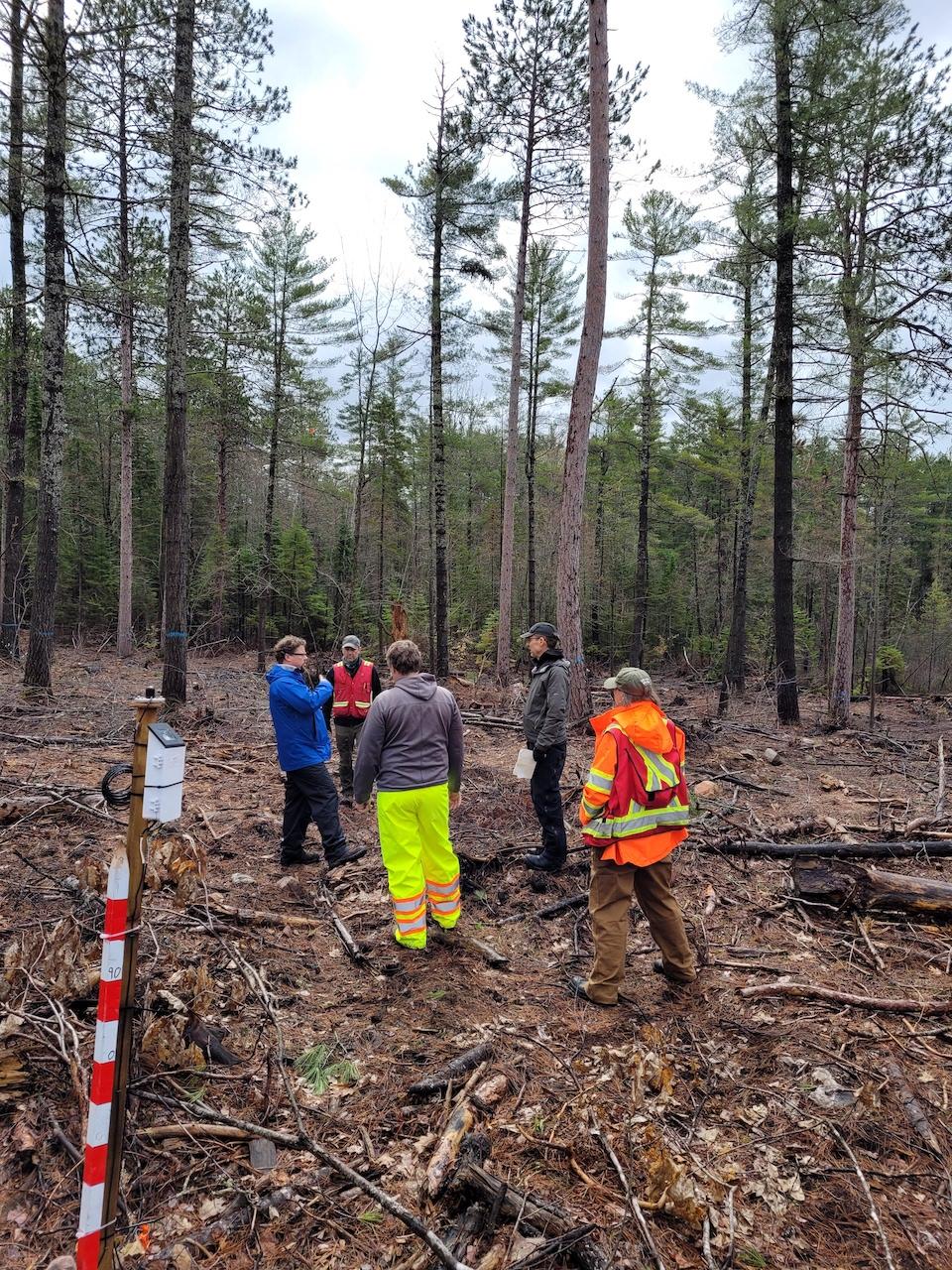
Photo: Driftless ASCC Core Planning Team at Yellow River State Forest in Iowa: (Back) Brad Hutnik, Mike Reinikainen, (Front) Bruce Blair, Miranda Curzon, Greg Edge, (not pictured) Paul Dubuque.
| | John Prince Research Forest ASCC Site | | |
The John Prince Research Forest Site recently completed post-harvest plantings across treatments with two components— operational and experimental plantings. Seedlings planted in the experimental plantings will be monitored and measured through time as individuals while operational plantings will be monitored using regular regeneration assessments.
All plantings have been completed. Species included in experimental plantings across all treatments are hybrid spruce, Douglas-fir and lodgepole pine. The resistance and resilience additionally included ponderosa pine while the transition included ponderosa pine plus four additional species, western hemlock, western redcedar, western white pine and western larch. Western redcedar will have browse protection added.
Monitoring planned for the rest of the year will focus on individual seedling data (in experimental plantings) and baseline forest health data on existing permanent plots. Wildlife data collection by collaborators is ongoing with projects related to rabbits and birds, among other animals.
Photo: Researchers record data on a recently planted ponderosa pine seedling at the JPRF ASCC site. Photo by Kristen Waring, Northern Arizona University.
| | Colorado State Forest ASCC Site | | |
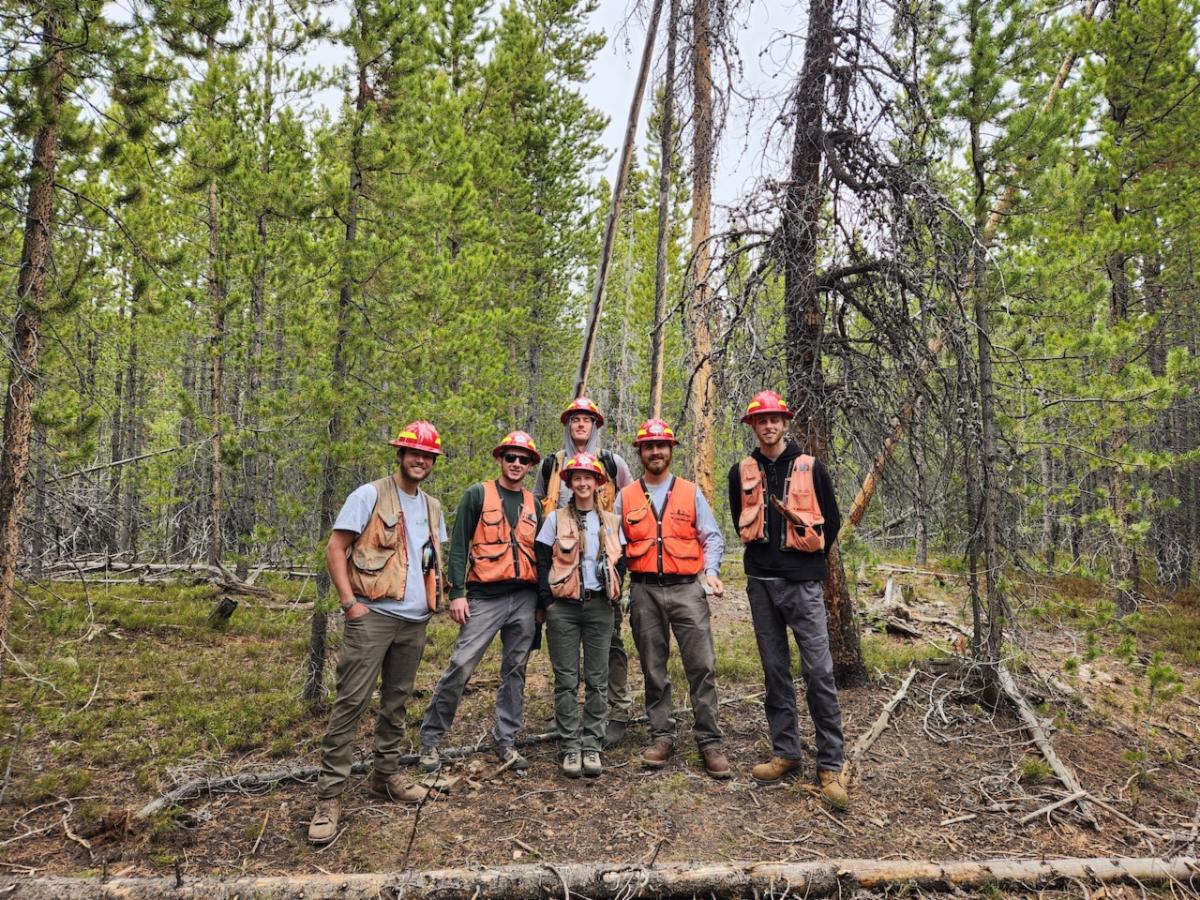
Things are moving along at the Colorado State Forest— the Colorado State Forest Service was able to secure funding for implementation! This is a huge success since the ASCC treatments will cost several thousand dollars per acre. This year's seasonal crew has started flagging boundaries and streamside management zones, and will start painting trees sometime this July! Bids for harvest are going out this fall and logging is expected to start by Summer 2024.
Monitoring funding from the U.S. Forest Service was awarded to aid in the pre-treatment/post-treatment measurements. This summer, soil samples and detailed botany data are being collected for pre-treatment inventories to develop a pre-treatment baseline of these important variables.
Photo: Seasonal Field Crew at Colorado State Forest. Photo by Bill Wolf, Colorado State Forest Service.
| | |
Southern New England
Exurban Affiliate ASCC Site
| | |
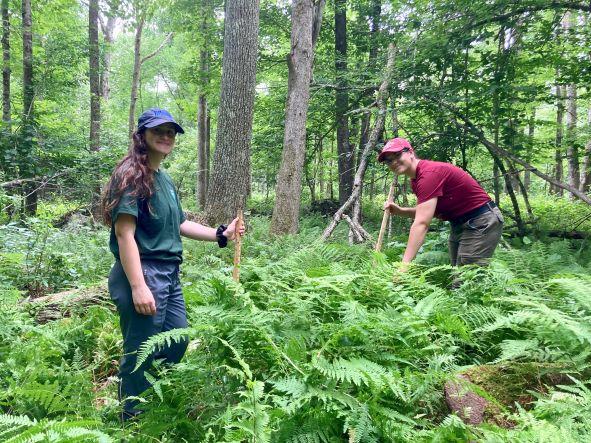
The Southern New England Affiliate site is composed of multiple small replicates (currently three) at different locations in Connecticut and Rhode Island to mimic the parcelized nature of forest ownership that exists throughout the oak/hickory range. This site is growing with the replicates in various stages of progress— from planning to tree planting to post-treatment monitoring. These sites are ideal settings to engage natural resource professionals, landowners, students, and the interested public on climate resiliency in regional forests.
Monitoring continues at the original treatment site on Mohegan State Forest in Connecticut. At the UConn Forest Lee Farm Tract inventories have been conducted, a workshop including students and forestry professionals was held, and prescriptions were developed for Resistance, Resilience, and Transition treatments. Marking of the stand for harvest will be completed this summer with implementation expected this fall or winter.
At the Hillsdale replicate in Rhode Island, a second round of baseline monitoring during summer 2023 will capture pre-treatment changes. Initial treatment implementation is anticipated to begin early this fall, followed by tree planting in the Resilience and Transition treatment areas in late fall 2023 and spring 2024.
Photo: Students and early career professionals gain experience with inventory and monitoring at the Hillsdale replicate site in Rhode Island. Photo by Christopher Rieley, University of Rhode Island.
| |
Crosby Farm Regional Park
Urban Affiliate ASCC Site
| | |
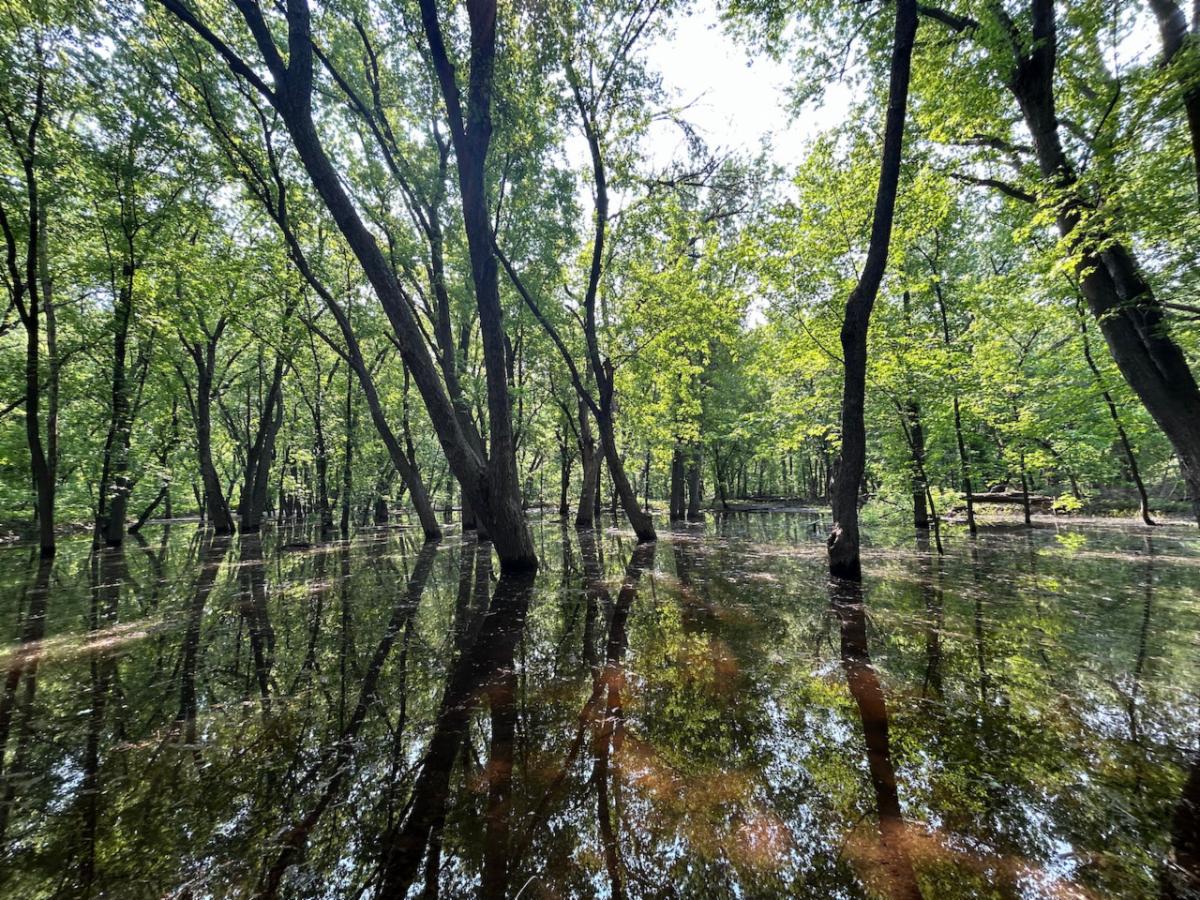
The Crosby Farm ASCC site has continued to grow over the past year. The high snowpack across the Great Lakes Region caused not one but two opportunities for the site's floodplain trees to test their flood tolerances. Flooding was wide spread across the network of plots. However, as May turned to June and the flood waters receded, the planted trees looked great. The Crosby Farm Site is in the middle of additional monitoring this summer and working to repair damages to fencing. Additional measurements are being conducted post flooding to quantify health and to see if flooding impacted short- or longer-term forest health. The team at Crosby Farm has collected understory vegetation and natural regeneration across the plots, and in the fall they will be measuring survival and growth.
The Crosby Farm site is excited to welcome two new graduate students this summer. One student, Catherine, will be exploring physiological measurements that might include above and below ground measurements of tree and root physiology. Another student, Nick, will be continuing year 4 and 5 measurements on growth and survival across the plots. Finally, Abby, who is in their second summer of sampling, is coordinating phenology measurements.
Photo: Flooded conditions at the Crosby Farm. Photo by Marcella Windmuller-Campione, University of Minnesota.
| | Petawawa Research Forest ASCC Site | | |
The Petawawa Research Forest is in the final year of establishing treatments at the site, and continues to collect data on bird abundance, soil moisture, and soil temperature. The seedlings are growing at the greenhouse and we are preparing for the tree plant to start in late August. Seasonal staff are installing pins with colour-coded flagging tape at locations to be planted in each of the measurement plots. These pins will ensure that we plant the correct seedling species and seed source in the correct location and enable us to track them for years to come. We are also establishing small “no-spray” areas— a new element of the project— across a gradient of moisture conditions in each treatment. The team will pin and plant trees in these zones to compare early growth and success under more competitive conditions. The ASCC team will plant the measurement plots and no-spray areas, and the remaining areas will by planted by a contractor.
A PhD student, Lisa Han, co-supervised by John Caspersen (University of Toronto) and Charles Nock (University of Alberta) will be joining the project this year. She will be investigating early growth related to light and competitive vegetation conditions in planted seedlings of each of our species and seed sources. During the summer, Lisa will establish and pin small spray and no-spray plots for monitoring early growth of seedlings. At these locations, all 10 species and seed sources will be established to evaluate their performance across the full range of light conditions.
Photo: The meeting of minds: scientists planning a Phd project. Photo by Mike Hoepting, Canadian Forest Service.
| |
Flathead National Forest/
Coram Experimental Forest ASCC Site
| | |
The Flathead National Forest/Coram Experimental Forest is busy sampling and planning next years plants now that their harvests are complete. This year post-harvest slash was piled and burned. Midstory hardwoods are still slated for slashing in two out of four units. The team is continuing to prepare for spring 2024 when they will be planting 50,000 seedlings in the Resilience and Transition treatments. In the meantime, they are conducting their first post-treatment measurement of forest structure and composition with a Forest Service and University of Montana field crew. The team is most excited about the microenvironmental weather and growth stations that they’ve set up across the variable canopy conditions in the Resilience treatment— which they hope will address the question of how forest growth is affected by irregular canopy structure.
Photo: Resilience treatment following logging, slash piling, and limited scalping. June 2022. Photo credit: Justin Crotteau, USDA Forest Service Rocky Mountain Research Station.
| | Second College Grant ASCC Site | | |
The Second College Grant site has had a busy year of research and monitoring!
Implementation and monitoring includes: 1) breeding bird surveys; 2) deadwood and soil moisture; 3) planted seedling survival, growth, and health; 4) seed rain; 5) nutrient availability; 6) snow depth; and 7) mammal communities.
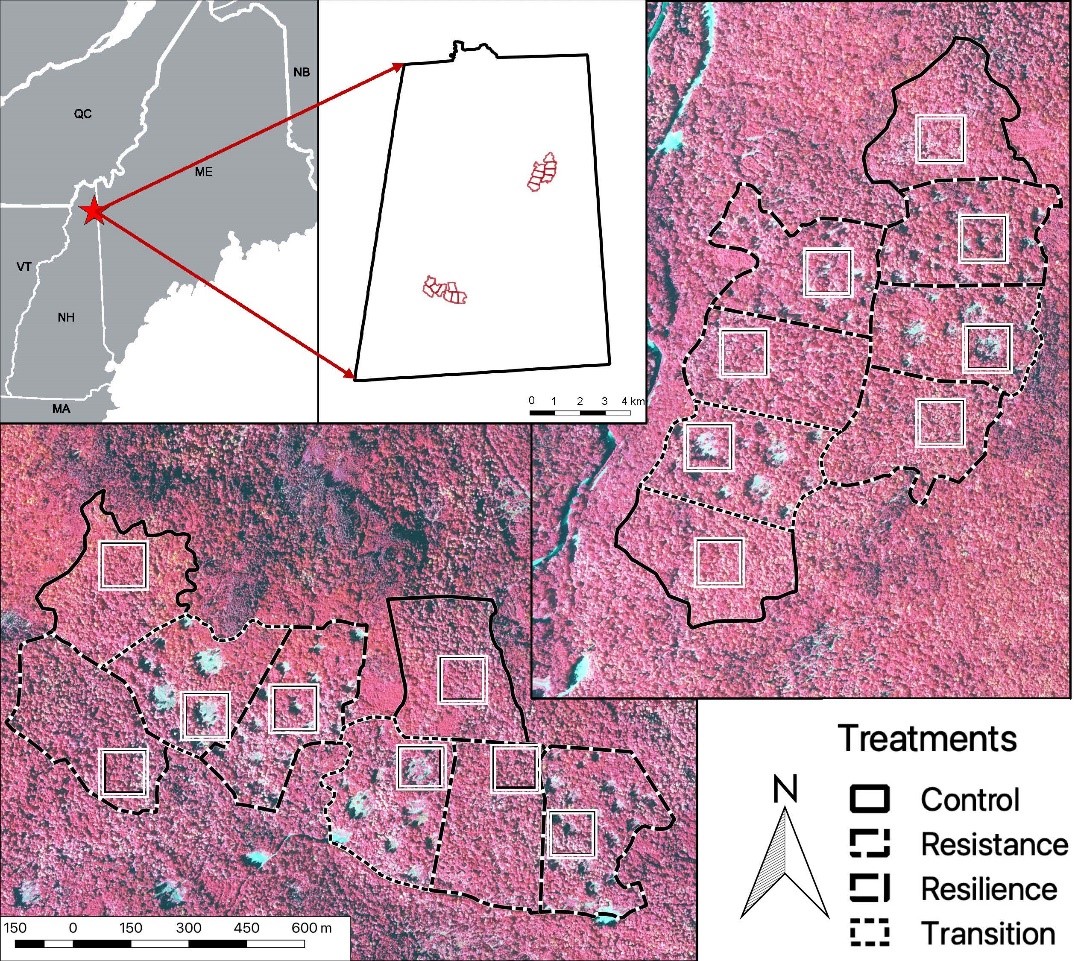
Jess Wikle’s dissertation research has provided valuable feedback on treatment efficacy at the Second College Grant site, summarized below. Spatial outcomes of forest adaptation treatments were quantified using 1-ha stem-mapped plots placed in each replicate of the New England ASCC experiment. Comparisons of the spatial structure of each ASCC treatment indicated Resilience and Transition treatments led to patterns with variable tree spacing and clumping, while Resistance treatments resulted in less pattern variation. This indicates that adaptation strategies that include uneven-aged regeneration methods that restore and maintain tree spatial patterns historically generated by gap dynamics can be successful at increasing heterogeneity in resource availability and adaptation pathways in northern hardwood-dominated ecosystems. Along with Wilke's (2023) paper in the Canadian Journal of Forest Research, summarized above, the Second College Grants team has published two other papers this year in the Canadian Journal of Forest Research and Ecology.
Photo: Spatial plot locations (squares) within New England Adaptive Silviculture for Climate Change installation at Dartmouth College Second College Grant, NH. Map created by Jess Wikle, University of Vermont.
| | The Jones Center at Ichauway ASCC Site | | |
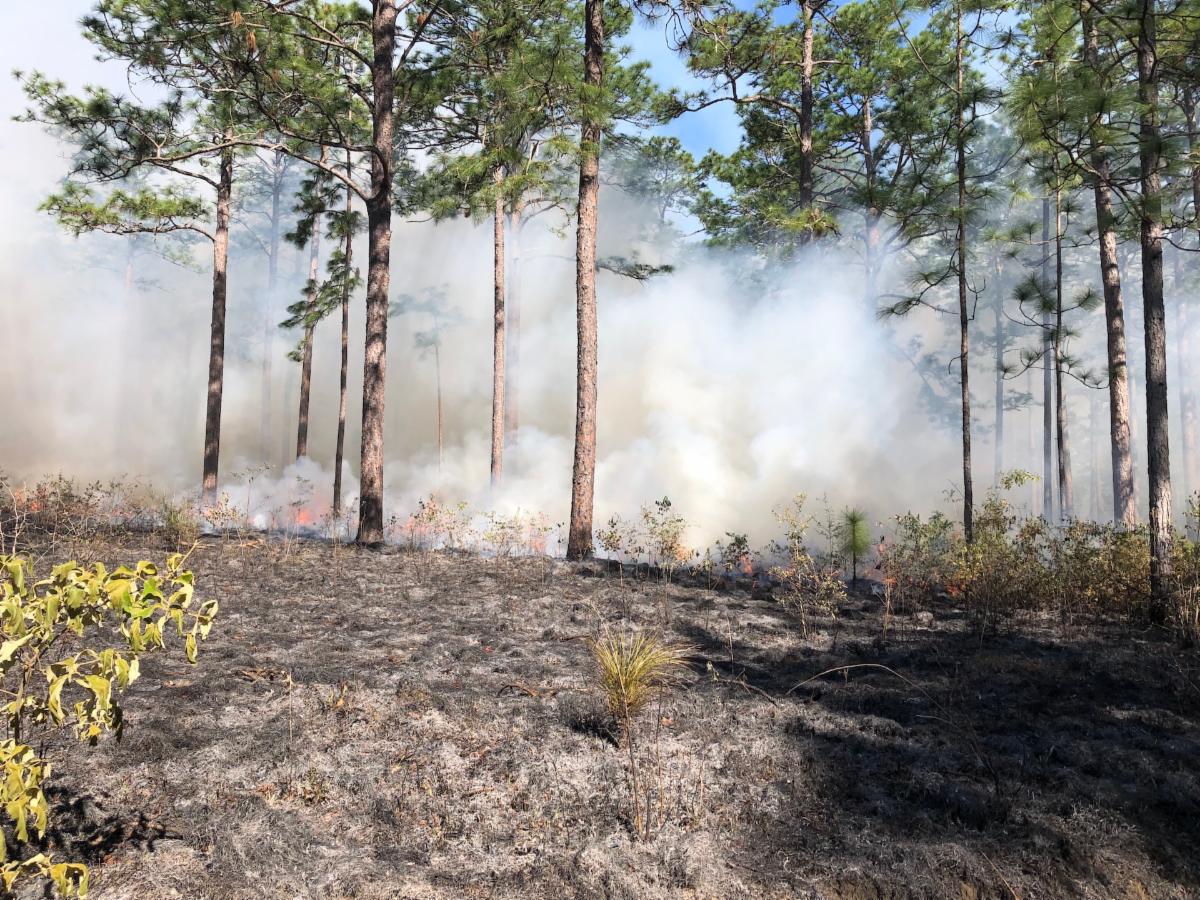
The Jones Center at Ichauway is deep in their monitoring this summer! During the 2022–2023 reporting period, the team at the Jones Center clipped plants from 1 m2 quadrats to determine biomass, carbon, and nitrogen concentrations by species or guild. The team also collected organic and mineral soil samples before and after prescribed fires, which were conducted in March and April 2023. These samples are currently being processed by a team of Ecological Silviculture Lab technicians. Quantification of understory and soil conditions will improve understanding of woodland productivity and carbon dynamics. This work is being done in addition to standard monitoring of forest attributes on permanent plots.
Photo: Prescribed fire on March 30, 2023 in the resilience treatment of Block C at The Jones Center at Ichauway. Photo credit Joshua Puhlick, The Jones Center at Ichauway.
| | San Juan National Forest ASCC Site | | |
It's been a long time coming, but it looks like the San Juan Site is on track for harvests starting in 2024! Bids for the harvesting will go out and are scheduled to start in late 2024 with the hopes of finishing within a few years.
The team is busy working to get pre-treatment data resampled this summer with our partner Mountain Studies Institute (since pre-treatment data was originally collected about 8 years ago), which will provide a valuable opportunity to assess how the stand has changed in the past 8 years without management. Layout for the units is happening this summer as well. Recent success in securing funding from the U.S. Forest Service to support the Rocky Mountain ASCC sites monitoring efforts has been extremely helpful, and the site now has the ability to sample pre-treatment botany and soils metrics.
Photo: Once the treatments are implemented we expect the resilience treatment to look like this. Photo by Matt Tuten, USDA Forest Service.
| |
Cutfoot Experimental Forest/
Chippewa National Forest ASCC Site
| | |
The Cutfoot ASCC study is entering its 10th year, providing an incredible opportunity to gain insight into longer-term responses to adaptation treatments. They are planning the year 10 remeasurement of adaptation plantings, including survival and growth. They are maintaining the embedded rainfall exclosure experiment and remeasuring the seedlings planted. The team is starting to gain insight into longer-term survival and growth of adaptation plantings in Resilience and Transition treatments and are able to show local managers more meaningful results.
Along with continued monitoring, has done a tremendous job engaging with forestry professionals and the public. The Cutfoot team has published five papers, given five presentations, hosted a field tour for a delegation from the Czech Republic, and been featured on National Public Radio (NPR) twice this year!
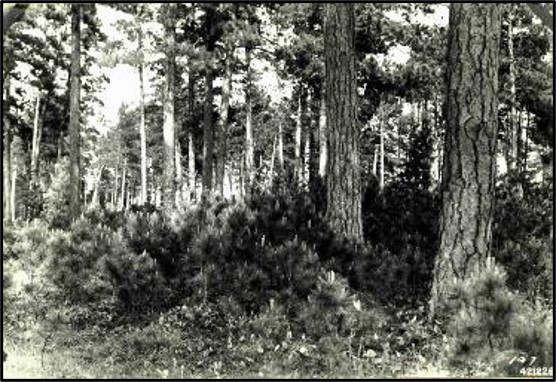
Photo: The past may be a key to the future. Restoring woodland structure, as in this early 1900's photo from the Cutfoot Experimental Forest, is the first line of defense against drought impacts.
| | Engagement & Outreach Metrics | | |
Engaging with scientists, land managers, and other partners is crucial to educating people on sustainable forestry to meet the needs of present and future generations and spreading the message of climate-adaptive land management. All of our sites have done a phenomenal job of hosting field tours, presenting at conferences and webinars, and publishing articles. Below is an overview of the outreach our various sites have done in the last year!
Across the network, there have been over 6 articles published in scientific journals, 13 presentations, 10 field tours, and 4 pieces in popular media or industry magazines such as National Public Radio and the Forest Stewards Guild. There are 5 presentations and 4 field tours already planned for the fall, including a two-part organized session on ASCC that will be given at the upcoming SAF Convention in Sacramento, California.
| | | | |