|
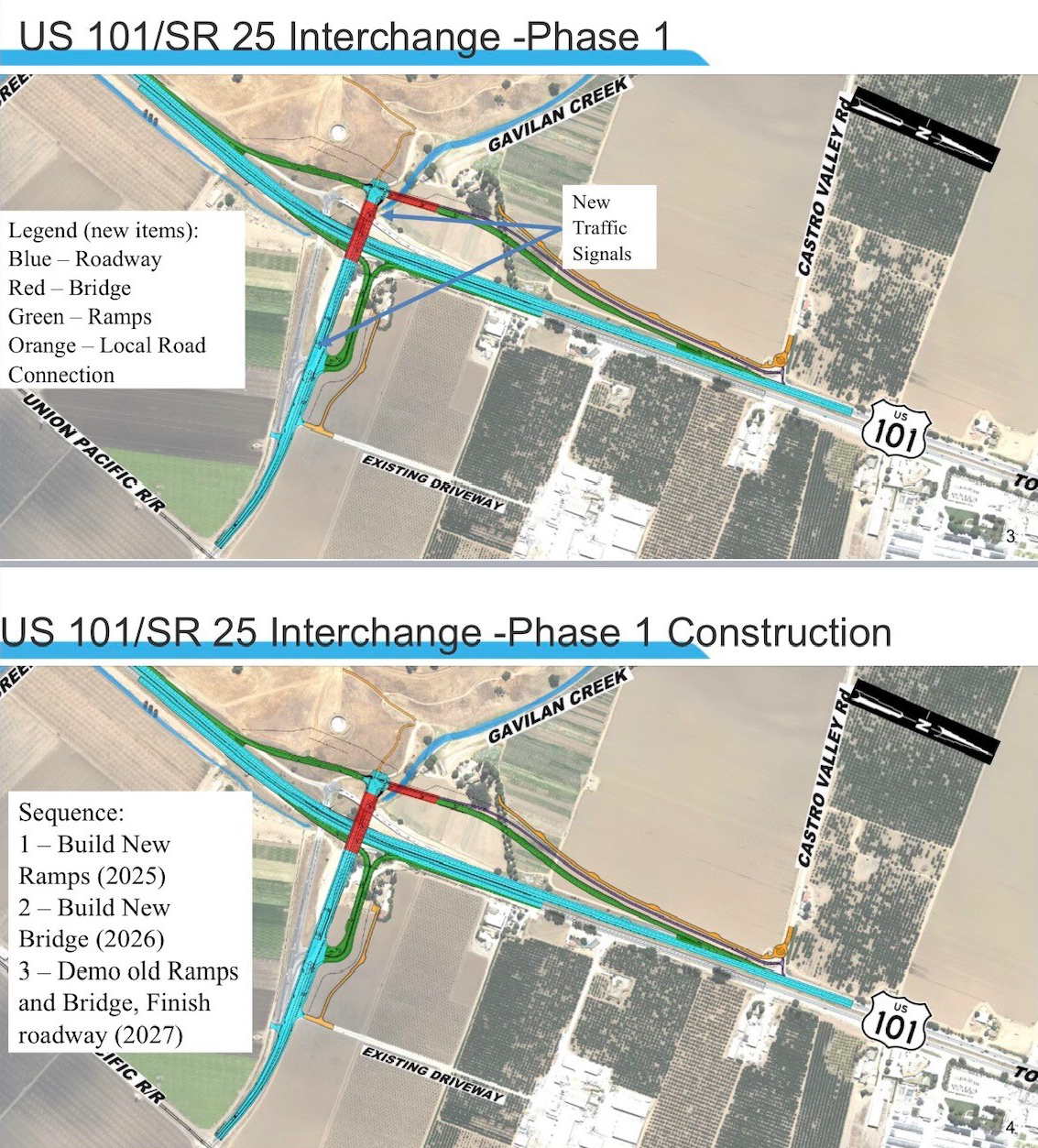
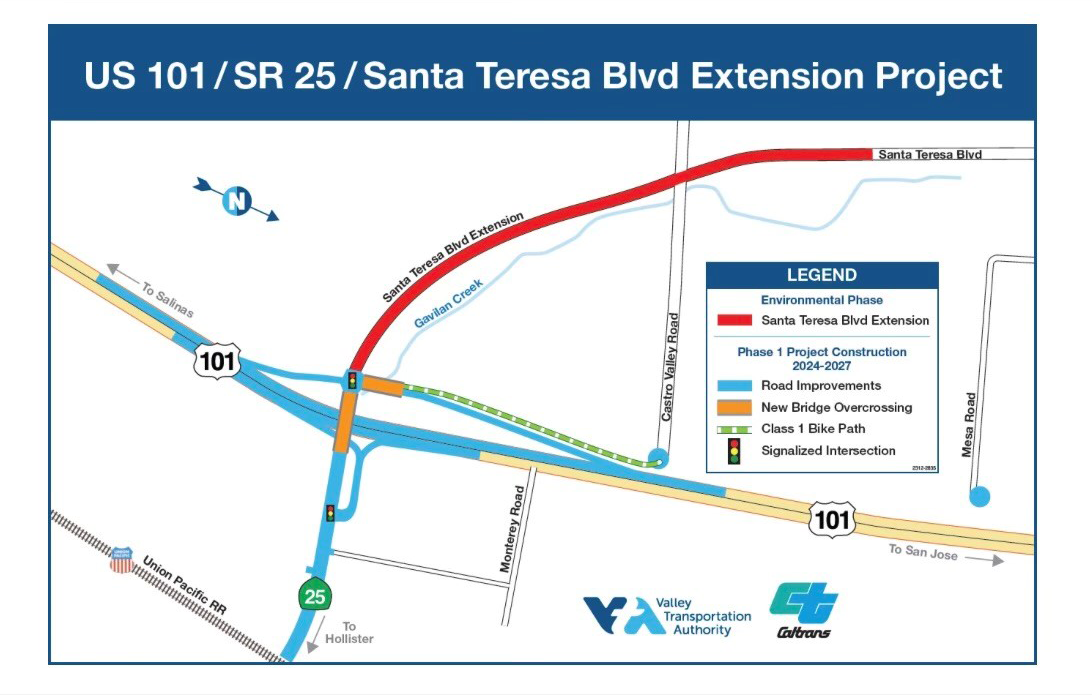
Adding a fourth lane to US 101 south of Cochrane in Morgan Hill has been in the CalTrans workplan for years, but timing and funding have not yet been identified. In 2022, thanks to strong advocacy from both Gilroy and Morgan Hill, $2 million federal dollars were awarded to begin required preliminary work on establishing that 4th lane that would also serve to continue the US 101 Silicon Valley Express Lanes Program though Gilroy. Sadly, the 4th lane expansion currently sits on the books as ending at 10th Street, but not for long if I can help it. These work plans are decades old, and given the housing soar in areas like Gilroy that remain a far distance from the job centers of Silicon Valley, added lanes on US 101 should continue at least through the US 101/ SR 25 interchange to avoid the same bottleneck in Gilroy that currently exists in Morgan Hill.
Tenth Street and US 101 bridge widening
Thanks to an $8 million grant award from the Measure B Highway Program in 2023, Gilroy’s current Capital Improvements Budget includes the widening of the existing bridge overcrossing at 10th Street and adds one lane in each direction from Camino Arroyo to Chestnut/Automall Parkway. This project not only includes widening the bridge structure and the roadway, but also ramp work, grading, striping and signal modification improvements.
Caltrain Weekday Service to Gilroy
In September 2023, Caltrain announced the beginning of a 4th commuter train to Gilroy! Considering that Union Pacific (the owner of the railway south of Tamien in San Jose) allows up to 5 weekday trains to Gilroy, it was about time. Before the 4th train, Gilroy had only three AM and PM weekday commuter trains as compared to 5 or more from San Jose to San Francisco. The argument has always been that ridership from Gilroy/Morgan Hill is lower than from San Jose north, but ridership is not a valid comparison where the underlying circumstances, such as train frequency, are not equal. Gilroy and Morgan Hill have half, if not less than half, of the train frequency enjoyed by cities to the north.
Since the addition of the 4th train, AM ridership from Gilroy has increased by 38 percent. PM ridership has also increased, but not by as much. To better address the needed flexibility of our commuters, the Caltrain PM schedule will change this September and will offer one earlier arrival time than currently exists and one later arrival time. Current PM Gilroy arrival times are 5:19, 5:40, 6:17 and 6:40pm, and will be changing to 5:09, 5:48, 6:48 and 7:09pm.
Gilroy Station Area Access Planning
With plans for High-Speed Rail to come through Gilroy, the Gilroy Transit Center will one day be a transit hub, second only to Diridon in San Jose for the stretch between Merced and San Francisco. Already underway are studies funded by Caltrans’ Sustainable Planning grant to identify and plan for access improvements to the Gilroy Transit Center. VTA is hosting pop-up tabling sessions in Gilroy as well as conducting an online survey to initiate their outreach to Gilroy residents and the surrounding neighborhood for feedback as to how access to the station by foot, bicycle, or vehicle could be improved, including things like wayfinding signage, improved lighting, better bus waiting areas, transit passenger amenities, and traffic calming measures. The online survey is being conducted from August 6 – September 6, 2024 and may be found at vta.org/gilroy.survey. Upcoming pop-up events in Gilroy where you may add your input are:
- Gilroy Downtown Live, 8/15 from 5-9pm
-
Gilroy Library, 350 W. 6th St, 8/22 from 10-1pm and 8/27 from 4-7pm
- Gilroy Transit Center, 7250 Monterey Rd, 8/22 from 4-7pm and 8/27 from 6-9am
Bay Area Rapid Transit (BART) Phase II
BART Phase I extended BART from Fremont to Berryessa in San Jose and was completed in 2021. Phase II will connect the Berryessa station to Santa Clara with a total of four new stations in between. This last 6 miles will complete BART’s circle around the Bay. The project cost is estimated at $12.7 billion, $4.6 billion of which has been generated locally in Santa Clara County over the past two decades through sales tax increases and other measures, and $5.1 billion of which was just committed on August 7, 2024 from a federal grant through the Federal Transit Administration. Through a combination of other funding sources, the gap remaining for VTA to fully fund BART Phase II is now $700 million. Major construction activities for the project are expected to begin in Spring 2025. The project will generate about 75,000 jobs and is estimated to be completed in 2037.
|