The content in this preview is based on the last saved version of your email - any changes made to your email that have not been saved will not be shown in this preview.


View as Webpage


Good afternoon!


This seems to be a common theme lately, but this was yet another very busy week with the Council engaged on many issues on behalf of our members. Although next week is school vacation week, the Legislature will continue on with committees working hard to tackle a mountain of work that is still ahead. At this point, notifications are significantly reduced, so please keep an eye on your inbox. We will try to alert you as much as possible as things progress.


But before we jump to the week ahead, here's a quick recap of this week. On Monday, the Council testified before the Environment and Natural Resources Committee in opposition to LD 269, "Resolve, Regarding Legislative Review Of Portions Of Chapter 375: No Adverse Environmental Effect Standards Of The Site Location Of Development Act, A Major Substantive Rule Of The Department Of Environmental Protection" and in support of an alternative proposal, LD 1458, "An Act Regarding Compensation Fees And Related Conservation Efforts For Solar And Wind Energy Development And High-impact Electric Transmission Lines Under The Site Location Of Development Laws."


The Council is concerned that this proposed rule has lifted the concept of Large Undeveloped Habitat Blocks (LUHBs) from IFW's Beginning with Habitat Program that is based on information voluntarily collected from private landowners for the purpose of collaborative conservation efforts, into a DEP rule that unfairly penalizes landowners for maintaining open spaces. The Council has worked collaboratively with the Sportsman's Alliance of Maine, Maine Coast Heritage Trust and Maine Woodland Owners on an approach that we feel will achieve better conservation outcomes without burdening landowners with a baseless new regulatory structure (LD 1458).


We remain hopeful that a compromise can be reached that addresses our concerns without compromising the intent of the rule (and its proponents). Thank you to Senator Craig Hickman for putting this bill forward on our behalf.


***


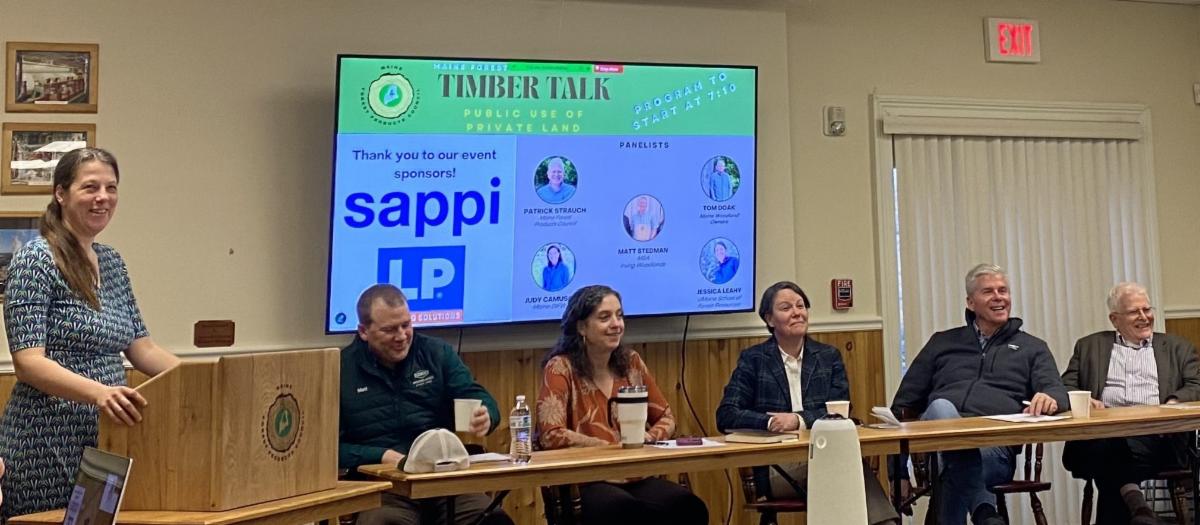
On Tuesday, the Council co-hosted our final Timber Talk breakfast event of the session with the Maine Woodland Owners on the topic of public use of private land. Thanks to Commissioner Judy Camuso, Dr. Jessica Leahy and MSA's Matt Stedman for joining us for this important and timely discussion. When planning this event, we couldn't have anticipated the sheer volume of landowner-related legislation that would be considered this legislative session.


Thanks to our sponsors of this event, Sappi and LP, and to the policy makers who joined us for this lively discussion.


***


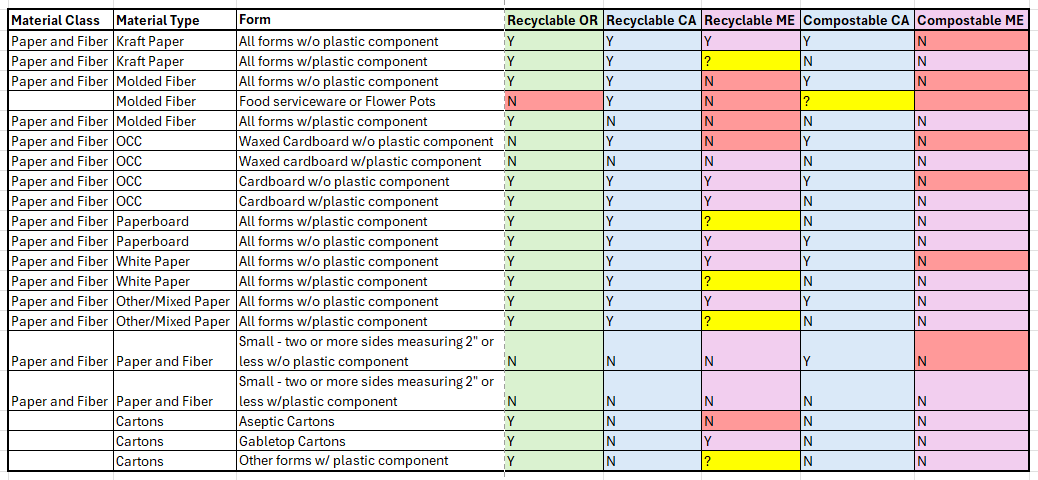
On Wednesday, we spent the morning with DEP staff at a stakeholder meeting to discuss the initial draft material types list. This list is an important component of the program, as it breaks out materials by type with designations for the recyclability, reusability and compostability of each material. Materials that are not designated as readily recyclable will be faced with higher fees throughout the program.


In our analysis (see graphic and link below), we found that Maine's categories lack clarity and continuity with other state programs, and it wrongfully designates molded pulp, a material widely recognized as a sustainable alternative to plastic packaging, as non-recyclable and non-compostable.


Other paper categories are not possible to evaluate at this time due to unclear language used to describe Maine's categories (the list below has been broken out into category by California's designations). The list also fails to recognize the compostability of any paper material type, even though many are compostable and can be verified by independent certification programs to industry standards.


While the list will go through another stakeholder process before the official comment period, it is our first glimpse into a program that is intended to drive innovation and demand for sustainable packaging products, which is a mission that we can all get behind. Unfortunately, from what we now know of the program , it is far more likely to have a chilling effect on our industry, and manufacturing in Maine as a whole, threatening investments that are necessary to meet our society's growing demand for products manufactured from our sustainably managed forests.


Next week we will have our first opportunity to make some targeted changes to Maine's new EPR law (more on that to come).


***


Also on Wednesday, the Council joined a coalition in support of LD 191, "An Act to Support Maine Businesses by Establishing a Pass-through Entity Tax and Tax Credit." We also presented testimony in support of LD 203, "An Act to Provide an Income Tax Credit for Employer-supported Child Care" and LD 1555, "An Act to Establish an Employer Tax Credit for Qualifying Child Care Costs." The Maine Morning Star covered this hearing here.


***


On Thursday, the Council was joined by a number of members from across multiple sectors of our industry in strong opposition to LD 1529, "An Act to Enhance the Protection of High-value Natural Resources." This bill fails to recognize Maine's position as a national leader in third-party certification for forest sustainability. Roughly half of Maine's forested land - 8.5 million acres, is certified to either the SFI or FSC certification standards, which have requirements above and beyond state regulations to both identify and conserve high value forests types which include late successional and old growth forests. Further, as part of the requirement of the SFI certification program to fund research to advance forest industry sustainability goals, landowners helped to fund the very research that this bill was based upon.


This bill ignores all of the important collaborative efforts that are underway, and it includes a completely unrelated objective to rezone upwards of 1,300 remote lakes and ponds without going through the LUPC process that is clearly outline in the Comprehensive Land Use Plan that includes stakeholder and public input. Such a move could have unintended consequences, such as the mandated loss of public access.


LD 1529 has the real potential to change the entire dynamic of LSOG conservation from one of collaboration to one of hostility and litigation. It should be swiftly defeated.


***


Now that's all for this week. Next week will be another important one with Wednesday being especially busy. The Labor Committee will hold a public hearing on roughly one dozen bills pertaining to Paid Family Medical Leave. This hearing will take place at 1:00 pm in Cross Office Building room 202. We aren't going to list all of the PFML bills off below, because there are many and members of the public will only be provided with three minutes to speak. Here are a few suggested talking points for our members to consider, although we are sure that you will each have more to add to the discussion.

  • Any effort to remove Maine's undue hardship provision must be rejected.
  • The fund should be protected from being swept for other uses
  • Maine's employers already face workforce shortages. This program will make it very difficult to adequately and safely staff facilities.
  • Maine's program is the most benefits-rich program in the country. It should be made voluntary and brought more in line with other programs.
  • Maine's program is ripe for abuse and it lacks necessary safeguards.


***


EPR Program must be reformed to avoid a cascade of new taxes on manufacturers that invest in Maine


Our industry has an important opportunity to vocalize our legitimate concerns at a public hearing this Wednesday.


Please strongly consider attending the public hearing to deliver comments, either in person or online. If you're unable to attend the hearing, please provide us with your comments in strong opposition to this bill that we can deliver along with our testimony.


WHO: Environment and Natural Resources Committee

WHAT: Submit testimony online or join us in testifying in strong support of LD 1423, "An Act to Improve Recycling by Updating the Stewardship Program for Packaging"

WHEN: Wednesday, April 23 1:00 PM

WHERE: Cross Office Building, Room 216 or sign up to testify online


Maine's new Extended Producer Responsibility program is drafted in a way that punishes manufacturers that invest in Maine by defining them as "consumers" within the program. Because of this flaw, anything manufactured in Maine will be taxed with new fees on packaging at every step through the supply chain before it reaches the end consumer. Products brought into the state, however, will be faced with just one fee, putting our businesses and economy at a significant disadvantage.


LD 1423 would make this important change, along with other noteworthy goals that include:

  • Amending the definition of "post-consumer recycled material" to fully recognize the paper industry's efforts to recycle "broke" and defective materials into value-added products.
  • Clarifies that "toxicity" means, with respect to packaging material, the intentional addition of a metal or chemical.
  • A California-style off-ramp that exempts materials from the program that achieve high benchmarks for recycling.
  • Clarifies who a producer is so it’s clear who the producer paying is based on various scenarios.


Other priorities have also been included in this bill, but these are issues that we hope can find some level of agreement.


If done right, EPR programs can create a strong incentive for producers to shift to readily-recyclable alternatives, which are often times paper-based. With the support of our state and federal government, UMaine and private industry, Maine is fortunate to be at the forefront of innovation on a host of materials that can help meet the needs of our society while supporting sustainable forestry and Maine's rural economy.


Unfortunately, in current form, the EPR program will serve as an anchor rather than a buoy. We need to see targeted changes now to protect our heritage forest industry.


PLEASE STAND WITH US IN SUPPORT OF LD 1423.


That is all for now. There will undoubtedly be more on the agenda next week than is included below. We will keep you posted to the best of our ability.


Thank you and have a nice Easter weekend.


Pat Strauch and Krysta West

Maine Forest Products Council

Draft Initial EPR Material Types List MFPC Comments

Bills scheduled for a public hearing


Public hearings are livestreamed and archived here on the Legislature's Website. Testimony will be accepted in-person, via Zoom or in writing. Committee meeting guidance for public/interested parties can be found here.


To sign up to testify via Zoom or submit written testimony, click here.


LD 1326 - "An Act To Protect The Drinking Water For Consumers Of Certain Water Systems By Establishing Maximum Contaminant Levels For Certain Perfluoroalkyl And Polyfluoroalkyl Substances"


Public Hearing in HHS on Tuesday April 22, 2025 @ 1:00 PM in Cross Building, Room 209


MFPC Position: TBD


This bill establishes maximum levels of regulated perfluoroalkyl and polyfluoroalkyl substances in the drinking water of community water systems and nontransient, noncommunity water systems. The bill allows the Commissioner of Health and Human Services through rulemaking to lower the maximum levels of regulated PFAS contaminants or include additional PFAS contaminants to the list of regulated PFAS contaminants, requires beginning January 1, 2029 treatment and notice to consumers if PFAS contaminants are found in the drinking water of community water systems and nontransient, noncommunity water systems and requires the water systems to submit drinking water samples and report to the Department of Health and Human Services in a manner as determined by the department.

_______________________________________________________________________


LD 1423 - "An Act To Improve Recycling By Updating The Stewardship Program For Packaging"


Public Hearing in ENR on Wednesday April 23, 2025 @ 1:00 PM in Cross Building, Room 216


MFPC Position: Strong support


This bill amends the laws governing the State's stewardship program for packaging to exclude certain commercial, cosmetic, medical, environmental, dangerous, hazardous or flammable product packaging and packaging of products related to public health and water quality testing from the requirements of the program and updates the definition of "toxicity" for purposes of the program. The bill requires the Department of Environmental Protection to adopt a process to approve a producer payment system under the program. It also updates the definition of "producer" to add clarification regarding packaging of certain products sold at physical retail locations in the State and via the Internet, remote sale or remote distribution.

______________________________________________________________


LD 1661 - "An Act To Establish A Comprehensive And Interagency Approach To Invasive Species Management"


Public Hearing in ACF on Thursday April 24, 2025 @ 1:00 PM in Cross Building, Room 214


MFPC Position: Support


This bill establishes the Maine Invasive Species Advisory Council and the Comprehensive Invasive Species Management Office to evaluate and prioritize invasive species management across all taxa and coordinate interagency collaboration to accomplish invasive species prevention, management, education and outreach.

_______________________________________________________________________


LD 1630 - "An Act To Amend The Open Space Tax Law"


Public Hearing in TAX on Thursday April 24, 2025 @ 3:00 PM in State House, Room 127


MFPC Position: Support with Amendment


This bill makes changes to the valuation method for the open space tax law. It modifies current options for a reduced valuation to land managed under a forest climate resilience and carbon management plan and to land on which an approved wildlife habitat management plan has been certified. The bill allows a landowner determined to be a nonprofit organization by the United States Internal Revenue Service to apply for classification for more than an aggregate total of 15,000 acres under the laws governing the valuation of open space land.


This bill also:


1. Increases the amount of the reduction of property taxes that land enrolled as open space is eligible for from 20% to 45% and reduces the additional reduction of property taxes that permanently protected open space land is eligible for from 30% to 25%;

2. Eliminates the additional percentage reduction in property taxes that forever wild open space land and managed forest open space land is eligible for; and

3. Provides an additional 25% reduction in property taxes to open space land for which an approved wildlife habitat management plan or forest climate resilience and carbon management plan has been completed.


Bills scheduled for a work session


Work sessions are livestreamed and archived here on the Legislature's Website.


LD 1275 - "An Act To Promote The Production Of Natural Resources Bioproducts By Amending The Renewable Chemicals Tax Credit"


Work Session in TAX on Thursday April 24, 2025 @ 1:00 PM in State House, Room 127


MFPC Position: Support


This bill amends the law governing the renewable chemicals tax credit to remove the requirement that the taxpayer must demonstrate to the Department of Economic and Community Development that at least 75% of the employees of the contractors hired or retained to harvest renewable biomass used in the production of renewable chemicals meet the eligibility conditions specified in the Employment Security Law.

_______________________________________________________________________


LD 1210 - "An Act To Regarding Renewable Electricity Generation By Hydropower Projects"


Work Session in ENR on Wednesday April 23, 2025 @ 12:59 PM in Cross Building, Room 216


MFPC Position: Support


This bill amends the laws regulating the Department of Environmental Protection's process for approving or disapproving a permit for a hydropower project and for issuing or denying a water quality certification for a hydropower project as required under the Federal Water Pollution Control Act. It requires the department, in determining whether to approve or deny a permit, or issue or deny a water quality certification, to consider the effect of that approval, disapproval, issuance or denial on the State's renewable energy, decarbonization and economic development policies and goals; the environmental and economic benefits to the State of the hydroelectric generation provided by the project; and, taking those factors into consideration, whether approval of the permit or issuance of the certification for the project is permissible notwithstanding the project's effect on wildlife habitat and aquatic life within the waters affected by the project, including affected waters downstream of the project.

_______________________________________________________________________


LD 1313 - "An Act To Promote Equity In The Forest Products Industry By Allowing Commercial Wood Haulers To Be Eligible For Certain Sales Tax Exemptions And Refunds"


Work Session in TAX on Tuesday April 22, 2025 @ 1:00 PM in State House, Room 127


MFPC Position: Support


This bill provides that commercial wood haulers are eligible for the refund of sales tax or exemption from sales tax on the purchase or lease of depreciable machinery and equipment for use in commercial wood harvesting.

About MFPC

Since 1961, the Maine Forest Products Council has been the voice of Maine's forest economy. MFPC's members are landowners, loggers, truckers, paper mills, tree farmers, foresters, lumber processors and the owners of more than 8 million acres of commercial forestland, but they are also bankers, lawyers and insurance executives. The Council represents members at the Maine Legislature throughout the state, in Washington D.C. and the U.S.


Patrick Strauch, Executive Director

Krysta West, Deputy Director

Annabelle Kidson, Office Manager


207-622-9288

www.maineforest.org

535 Civic Center Drive, Augusta, Maine 04330

Thanks to MFPC's sponsors!

Click on the images below to visit their websites


Visit our website

Follow MFPC on Facebook