Children’s 2022 Quality Improvement Highlights | |
We made it through the first half of 2023! As we look back, we wanted to take a moment to recognize just how far we’ve come in our quality improvement efforts. As healthcare providers and leaders, you are a unique group of individuals who strive day in and day out to care for the families and communities we serve. You deserve a high-five and a congratulations- we couldn’t succeed as a network without your contribution. In that same sense of accomplishment, let’s take a moment to reflect on some exciting improvements seen within the Children’s community- it’s a direct reflection of how quality improvement efforts can make a big impact.
In 2022, pediatric health care systems continued to face unique challenges, such as unpredictable surges in volumes and high acuity. Nationwide, children’s hospitals experienced demand-capacity mismatch, where exceedingly high demand for services overwhelmed capacity (e.g., physical bed space, staffing, etc.). Despite these unprecedented circumstances, our teams have demonstrated remarkable resilience while staying focused on delivering exceptional care.
2022 Highlights:
-
We use improvement science methodology to understand our current state, identify gaps and aims, propose a theory for improvement and test changes. Our improvement advisors work collaboratively with frontline teams to build quality and patient safety into everything we do.
-
We made great strides in improving the safety of blood transfusions. It has been over one year since we had an overtransfusion.
-
Our medication safety program is best in class, with a serious medication error rate of effectively zero.
-
We take surgical safety seriously. We have reduced significant events in the operating room by 86% in the past two years.
-
We have reduced our rate of unplanned extubations by 33% over a period of three years and have spread improvements between our intensive care units to ensure all patients receive the same standard of care.
-
We work hard to prevent infections in our facilities. We have cut our rate of Central Line Associated Blood Stream Infections (CLABSIs) by more than 50% over a period of five years, and we compare favorably nationally. We use best-practice checklists and proactive rounding to keep our patients safe.
-
In 2022, we had a successful regulatory survey by our accrediting body, The Joint Commission (TJC).
-
We leverage powerful, integrated data systems, real-time tracking and clinical decision support to uncover insights and find ways to make care safer for our patients.
-
We demonstrate our commitment to excellence through our participation in national learning networks, such as Solutions for Patient Safety and Improving Pediatric Sepsis Outcomes.
-
We are building the state-of-the-art Arthur M. Blank Hospital to meet the needs of our community. Learn more about the new hospital that’s on track to begin serving patients and families starting in fall 2024, and follow along with our latest construction updates.
Quality improvement is a group effort- and we thank you for your continued hard work and dedication to the cause. We can’t wait to reflect back on all that we will accomplish this year- together!
| | TCCN Sponsors the Children’s Annual Professional Staff Meeting | |
The Children’s Care Network is sponsoring the 2023 Children’s Annual Professional Staff Meeting on Wednesday, August 23 at 6:00 pm at the Children’s Support Center.
This meeting replaces the TCCN Fall Clinical Quality Forum, so your attendance at the event will count towards your 2023 meeting attendance requirement.
We have coordinated to make tables available for subspecialty physicians to connect with pediatricians and other physician attendees.
This networking opportunity has been requested by many of you and we strongly encourage pediatricians in particular to attend!
Please note that this meeting will not be recorded. Come and enjoy free food, beer and wine!
| | Tips for Centering Equity in Improvement Coaching | |
Equity in quality improvement coaching is a topic that is gaining recognition in the healthcare community. However, according to this article from the Institute for Healthcare Improvement, “not all improvement efforts automatically lead to equitable improvement. In fact, without centering equity, we risk improving for some but not all or even expanding equity gaps."
Fortunately, there are steps we can take to ensure that equity stays at the forefront in our quality improvement efforts. Read on for some helpful tips:
-
Bring the right people to the table- it’s important to get input from people who represent, and will ultimately benefit from- the outcomes of quality improvement programs. Are we truly taking into account both the socioeconomic and other external factors that our patient populations deal with? In essence, the question that should be asked is “How do we avoid designing for and, instead, design with the communities and populations we need to hear from?”
-
Pay attention to team dynamics- be cognizant of the different perspectives from your team members. It’s important to be open and encourage conversations about different perspectives and factors that make up our viewpoints. The goal is to create a space where everyone can share their voice and values equally.
-
Learn and acknowledge your local history- As you are trying to close equity gaps, it is vital to understand the root causes of the inequities that exist in your organization’s community. Acknowledge this history as you then co-design solutions with those who experienced that harm and understand that it may take time and intentional effort to build or rebuild trust with the community.
-
Consider adapting traditional improvement tools and methods for equity- Even if you are already well-versed in a certain quality improvement methodology for your organization, it can be a benefit to also consider using alternative methods. You may want to consider adding a secondary aim to focus on a specific sub-population experiencing worse outcomes, and then analyzing how you can stratify measures to ensure both outcomes and processes are being improved equitably.
-
Make space to process hard truths- Hard truths may come out of your quality improvement efforts, especially as you tackle equity issues. It is important to create space and time for the team to reflect together, acknowledge harm, and eventually think about how to do something new.
In the end, your goal as an improvement coach is not to have all the answers, but to help teams discover and create more equitable solutions.
To read the full-length article from the IHI website, please click here.
| |
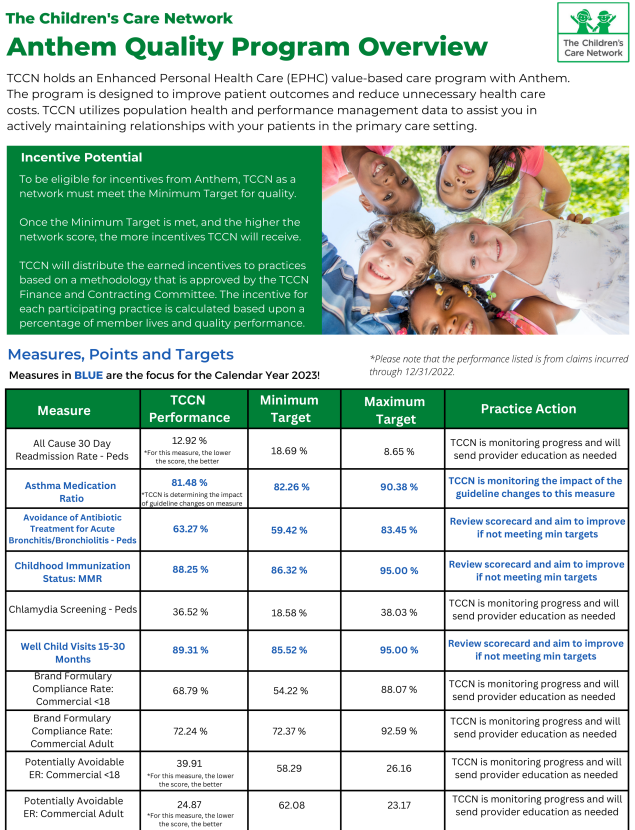
Anthem Quality Program 2023
Thank you all again for your continued hard work over the past two years. With your help, we have seen significant success throughout our participation in the Anthem Quality Program. In 2021, TCCN received incentive distributions as a result of meeting network quality performance metrics. At this time, we are waiting on Anthem to send our final performance metrics for 2022. As soon as this information is received, we will be sure to send an updated communication sharing our wins for the previous year!
Highlight: Please keep up the improvement and thank you for your continued support!
Let’s keep building on our success! For 2023, we have updated the Anthem program flyer with more details about the measures and potential for incentive payments. We will send out updated versions of the flyer every two months to reflect our current network performance. At the end of this month, you can also expect to see updated measure definition sheets, which outlines the parameters and coding requirements of each measure along with additional resources to help you. These resources are currently being reviewed by specialists in the area to ensure we have the most up-to-date information and guidelines to share with you.
For this year, we will be sharing measure scorecards bi-monthly for these Anthem measures of focus:
As an added reference tool, we are also sharing the measure scorecard for Chlamydia Screening. Although this is not currently a measure of focus, we realize it is an important measure that many practices may want to evaluate their performance with their peers.
Read More Here
| |
DEI-Focused Clinical Quality Forum Recording
| |
Thank you to everyone who attended our virtual Clinical Quality Forum. We had 140 attendees, which is one of our highest turnouts and a great start to our programming for the year!
If you were not able to attend live, we highly encourage you to watch the recording and complete the attestation via this link or the QR code to receive your TCCN participation credit.
The recording is roughly 1 hour. If you attended live, there is no further action needed for your practice to receive credit. One least one provider from each practice must view this program or the upcoming Fall Clinical Quality Forum. In addition, each practice must view the short DEI educational video that was at the beginning of the module, so your participation for this program will fulfill two of your 2023 requirements.
| | |
We are excited to build on last year’s momentum as we launch the 2023 TCCN Quality Program. We will continue to renew our commitment to excellence by focusing on moving the needle forward on quality improvement outcomes. Our network objectives for this year are to improve well child visit compliance rates, appropriate treatment for asthmatics, and appropriate screenings.
This year, we are asking that all practices commit to quality improvement activities listed on the required practice attestation which will need to be completed ASAP.
Click here to read the full communication
| | Reminder: 2-Week Data Submission Requirement | |
The Summer season is in full swing! But even as we continue through this busy season, please don't forget to submit your claims data through CorePoint! As previously communicated, all primary care practices are required to submit claims within 14 calendar days so that we can maintain accurate data to drive our programming and demonstrate the great quality of our practices.
We wish you all a safe and happy summer season and thank you for all you have done so far this year!
| | Continuous Education & Resources | | TCCN Antibiotic Stewardship Webinar: Why It's Important For Your Practice and Patients | |
Join us on August 16 at 12:30 pm as we continue our 3-part virtual series 'Antibiotic Stewardship: Why it's Important for Your Practice and Patients'.
This lunchtime series presents the new Georgia Pediatric Antibiotic Stewardship website, gpas-online.org, designed to help you in your busy practices with guidelines and a new antibiogram visualization tool.
Webinar #2: August 16, 12:30-1:30
Please be sure to register in advance to receive the meeting link. Same-day registrations may experience issues with logging on.
If you missed it, click here to watch
Webinar #1: How to Access and Use the Website
Save the dates for upcoming webinars:
Webinar #3: November 1: Antibiotic Dosing
| | TCCN Seizure Action Plan Video and Resources | |
TCCN member group, Children’s Neurology, has been awarded a 1998 Society grant for a quality improvement project aimed to reduce emergency department visits and hospitalizations for patients with breakthrough seizures. Read more here.
TCCN has developed the following video in support of this grant. The video provides an overview of the self-management education and resources provided to patients and families as well as coordination of care documents for providers and how to locate them in accessCHOA. Teaching sheets utilized by the neurology team are also included.
| | |
Resources:
For questions about the Seizure Action Plan video or resources, please contact Melissa Yeager at melissa.yeager@choa.org.
| |
TCCN Allergy Resource Now Available
At the Spring 2022 Clinical Quality Forum, The Children’s Care Network, in collaboration with CPG Allergy and Immunology launched a symposium on the topic of appropriate allergy testing and referrals. This education discussed the causes and management of eczema and its relationship to food allergies.
The good news is that in recent years we have seen increased awareness around childhood allergy testing and the potential link between food related allergies and other inflammatory diseases. Unfortunately, the bad news is that there is still a lot of confusion and contradictory information out there regarding this topic. Childhood allergies- especially food allergies, continue to be a problem that affects a large number of families in our pediatric communities.
With help from our partners at CPG Allergy and Immunology and Childrens, we have created a list of resources that includes the latest developments and guidance on childhood allergy testing. The links below includes videos, tools, and written materials aimed at both providers as well as patients and their families. We plan to update these resources frequently with updated information to keep it current with the latest guidance.
Check out these resources included below:
We would love to hear your feedback on this resource as we plan for future updates. As always, thank you for your continued support.
If you have any questions or concerns, please message us at contact@tccn-choa.org.
| | |
In Case You Missed It (please use the links below to review)
TCCN Requirements
TCCN Resources
Community Updates
|
| |
|
The Children's Care Network
Phone: 404-785-0101 l Visit us at www.tccn-choa.org
Please add contact@tccn-choa.org to your list of trusted senders
"Great pediatric doctors and leading children's hospitals improving healthcare and the health of our children, because our children deserve it!"
|
| | | |