Message from the Director | |
| |  |
Greetings Friends and Supporters of Willard,
Willard House & Clock Museum celebrated through the close of its 50 Anniversary and now looks forward to The Next 50 Years. How the world will look in the next half-century is pretty much a mystery, but the museum will surely keep up with the times. Future plans include continued care for our historic site, homestead, and workshop with an eye towards how best to expand our campus to accommodate our vision. Many needs are on the list including significant additional exhibition space for an important promised gift along with related infrastructure like proper collection storage to allow changing exhibitions, expanded conservation area for museum and student work, and re-designed accessibility throughout to guarantee an improved experience for everyone.
We already have the basic ingredients to make Willard a center for all things horological: a preeminent collection of Willard clocks, the historic homestead and shop on 52 acres of land, 46 of which were actually owned by the Willards, an important research library growing larger every day, and most importantly, an ever-expanding group of supporters, like you who believe in what we do.
Launching Our Most Ambitious Fundraiser on Record - The Next 50
Years Campaign.
The first of several steps towards this goal was the launch of 2023 Annual Appeal - The Next 50 Years. This is our first fundraiser for the year and our goal is to raise $75,000. The money goes toward our operating budget so that we can keep the lights on, bring in new programming and pay for our staff. As we move to phase two, our emphasis will be the future, our endowment. Our endowment is the engine to supply income for special projects and education. Thanks to you, we are on the way. Thank You!
| |
Phase 1 of the WHCM Refresh is Done.
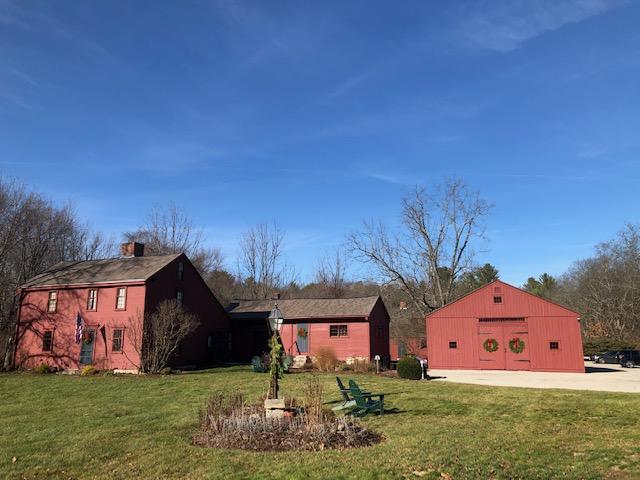
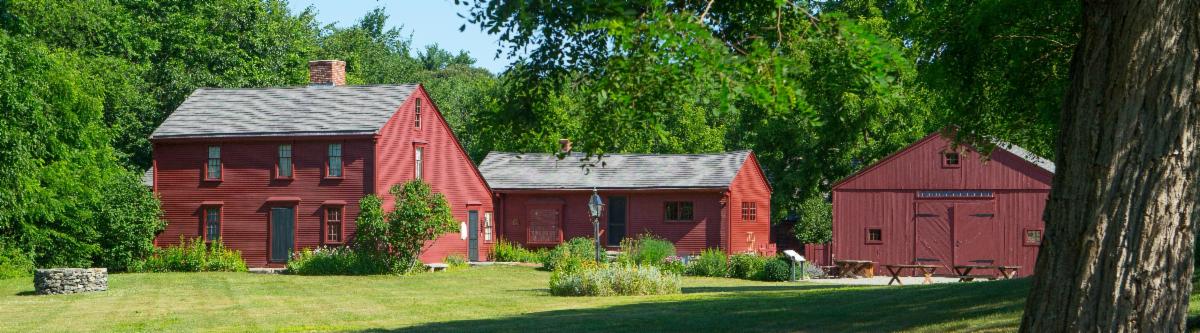
After nearly eight weeks of painstaking hand-scraping, repair and painting work, the south and east facing sides of of the main buildings got a a fresh face. We are grateful to our grant providers. This is only phase 1. Next year, hopefully we can get to the far less compromised north and west sides of these structures.
| |
The First David G. Gow Scholarship Recipient
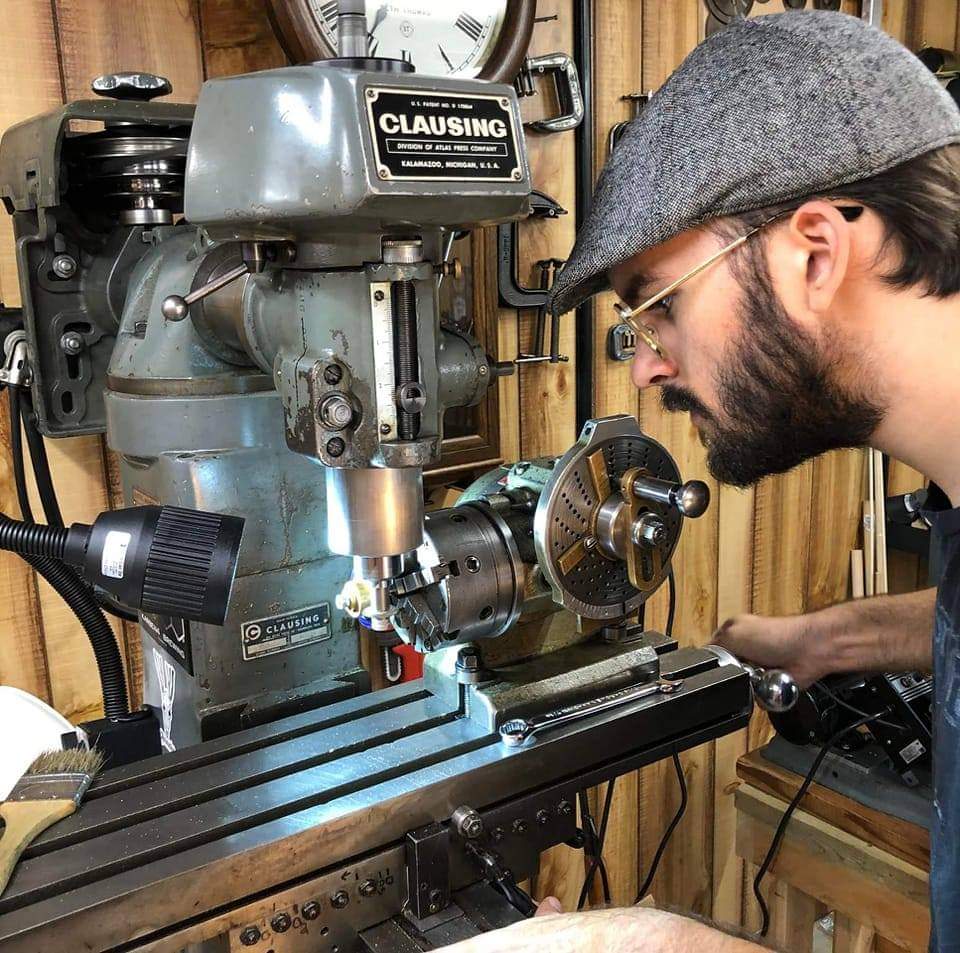
Willard and the Gow family were very pleased to announce the first recipient of the David G. Gow Memorial Scholarship for Horological Education. Twenty-one year old Parker Boughton of Des Moines, IA was chosen from a group of over 20 applicants to receive $5,000 to get a start on a career in professional clock conservation. Applications for 2023 are due November 4th, 2023 and the award will be presented on December 14th. Click HERE for additional information. Congratulations Parker!
| |
Featuring a New Guest Writer.
We have a new guest contributor to the Research Corner - Katharine F. Grant presently living in Nashville, TN. Katie is a recent graduate of the masters degree program at Winterthur Museum and Gardens in Winterthur, Delaware and serves on the Board of Trustees at Willard. In the Research Corner she gives us some details about the role that chronometers play in navigation.
| |
Reaching Out to a Variety of Audiences and Growing Partnerships.
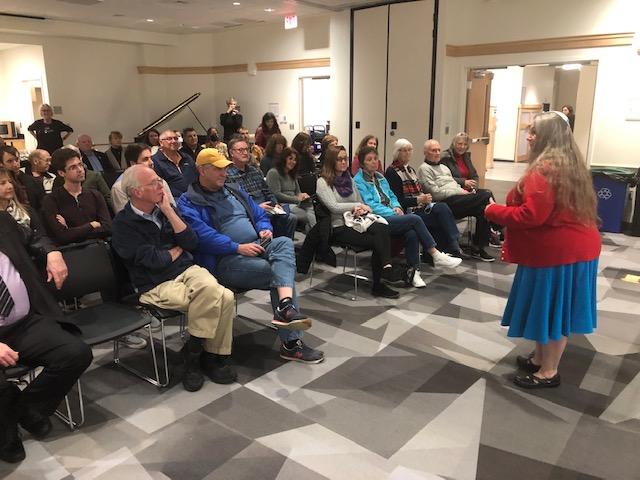
Willard House & Clock Museum - 50 Years of Collecting Excellence was presented by Director Robert C. Cheney to a full house at the newly expanded Grafton Public Library on November 14th.
Supporting an expanded partnership with the library, the museum provided a long-term loan of a Benjamin Willard clock. The clock is featured in the library's Historic Reading Room and provides beautiful chimes every hour on the hour. The clock was installed and featured as an important part of the library as the Willard family and its clocks were integral to Grafton. The story is even better as library visitors (totaling in the tens of thousands, annually!) can admire the Benjamin Willard clock in the reading room and see an Aaron Willard steeple clock just outside of the reading room windows.
| |
Why Horolology Matters
Horology has been a neglected science throughout our schooling yet it is perhaps the most important of the sciences for the development of our modern world. Virtually every important discovery you can think of depends on horology. David Rooney the esteemed historian of horology went further to say, "A History of clocks is a history of civilization". This places the four Willard brothers in a completely different context, certainly an American story worthy of your support.
The future is our challenge and the future is now.
Thank you for your continued support and a great-big thank you for any additional support you can offer. Our task here is an important one.
Sincerely,
| |
Reading Corner
A New Masterwork from Paul J. Foley
| |
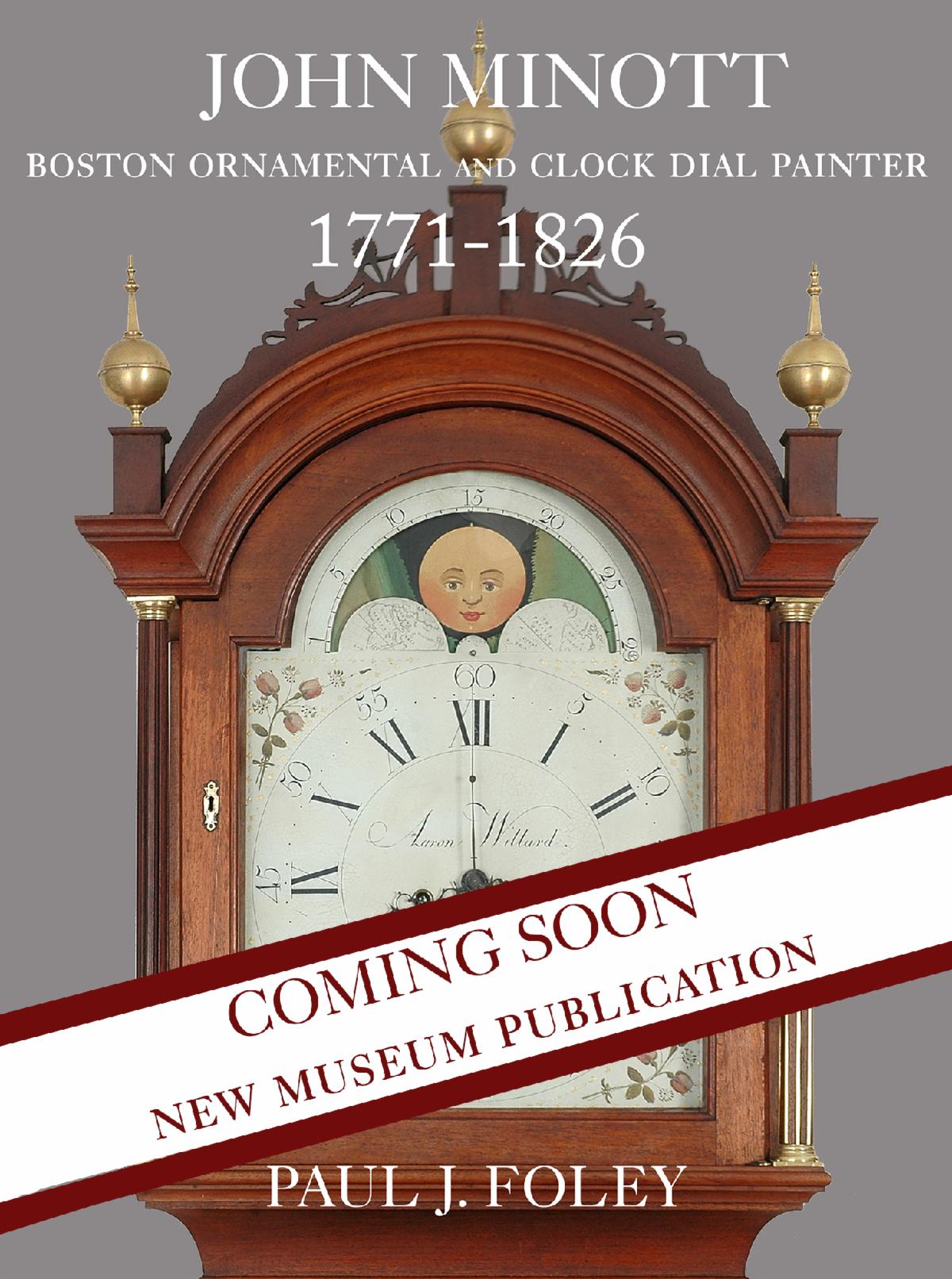
Paul Foley has done it again! In this monograph, Paul closes the book on John Minott of Boston, one of the important circle of ornamental painters who painted dials for Willard's eight-day clocks. Paul has catalogued Minott dials for 30-years, and painstakingly recorded and photographed the important details.
The serious student now has the added details necessary to provide important historical connections between clockmaker and a local prolific dial artist. A great read and eye-candy photography! (RCC)
Published soon by Willard House and Clock Museum. Check our website.
| |
Research Corner
Special Contributor, Katherine F. Grant
| |
"Marine Chronometers
and their Grafton Ties"
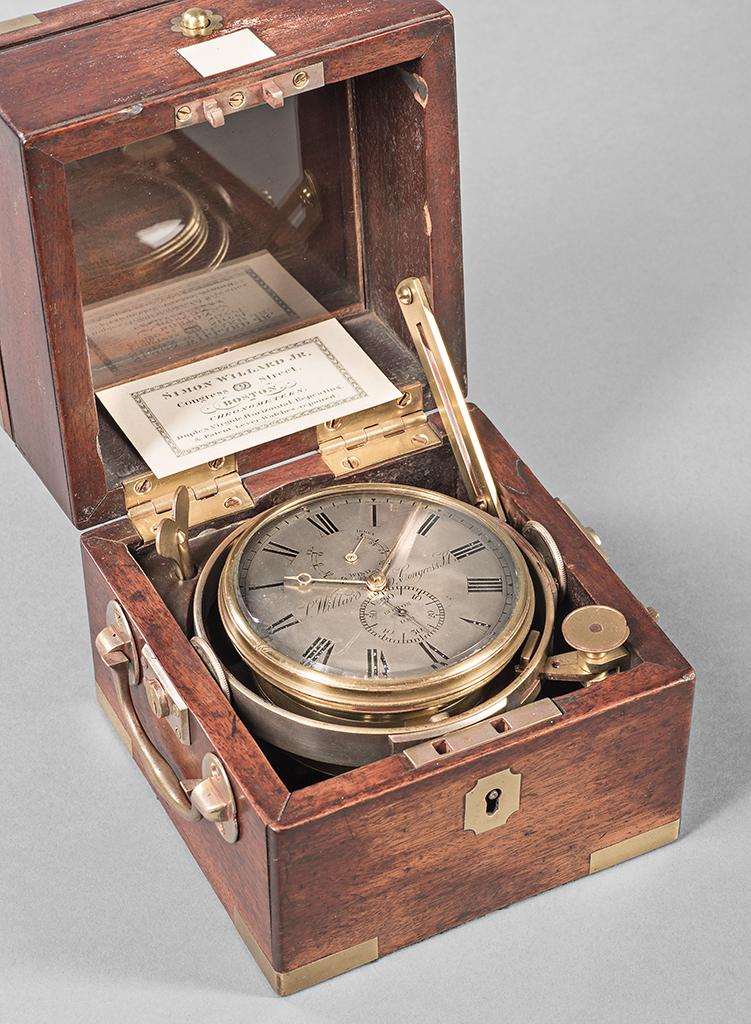
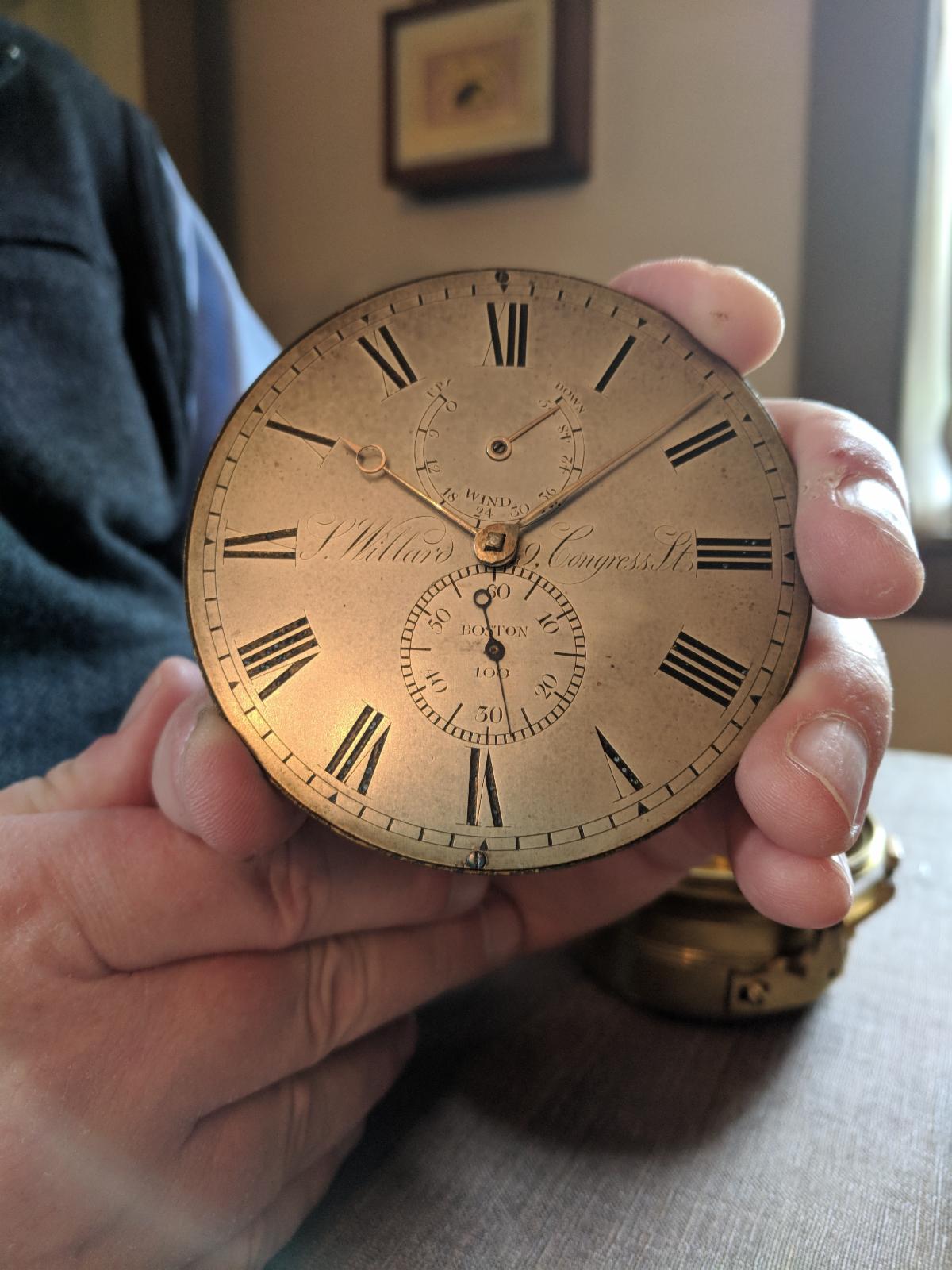
| | My first experience at Willard was for maritime purposes—strange, I know, considering that we are located in Central Massachusetts. I was just beginning thesis research for my Masters degree at the Winterthur Program in American Material Culture, and I needed help from a timekeeping expert and friend. When I told Robert Cheney I was determined to research marine chronometers in 19th -century America, he insisted I come see him at Willard and make sure I learned the basics—using a marine chronometer made by Simon Willard, Jr. himself. My confusion did not last long once I recalled the Willards’ Boston, and therefore maritime, connections. | | Simon Willard, Jr. Marine Chronometer | |
Before the marine chronometer, mariners had a variety of tools they could use to approximate their location on the open ocean. Devices like quadrants, sextants, and octants enabled sailors to measure the altitude of a star from the horizon line.[1] These observations were then incorporated into calculations for the ship’s latitude, or North-South, position. The results of these mathematics were plotted on charts to track the ship’s movement in relation to celestial bodies and the North or South Pole.[2] However, none of these tools gave mariners their longitudinal, or East-West, position. Logs and lines gave sailors the ship’s approximate speed, and the use of a compass provided the ship’s general direction.[3] Called “dead reckoning,” this method supposedly allowed sailors to approximate the ship’s longitude for centuries.[4] Unfortunately, it was an inexact process that often did the opposite, leading ships farther from their destination.
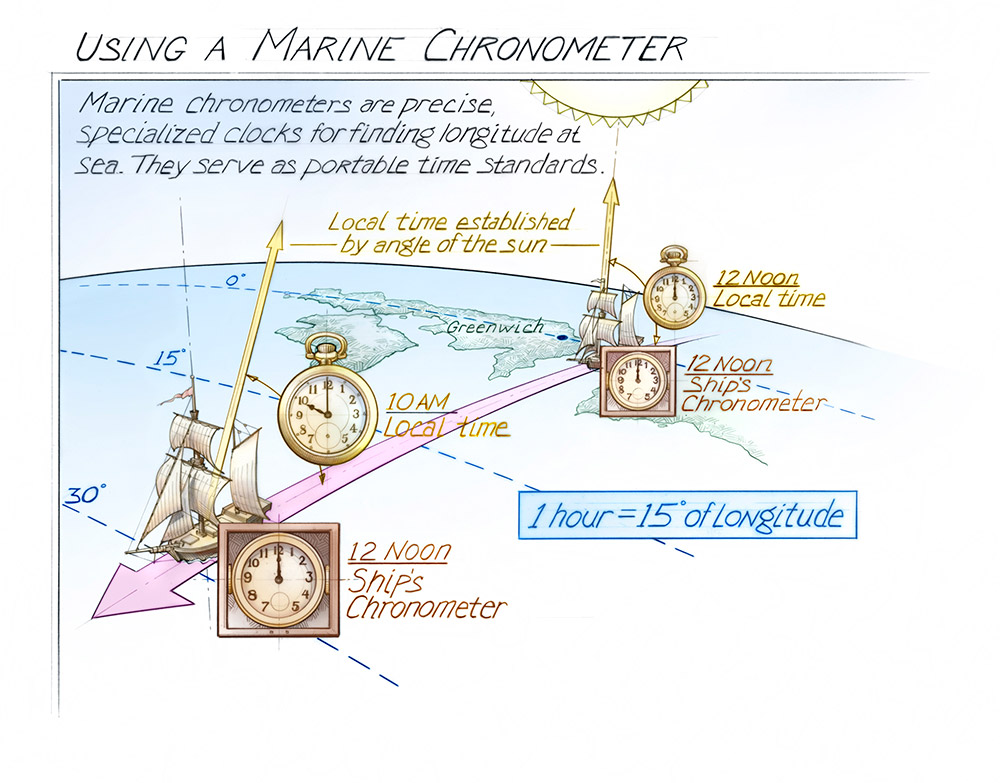
John Harrison, a British eighteenth-century clockmaker, is credited with proving that timekeeping could solve this longitudinal problem.[1] By taking readings of the time at a specific reference point on land, mariners could calculate their distance from that location and better understand the ship’s East-West position. Marine chronometers provided accurate timekeeping for this practice. By comparing the local time—found through celestial observation—with the reference point’s time as shown on the chronometer, mariners could understand their ships’ locations on the open ocean in three-dimensional reality. Marine chronometers were crucial to mariners’ wayfinding capabilities because of their accuracy, but they were only effective when used with this host of other astronomical instruments.
| |
“Using a Marine Chronometer” graphic which demonstrates how a marine chronometer was an integral tool in finding one’s location on the open ocean. Image from Time and Navigation, an exhibition at the National Air and Space Museum. Courtesy Smithsonian National Air and Space Museum (NASM9A11818).
The nineteenth-century adoption of marine chronometers by American naval and
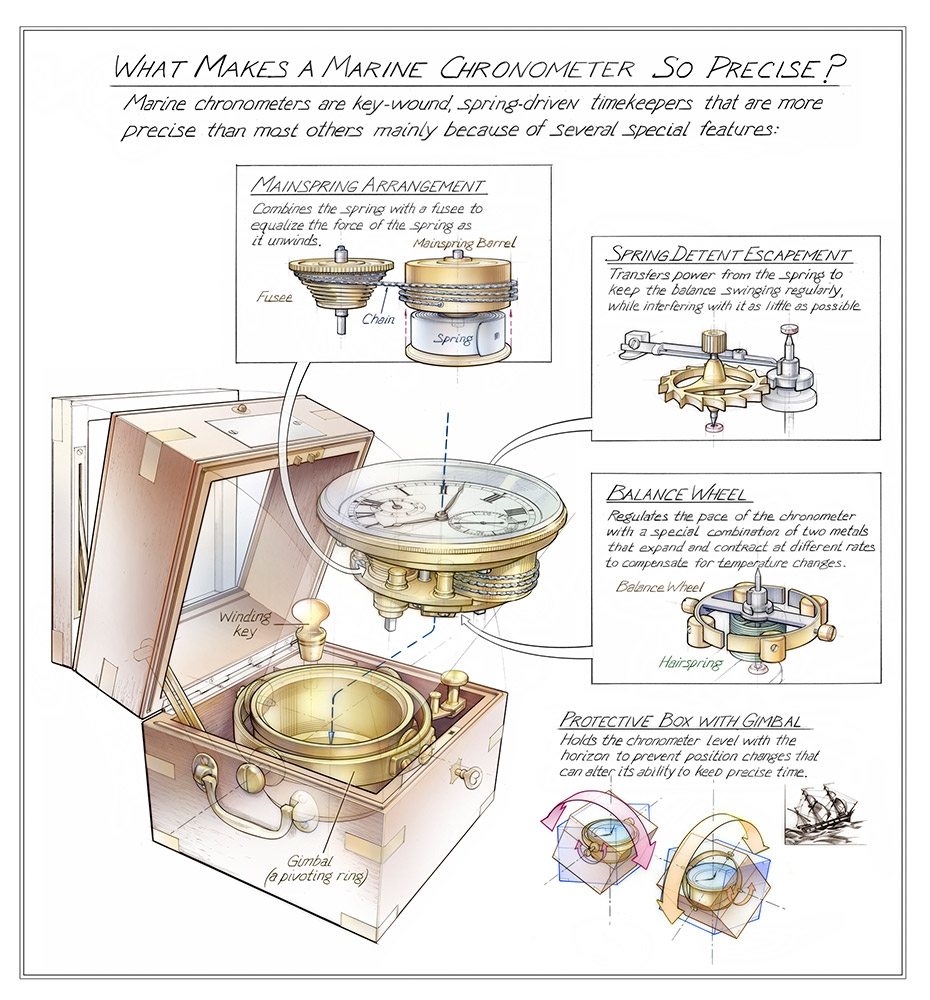
merchant vessels made travel on the open ocean safer and faster. However, marine chronometers required extensive inspections and routine winding during use at sea. To maintain their accuracy, these intricate clocks relied on highly skilled mariners who counted on these objects both as timekeepers and global positioning systems. However, mariners could not care for these instruments alone. They needed skilled craftspeople on land to complete regular cleanings and occasional repairs.
| |
“What Makes a Chronometer so Precise?” graphic which explains the key features of a marine chronometer. Image from Time and Navigation, an exhibition at the Smithsonian National Air and Space Museum. Courtesy Smithsonian National Air and Space Museum (NASM9A11805).
Simon Willard, Jr. was one of these experts. The marine chronometer trade in the United States began in Boston itself in the 1810s, and by the mid-19-th century Willard was one of the few favored clockmakers in the city who mariners trusted to help maintain these instruments. In addition to the many beautiful eight-day clocks and timepieces in the collection at Willard House and Clock Museum, we are fortunate to have one of Willard’s marine chronometers: dial engraved and in what we believe to be its original case, the chronometer provides a unique foil to the “landlubber” timepieces throughout the house and gallery.
For better or worse, by 1864 all of Boston’s—and Willard’s—chronometer business had changed. The United States Navy had officially adopted chronometers and signed contracts with multiple chronometer makers to help build exclusively American-made instruments and maintain the fleet’s set. As Willard utilized English-made movements and components that were a more consistent quality at that time, his firm was ineligible for the Navy commission. Nevertheless, Willard continued to provide repair and maintenance services for marine chronometers on private and mercantile vessels.
| |
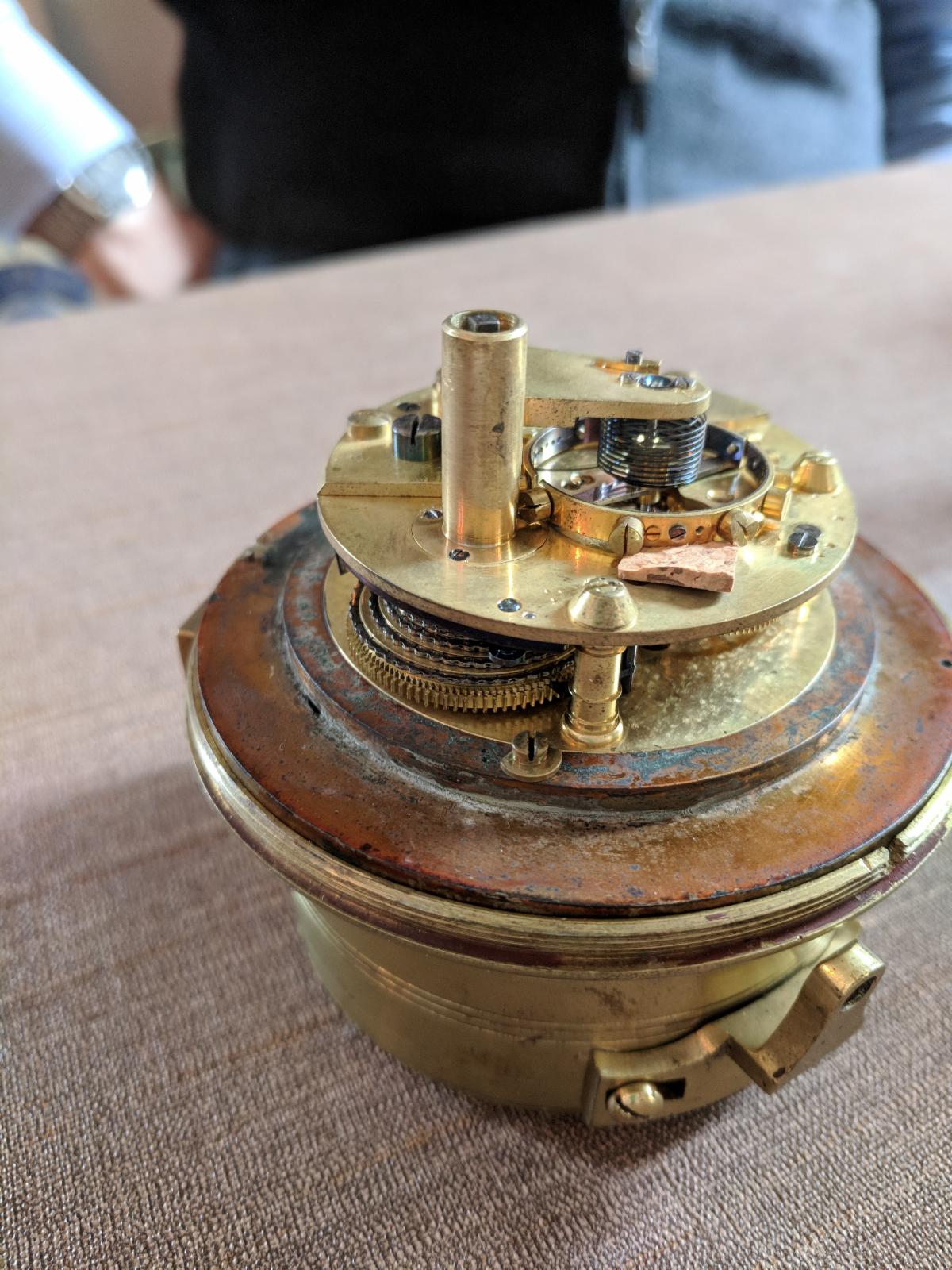
The interior of Simon Willard's marine chronometer at Willard House and Clock Museum, showing balance wheel and helical hair spring held in place by a small piece of cork--a means of protecting the delicate balance pivots while the movement is at rest.
We have so many gems in the collection at Willard House and Clock Museum, but Simon Willard’s chronometer may be my favorite. It is one of the few obvious links to the Willards’ maritime expertise and their role in American navigation. Almost 40 miles west of Boston, our wonderful historic house and museum contains vital pieces of our seafaring history that are worthy of both further protection and research.
| |
[1] M.V. Brewington, The Peabody Museum Collection of Navigating Instruments, with Notes on Their Makers (Salem: Peabody Museum, 1963), 3.
[2] For instructions and practice problems in calculating latitude, see Nathaniel Bowditch, The New American Practical Navigator, 8th ed. (New York: E. & G.W. Blunt, 1836).
[3] “Logs” were blocks of wood tied at designated intervals along a rope, or “line.” The speed at which the logs disappeared beneath the ocean as the user released the line gave “knots,” or the approximate speed of the vessel.
[4] Dava Sobel and William J. H Andrewes, The Illustrated Longitude (New York: Walker, 1998), 18.
[5] Dava Sobel and William J. H Andrewes, The Illustrated Longitude (New York: Walker, 1998), 21.
| |
Museum Winter Hours:
Open Thursday- Saturday
Tours: 10:30am and 2:00pm
Large groups by appointment only
Sunday - Wednesday and
all national holidays: Closed
| |  |
Museum Fees:
Members FREE
Adults $10
Seniors 60+ $9
Kids 13 plus: $6
Kids 12 and under: FREE
Veterans and First Responders: FREE
| | |
Thank You
Sponsors and Donors
The Willard House and Clock Museum is very grateful for the generous support of the following corporate and personal donors. At Willard, we try very hard to maintain a high level of programming throughout the year and without outside support, this would not be possible.
If you or your business wishes to support the programs, donations of any size are welcomed and go to continued and new events here at Willard.
|
If you would like to learn more about special events or customized corporate or foundation programming, please contact: Robert@willardhouse.org Thank you.
|
Corporate Sponsors
Annie’s Garden
Fuller Foundation
Country Bank
Post Road Art Center
Wegmans
United Airlines
Partners
Corporate Donors
Clock Folks of New England
Gaudette Insurance Agency
Fuller Foundation
Savers Bank
Sandra Liotus Lighting Design, LLC
Schmitt Horan & Company
Thomas J. Woods Insurance Agency
Wellfleet Osprey Photography
Worcester Sound & Lights
Wegmans
Exhibition Donors: Musical Clocks
David Croll
James & Marylou Hawkes
Edward W. Kane & Martha Wallace
John & Marjorie McGraw
Scott R. Talkington
NAWCC Chapter Donors: $500
Chapter 3 Chicagoland
Chapter 8 New England
Chapter 28 Lake Erie
Chapter 83 Peace Pipe
Chapter 133 Western Electric
| |
Donors
Life Members $500 +
| |
Robert Ain
Wayne & Susan Andrews
William Anderson
Mildred Bean **
Gordon Bethune
Marie Bender
Larry** & Betty Chelmow
Denise & Robert C. Cheney
Fred Clough
Raymond Cobb
David Croll
Dana Cranmer
Mark & Dianne Davidson
Dana Davignon Jr.
David DeGhetto
Nancy Druckman
Jeremy Dubois
James Dutton
Karen Eisenhauer
Kenneth & Patricia Elovitz
Ralph Fletcher
William & Joyce Fletcher
Paul J. Foley
Bruce Forman
Michael Friedman
Robert Frishman & Jeanne Schinto
George Goolsby
David** & Barbara Gow
Charles N. Grichar
Claire & Jay Haggerty
Donald Hare
James & Marylou Hawkes
Robert Hendrickson
Ken Hogwood
Dr. Wayne Hooper
Howard Hyle
Randi Isaacson
Edward W. Kane & Martha Wallace
Judith King
Matthew & Anna Keiter
| |
William Kerr
Matthew Koskinen
Sandra Liotus
Albert MacDonald
William Miller
Richard Newman
David Newsom **
Bernice Norton **
Albert & Barbara MacDonald
Sean & Anne Margaret Padgett
Natalia Pavlova
Diana Pearson
Ralph Pokluda
Mark Purdy
Arthur Richmond
David & Susan Roberts
Lee & Jane Robinson
Dr. Roger & Imogene Robinson **
Ralph Robinson
William & Karen Robinson
Ann Sargent
Bradford Schlapak
Terry Seaks
Janet Spanknebel
Joseph Seremeth
John Stephens
Gary Sullivan
Marie Bender
Scott Talkington
Dr. James L. Telfer
Gerald Tiemens
Sumner Tilton
Gilbert Tyler
Greg Wilde
David Willard
Peter & Shirley Williams
George Whitman
John Wood
Peter Wunch
Dean Ziegenbien
**Deceased
| |
Clocks For Kids Program Donors
David Hagberg
Richard Saul
Steven Sandborn
Granite State Timekeepers, Chapter 189, NAWCC
************
Museum Staff
Robert Gierschick - Development Director
Beverly Snow - Program Coordinator
David Gow** - Conservator
Anna Keiter - Finance Manager
Sarah Mullen - Administrative Assistant
Natalia Pavlova - Registrar
**Deceased
Board of Trustees
Dr. Wayne Andrews - President
Sumner Tilton, Jr. - Vice-President
Charles N. Grichar - Treasurer
Robert C. Cheney
Ralph Fletcher
Paul J. Foley
Katherine F. Grant
Sandra Liotus
Jane Robinson
Lee Robinson
Gary Sullivan
Dr. James L. Telfer
Trustees Emeritus
Larry Chelmow**
Richard Currier
Arthur Richmond
John Losch
Advisory Board
Susan Bastian
Robert C. Cheney
Louis F. Genatossio
Robert Gierschick
Tim Kness
Sandra Liotus
Dave Myers
**Deceased
| |
Please support the historically important
Willard House & Clock Museum
-The Center of Early American Clockmaking-
WHCM is a 501(c)(3) non-profit museum
| | | | |