|
October 2022
In this issue:
- The SOFIA/EXES Mid-IR High Spectral Resolution Library
- Signatures of AGN Feedback: The Post-SOFIA Era
- Onboard SOFIA's Last Flight
- Join Science Talks Remotely
|
|
The SOFIA/EXES Mid-IR High Spectral Resolution Library
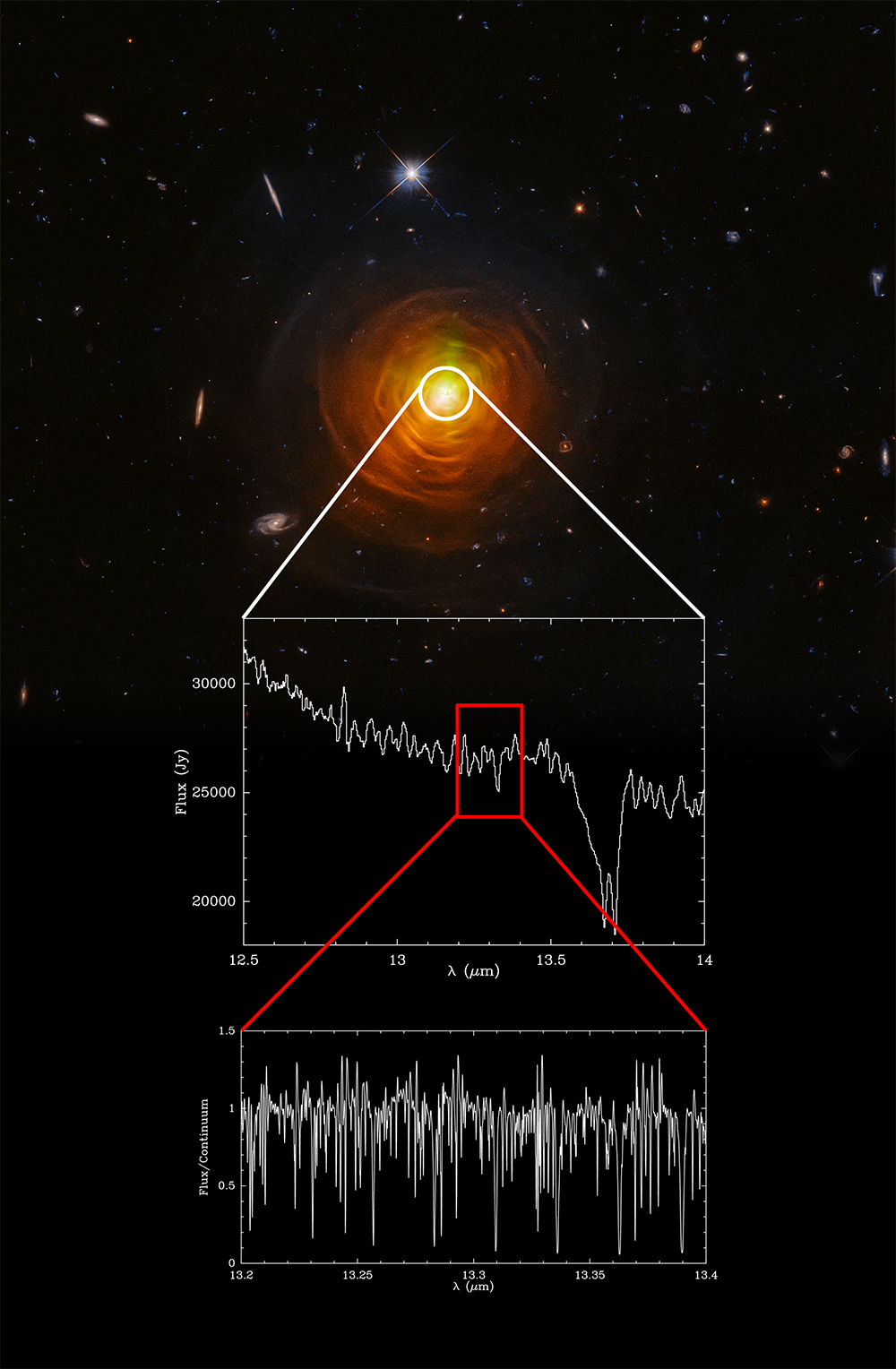
The sensitive, powerful instruments of JWST are already unveiling previously hidden astrophysical mysteries, but the science might be limited by the relatively low spectral resolution. In this respect, the EXES instrument on SOFIA is a valued partner for JWST. Its high-spectral resolution spectroscopy can separate the lines of the vibrational bands and reveal the weak signals of low-abundance molecules that would otherwise be hidden among a forest of stronger lines from other species.
The EXES Legacy program was designed to create a library of these weaker lines so they could be incorporated into the JWST spectral fitting software, substantially enhancing the scientific value of the JWST molecular observations. The program was tailored to include the three most promising sources over most of the mid-infrared range (from 5 to 28 µm) with a spectral resolution better than 6 km/s.: the hot cores NGC 7538 IRS1 and AFGL 2136, as well as the asymptotic giant branch star IRC+10216.
A detailed analysis of the thousands of molecular lines in the observed spectral range is on-going. Many lines, primarily beyond 7 µm, show P-Cygni profiles (features with emission and absorption components) that belong to low-excitation, vibrational bands of the so-called parent molecules that form at the stellar photosphere or very close to it. The rest of the lines are seen only in absorption and are either produced by molecules that form in the intermediate and outer layers of the envelope, or are lines of highly excited vibrational bands.
All calibrated data are available in the IRSA SOFIA Archive, mostly under project ID 75_0106, with complementary data under project IDs 05_0041, 06_0117 and 75_0024. Read more.
| | Hubble Space Telescope image of IRC+10216 together with a small portion of the SOFIA/EXES high-resolution spectrum around 13.3 µm. The low-resolution spectrum taken with the Infrared Space Observatory is similar to the results expected from JWST. Credits: ESA/Hubble, NASA, and Toshiya Ueta (University of Denver), Hyosun Kim (KASI); Cernicharo et al., 1999; Montiel et al. (in prep); Fonfría et al (in prep) | |
Thursday, October 20 2022
7:30 - 11:30am PDT
The main goal of this free online workshop is to present recent impactful observational results on AGN feedback from IR observations in particular from SOFIA, and to offer the opportunity for AGN observers to discuss the current status and future approaches for IR AGN research. Six talks will cover topics such as recent advances in MHD modeling, galactic winds, shocks and turbulence, magnetic field structure, and AGN-induced star formation. A panel discussion will focus on the role of IR studies in the current observational landscape.
Confirmed speakers:
Kung-Yi Su (Harvard)
Dario Fadda (SOFIA)
Allison Kirkpatrick (Kansas)
Enrique Lopez Rodriguez (Stanford)
Mark Morris (UCLA)
Sylvain Veilleux (UMD)
Confirmed panelists:
Mark Lacy (NRAO)
Allison Kirkpatrick (Kansas)
Chris Packham (UTSA)
Lauranne Lanz (TCNJ)
Lee Armus (IPAC/Caltech)
| |
Onboard SOFIA's Last Flight
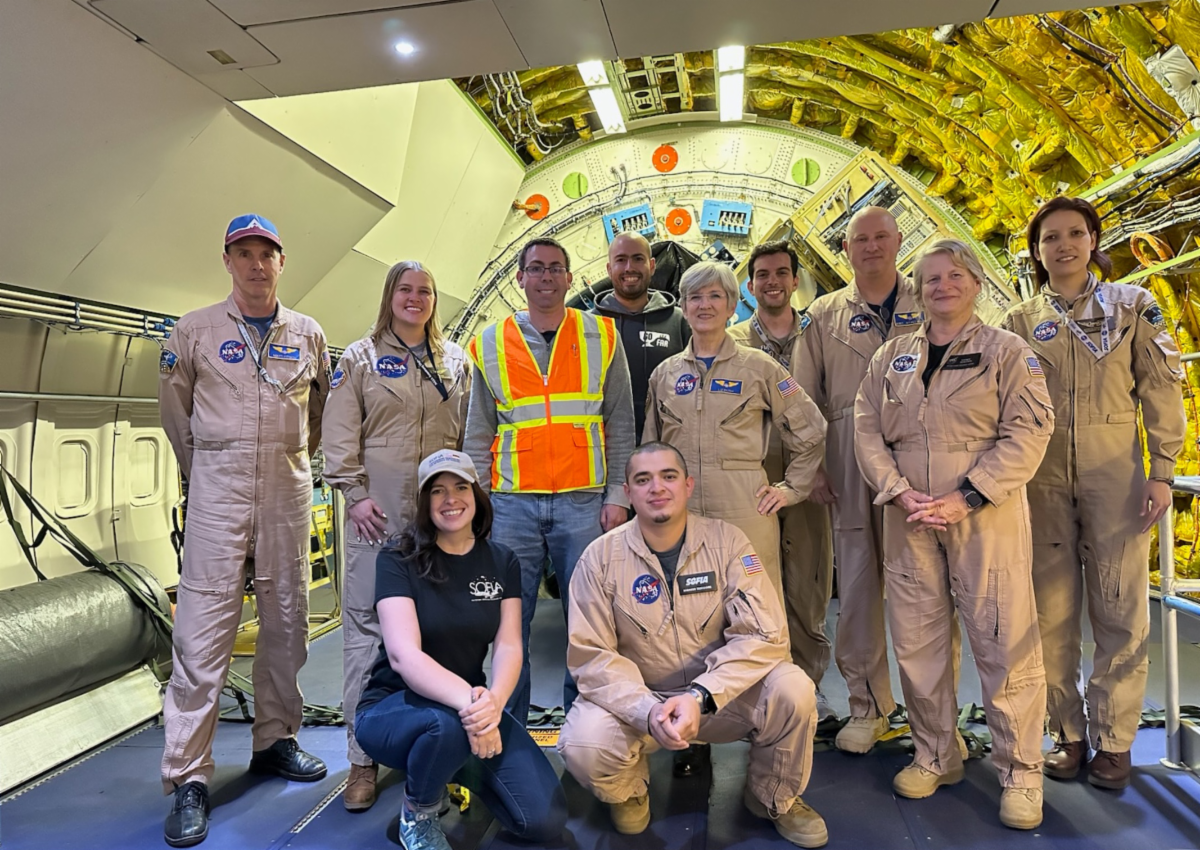
On Thursday, September 29th, SOFIA landed its final science flight - flight #921. This was a very productive final HAWC+ flight, collecting data for two legacy surveys, a testament to the work of maintenance, engineering and software teams. This successful flight over the Pacific was an amazing way to bookend SOFIA science flights with perfect planning and operation. | |
Flight crew members of FT920. Credit: E. Bevins, SOFIA/USRA.
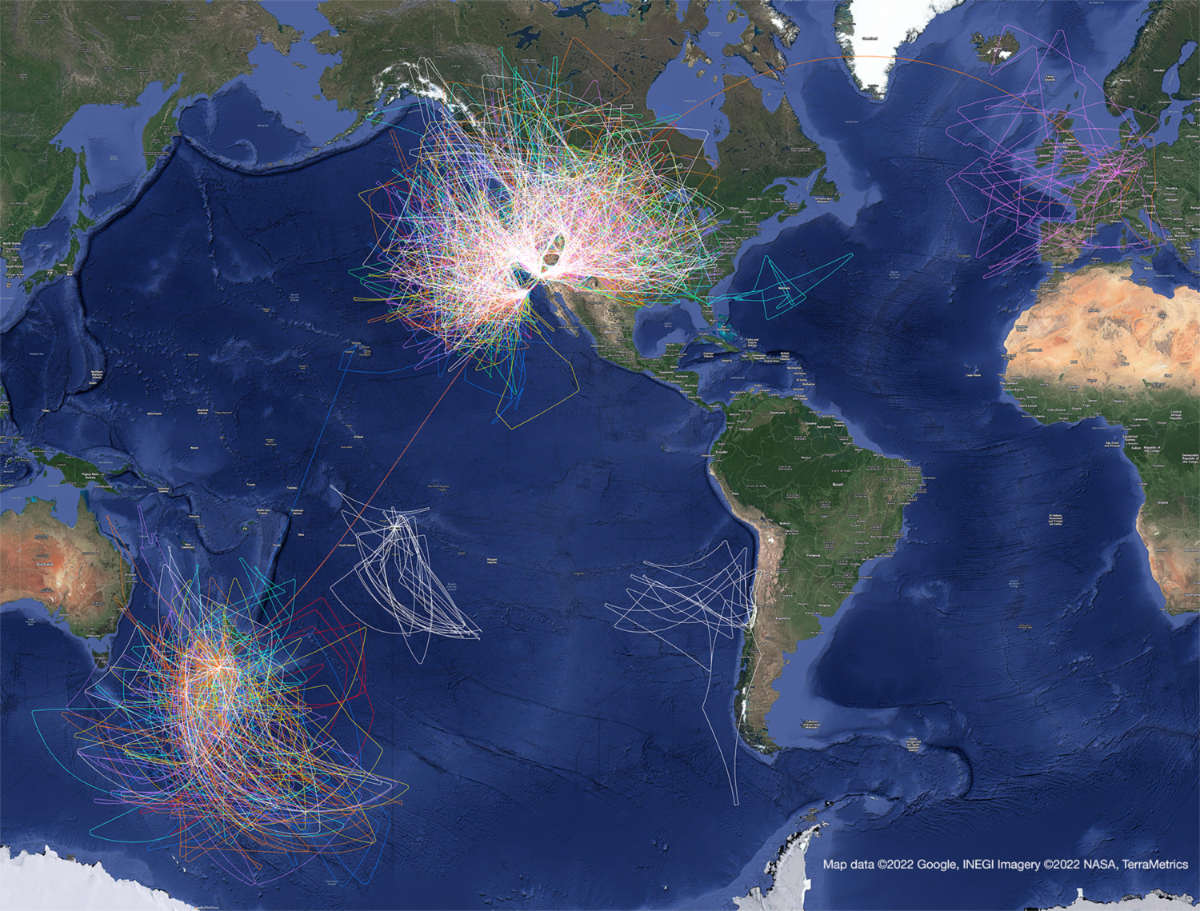
| | This map shows the paths of all of SOFIA’s science flights from 2013 to 2022, totaling 732 nights of observations, color coded by observation cycle. These include flights out of its home base at NASA’s Armstrong Flight Research Center in Palmdale, California as well as regular deployments to the Southern Hemisphere and deployments to Germany. Credit: Map data ©2022 Google, INEGI Imagery ©2022 NASA, TerraMetrics | |
Join Science Talks Remotely: Tele-Talks
Tele-Talks are scientific presentations given via phone, with slides distributed ahead of time. The talks are held approximately twice a month on Wednesdays at 9:00 a.m. Pacific, noon Eastern. For information on how to participate, check SOFIA Tele-Talk webpage.
Upcoming Tele-Talks
-
October 19: Casey Honniball (NASA GSFC); Recent Results of Lunar 6 µm SOFIA Observations and a Very Preliminary Look Into the VIPER Landing Site
- October 26: Andre Beck (University of Stuttgart, DSI); Infrared View of the Multiphase Interstellar Medium in NGC 253
- November 2: Jeremy Chastenet (Ghent University); FIR Polarization and Dust Properties in the Crab Nebula
- November 9: Pak-Shing Li (UC Berkeley); Role of Magnetic Fields in Stability and Fragmentation of Molecular Clouds
- December 14: Lars Bonne (SOFIA Science Center); Dynamics and Mass Ejection in RCW36
| | |