|
August 2022
In this issue:
- Deuterated Hydroxyl as a Star Formation Tracer
- Featured Public Archival Data: Using ISM Structure to Constrain the Origin of the Anomalous Microwave Emission
- Southern Deployment in New Zealand
- Southern Lights from SOFIA in APOD
- SOFIA Archival Research Program Proposals Selected
- Join Science Talks Remotely
|
|
Deuterated Hydroxyl as a Star Formation Tracer
Water is one of the most important molecules in the processes that govern star and planet formation. Although the relative importance of its creation and destruction mechanisms in the interstellar medium are still debated, the large water content of the Earth’s atmosphere limit direct measurements of its abundance variations. Fortunately, observations of the hydroxyl radical, OH, can constrain chemical pathways leading to the production of the water molecule. In addition, tracing the deuterated form, OD, can place constraints on the chemical formation routes by measuring the quantity of the enhancement of deuterium-containing molecules in the star-forming gas.
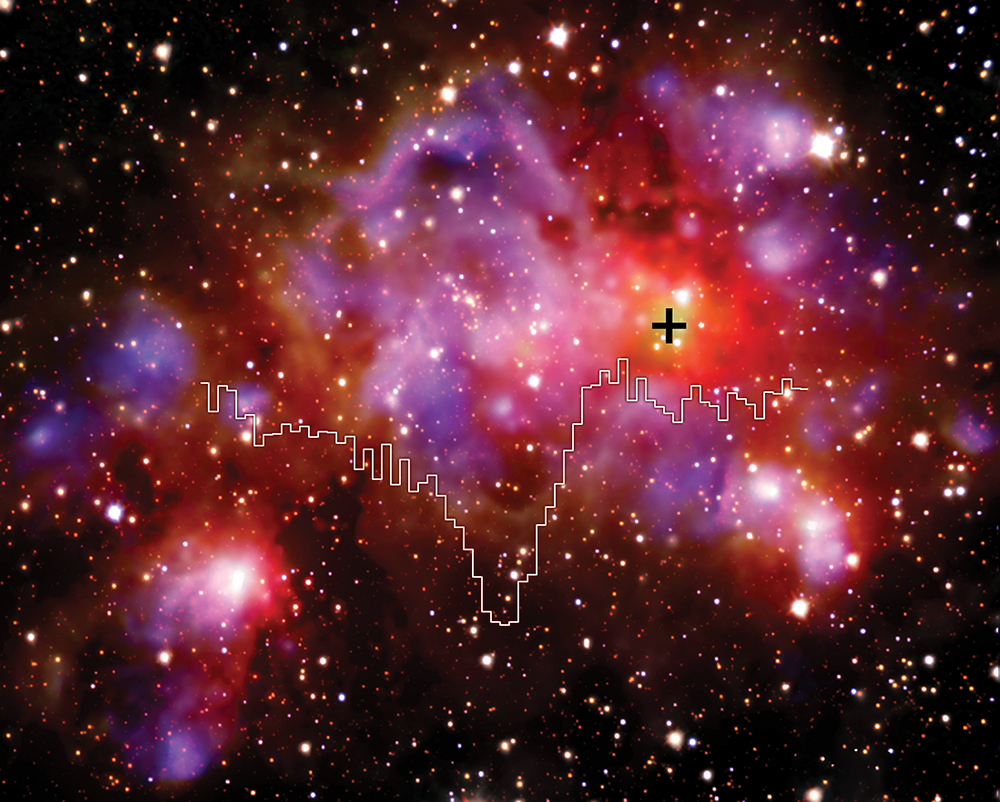
Rotational transitions from the OH and OD molecules lie in the THz band and can be probed with the German Receiver for Astronomy at Terahertz Frequencies (GREAT) instrument onboard SOFIA. A team led by T. Csengeri studied 13 new OD detections toward a wide variety of galactic targets, including cold quiescent clouds as well as more evolved regions with ionizing OB type stars. OD was identified toward all evolutionary stages of the targeted sample, suggesting a long lifetime for the molecule. However, data indicate that the OD abundance in the cold dense gas is higher at the onset of the cloud collapse and decreases with time. Read more.
| | The two-component OD absorption spectrum from GREAT superposed on a three-color image of W49A; SOFIA-FORCAST 20 μm (blue), SOFIA-FORCAST 37 μm (green), and Herschel-PACS 70 μm (red). Stars are from Spitzer-IRAC 3.6 μm (white). The plus sign marks the position of the spectrum. Credit: De Buizer et al. 2021/SOFIA/Herschel/ESO/Csengeri et al. 2022. | |
Using ISM Structure to Constrain the Origin of the Anomalous Microwave Emission
Understanding the structures present in the interstellar medium is an important step for determining how energy and material flow through our galaxy. The [CII] emission line is an ideal tool for studying structure, as carbon has a relatively low ionization potential, and therefore traces the interface between the ionized gas and the atomic gas. Spectrally resolved maps of the [CII] emission across the Perseus Molecular Cloud and the HII region RCW175 created by the GREAT instrument provide detailed information about the structure and kinematics of the gas in these two regions. Combining this data with archival IRS spectral maps of the PAH emission across these regions would provide for comparisons between the gas and the small dust grains in both an HII region and a molecular cloud.
In addition to providing detailed maps of the gas in these two regions, this data provides an exciting resource for studying the anomalous microwave emission (AME). AME has been detected in a variety of Galactic sources and even some extragalactic targets. Observations of the microwave emission by COBE and PLANCK both show more emission than predicted by models of thermal vibrational dust. Current theories suggest the AME is caused by spinning dust grains, although there is still some speculation about the true source. Characterizing the ISM conditions in which the AME is enhanced could provide key insights into what generates this emission, and allow for better constraints to be placed on the removal of the emission from measurements of the Cosmic Microwave Background (CMB). As there have been strong detections of AME in both the Perseus Molecular Cloud and RCW175, these [CII] maps provide resources for constraining the gas and dust conditions in regions producing AME.
All corresponding data are publicly available from the IRSA SOFIA Archive (projects 04_0028, 06_0198). | | (Left) The GREAT [CII] map of RCW175 with contours from the WISE3 11.3 micron map overlaid. (Right): The [CII] spectra for one of the pixels at the edge of the HII Region. | |
SOFIA Southern Deployment in New Zealand
SOFIA has returned to its usual base of operations in Palmdale, CA after a month of science observations in the Southern Hemisphere. The observatory was temporarily based out of Christchurch International Airport in New Zealand, and has now resumed flights from California.
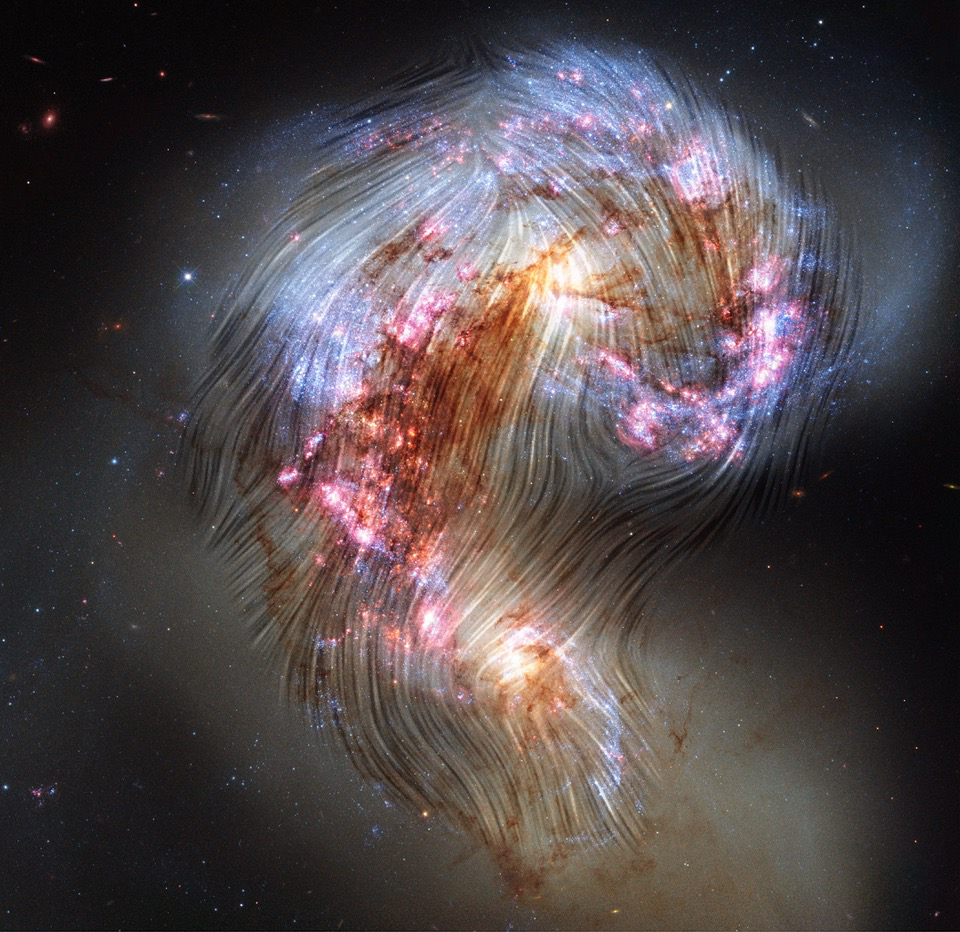
SOFIA had been scheduled to remain longer in New Zealand before severe weather caused damage to the aircraft, requiring the mission to adjust its science observation plans and cancel the remainder of the deployment. During its time in the Southern Hemisphere, SOFIA collected data for several legacy programs, including HAWC+ dust polarization observations of the Antennae galaxies for the SALSA program -- resulting in this stunning map of its magnetic field large-scale structure. Read more.
| | The magnetic fields of the closest merger of two spiral galaxies, the Antennae galaxies, as shown using observations by SOFIA/HAWC+. These observations show how mergers affect the B-fields in the gas within and around galaxies. The Antennae galaxies show ordered magnetic fields structures of ~8.9 kpc connecting both galaxies, and in the tidal tail toward the intergalactic medium. Both of the galaxy cores and the star-forming regions produce highly turbulent magnetic fields. The color image comprises HST observations using the filters F435W (blue), F550M (green), and a combination of F814W and F658N (red) by Withmore et al. 2010. The streamlines show the magnetic field orientations observed by SOFIA HAWC+ (Credit: ESA/Hubble/E. Lopez-Rodriguez). | |
Southern Lights from SOFIA in APOD
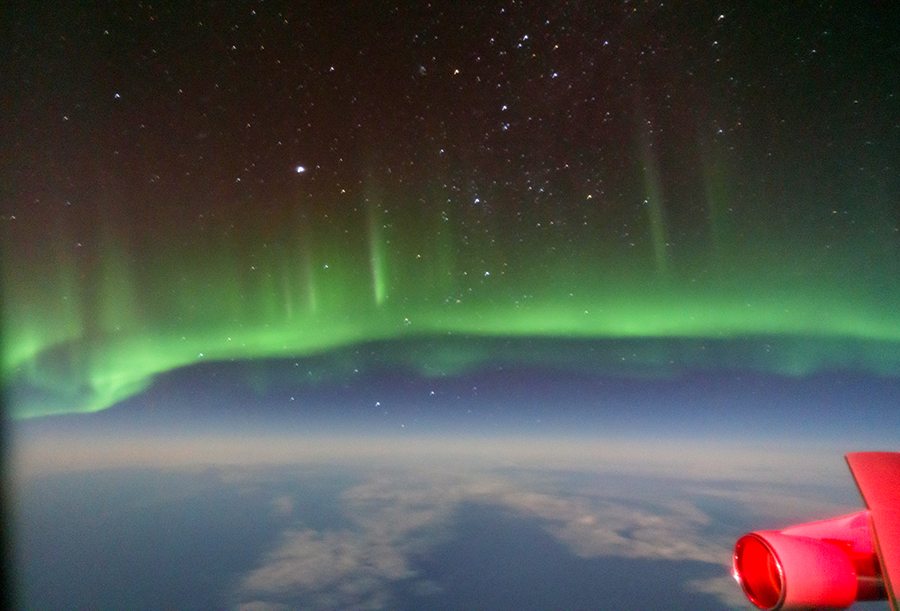
This view of Southern lights from SOFIA was featured as NASA's Astronomy Picture of the Day on July 29th. It was captured on July 17, 2022, during a science mission flying into the southern auroral oval, by astronomer Ian Griffin, director of New Zealand’s Otago Museum. One can see the bright star Canopus shining in the southern night above curtains of aurora australis, or southern lights. The plane was flying far south of New Zealand at the time, at roughly 62 degrees southern latitude. | | Image credit: Ian Griffin (Otago Museum) | |
SOFIA Archival Research Program Proposals Selected
The SOFIA Science Center is pleased to announce the selection of awarded SOFIA Archival Research Program (SARP) proposals. SARP funds archival research projects primarily using SOFIA data. The purpose of the program is to encourage the use of public SOFIA archival observations for impactful science. Six (6) projects spanning a variety of scientific topics were awarded funding for a total of about $1M. See the full list of the accepted proposals.
| |
Join Science Talks Remotely: Tele-Talks
Tele-Talks are scientific presentations given via phone, with slides distributed ahead of time. The talks are held approximately twice a month on Wednesdays at 9:00 a.m. Pacific, noon Eastern. For information on how to participate, check SOFIA Tele-Talk webpage.
Upcoming Tele-Talks
- September 14: Rubén Fedriani (Chalmers); SOMA Massive Star Formation Survey
- September 21: Erin Cox (Northwestern); twisted magnetic field of the protobinary L483
- October 12: Andre Beck (University of Stuttgart, DSI); Ionized Gas in NGC253
- October 19: Casey Honniball (NASA GSFC); Map of Molecular Water on the Moon
| | |



![The GREAT [CII] map of RCW175 with contours from the WISE3 11.3 micron map overlaid and the [CII] spectra for one of the pixels at the edge of the HII Region.](https://files.constantcontact.com/54bfff4e601/c1e0bbaa-85db-4cc7-a7fa-d16f503b1518.png?rdr=true)