Evaluations conducted within the context of child custody litigation can be among the most complex evaluations undertaken by mental health professionals. Data collection for these evaluations typically falls into one of several foundational categories: direct and collateral interviews, psychological testing, review of records, and observed interactions. Within the category of ‘records,’ data from emails, text messages, social networking site (SNS) posts, various cell, tablet, or computer applications, and other online sources of interpersonal communication can provide evaluators with information useful for their evaluation’s purpose. We propose using the term Electronically Stored Information (ESI) to refer to this type of information. ESI is information created, manipulated, communicated, stored, and best utilized in digital form, requiring the use of computer hardware and software. | | |
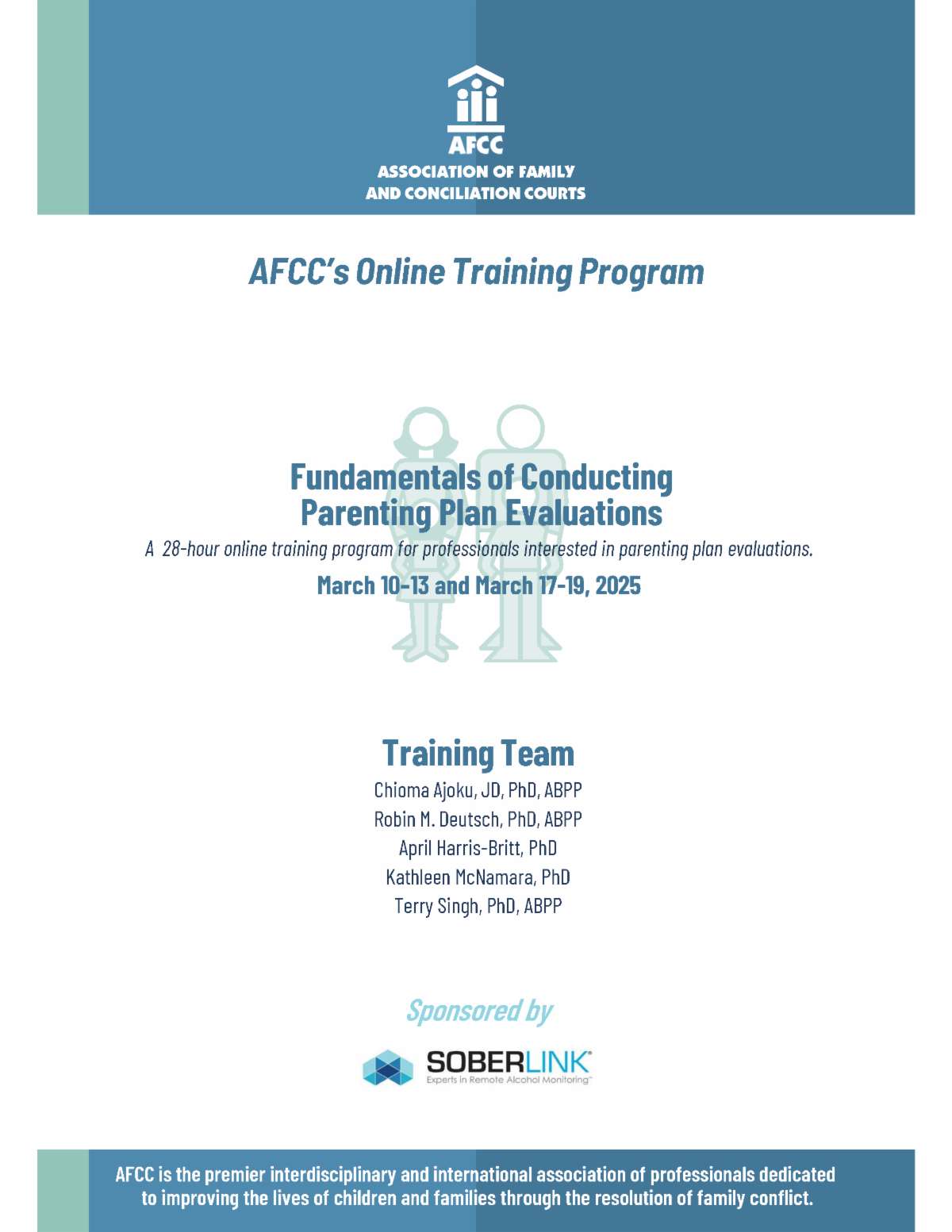
28 Credit Hours | Two 2-Hour Sessions per Day | 7 Days
This online training covers the essential aspects of parenting plan evaluations including the purpose and role of the parenting plan evaluator, implications of child maltreatment and intimate partner violence, cultural considerations, current research, and the development of parenting plans. If you are interested in expanding your practice into PPEs or simply want a refresher, you will not want to miss this online training program!
Pricing:
- AFCC Member: $375
- Non-member: $550
Expert Training Team:
- Chioma Ajoku, JD, PhD, ABPP
- Robin M. Deutsch, PhD, ABPP
- April Harris-Britt, PhD
- Kathleen McNamara, PhD
- Terry Singh, PhD, ABPP
| | There is an important conversation happening throughout the United States, as well as internationally, on the topic of coercive control. Practitioners like GALs, attorneys, advocates, and survivors are actively debating the topic – what it looks like in families, how it impacts children, and whether coercive control should be codified in the family laws of their state. Several jurisdictions across the U.S. have already codified coercive control. These jurisdictions are seeing both benefits to survivors and their families, as well as some unintended consequences. This webinar will walk participants through the pros and cons of codifying coercive control in the family law context and open conversation about how to best address the issue in their state. | | |
Tracy Shoberg, JD, is the Deputy Director of the National Legal Center on Children and Domestic Violence with the Battered Women’s Justice Project. In this role, she has trained thousands of legal practitioners to enhance their practice surrounding domestic violence, including how to effectively use the SAFeR approach. Tracy attended the University of Wisconsin-Madison, receiving BAs in English and Gender Studies, and the University of Minnesota Law School. She committed herself to this work starting in 2012 when she began her career at End Domestic Abuse Wisconsin.
| | |
Anadelle M. Martinez-Mullen, JD, has been working in the field of violence against women for more than 20 years. She began her work in this field as an advocate assisting victims of intimate partner violence. Upon graduating law school, she practiced family law. Before coming to BWJP, she represented victims of violence in civil protection order actions. Ms. Martinez-Mullen has also served as an Adjunct Professor at Florida Coastal School of Law.
| | |
Registration
Members: $15
Non-Members: $50
Certificate of Attendance
Members: $15
Non-Members: $20
| | | |
More Upcoming Webinars!
See below for a comprehensive list of upcoming webinars:
AFCC's monthly webinars are eligible for one-hour of continuing education credits for qualifying professionals.
| |
|
Family Court Review
Volume 63, Issue 1
The January 2025 issue of Family Court Review is set to be fully released soon. However, you can access articles that have already been published online in the FCR digital archives. Visit the archives to explore the content ahead of the full issue release and gain early insights into the topics and scholarship featured in this special issue.
This special issue focuses on the role of cultural awareness and diversity in family law. It emphasizes the need for family law professionals to understand and respect the unique cultural, individual, and familial differences that shape parenting beliefs, co-parenting dynamics, and parent–child relationships. The issue fosters cultural curiosity while highlighting the importance of moving away from a "one-size-fits-all" approach to culturally responsive and tailored recommendations that align with families' values while prioritizing child well-being and legal standards.
Key topics include:
- Supporting LGBTQ+ youth caught in the middle of parental conflict
- Incorporating the nuances of specific religious cultures into the training of family law professionals.
- Examining unique obstacles faced by veterans and military service members in custody disputes
- Exploring the relevance of ethnic-racial identity in multiracial and transracial families
- Reviewing the evolution of diversity considerations in past and present scholarship, and implications for future research.
Overall, the issue aims to increase awareness of diversity's role in family law practice, and encourage more equitable, informed, and respectful approaches to family law decisions.
| |
| |  | After nearly five decades of dedicated service to the legal community, AFCC member, Bill Howe is embarking on a well-deserved retirement from the active practice of law—but not from making a difference. Since 1975, Bill has been a force in the legal field and, since 1995, he has devoted himself exclusively to family law with Gevurtz Menashe. His work has shaped the landscape of family law in Oregon and beyond. During his distinguished career, Bill served as chair of the Oregon Task Force on Family Law, whose efforts led to transformational changes in family law practices, including parenting plans, mandatory mediation, and the unified family court and as vice-chair of Oregon’s Statewide Family Law Advisory Committee for over 20 years, working tirelessly to improve family law systems. He has held leadership roles with national and international organizations, including the Family Justice Initiative and the Association of Family and Conciliation Courts and has been the recipient of numerous honors, including the 2021 Wallace P. Carson Outstanding Achievement Award and recognition in Best Lawyers in America and Super Lawyers. Bill transitioned to “Active Pro Bono” status with the Oregon State Bar on January 1, 2025, where his commitment to service continues.
| |
| | | Ron Silikovitz, a psychologist and member of AFCC since 1998, retired on January 1, 2025, after 25 years of practice. Ron has attended almost every annual AFCC conference since that time. He was so inspired that he founded the New Jersey chapter upon his return home following his first conference, and he became the first president of the New Jersey Chapter. Ron has remained involved in chapter leadership, and the chair of the chapter’s 25th anniversary celebration committee. He is a recipient of the Phil Sobel award, named in honor of his co-founder. Ron has been an active member of the New Jersey Psychological Association, and is also the recipient of the New Jersey Psychological Association Lifetime Achievement Award and the Bonnie Brae Educational Center Lifetime Achievement Award. He recently was named president of the West Orange, New Jersey Chamber of Commerce, and plans to remain involved with AFCC through both the New Jersey chapter and parent organization. Ron has been married to Arlene for 60 years, with whom he shares 2 adult sons. Ron is a rabid fan of the Philadelphia Eagles and the Phillies. He and Arlene hope to enjoy retirement with continued involvement in local community activities and as patrons of the arts. Congratulations Ron!
| Have you recently received an award or celebrated an exciting achievement? We’d love to hear about it! Email AFCC's eNews Editor, Ann Ordway, to share your story! | | |
AFCC Chapter News
In November, Utah AFCC held its third Mediation Day event at the Matheson Courthouse in downtown Salt Lake City. This inspiring and fun event, which builds upon the success of the previous two Mediation Days, has now successfully mediated over 60 family law cases for low-resource families. The Mediation Day Program provides each case with a free AFCC mediator, two pro bono attorneys, a paralegal for document drafting, and, in most cases, an AFCC-informed mental health professional to assist with custody and parent-time issues. These efforts reflect Utah AFCC’s commitment to providing valuable support for families in need and enhancing access to justice within the community. Utah AFCC was excited to see several local news outlets publish a story about Mediation Day, including this one.
| | |
Board of Directors Nominations
The AFCC Nominating Committee is seeking nominations for individuals to serve on the AFCC Board of Directors. Recommended individuals must be AFCC members and have an interest in and knowledge of AFCC and its work. Nominations must be received by February 28, 2025, to be considered by the committee prior to the election at the AFCC 62nd Annual Conference. The term is three years, beginning July 1, 2025, and concluding June 30, 2028. If you or a member you know is interested, please send your/their contact information, resume, and a letter of interest to the AFCC Nominating Committee via email to afcc@afccnet.org.
| | |
AFCC eNEWS
The AFCC eNEWS is the monthly e-newsletter of the Association of Family and Conciliation Courts. The eNEWS provides up-to-date information for professionals including practice tips, international news, and the latest initiatives in family law and conflict resolution. The AFCC eNEWS is provided at no charge to you; anyone can subscribe.
AFCC members are free to share eNEWS content.
EDITOR:
Ann Ordway, JD, PhD
ASSOCIATE EDITOR:
Patrick Sommer, BS
| | | | |