Fall 2023 Newsletter – Vol. 125 | |
President's Greeting
Dear ACASA Members,
The ACASA board recently submitted our annual report to the Mellon Foundation as the end of August marks the completion of our first of three years of grant funding. A few points from this report are worth highlighting. Last November 2022 we hired Caroline Bastian as an Arts Administrator/Project Manager on a contract basis. Caroline has supported the board’s operations in multiple ways including helping to facilitate communications with the CCRBP, vetting our membership list, assisting in Triennial planning, and collecting and cataloging archival materials. We have reached an agreement with the Herskovitz Africana Library at Northwestern University to house ACASA’s archives, both physical and digital. This was a logical choice given that the library also houses the archives of our parent organization, the ASA. In the process of hiring Caroline, we realized that ACASA does not have a DEAI statement. We are therefore in the process of hiring somebody on a contract basis to help us fashion a DEAI statement and travel support statement, revise as necessary our mission statement, and devise follow-up materials to evaluate our DEAI efforts down the road. The board is also putting together a regular schedule of webinars to be held in the Autumn and Spring of each year, accessible exclusively to ACASA members … so be sure to renew your membership annually to have access to these events!
Triennial planning continues apace. After some frustration in settling the date, the Triennial has been confirmed for August 7–11, 2024 at DePaul University and the Art Institute of Chicago. The various planning and awards committees have been formed and calls are being sent out. In particular, all members should have received the call for panel and roundtable proposals. The Programming Committee has decided to return to the practice of identifying a conference theme, which we have not done since the 15th Triennial at UCLA in 2011. In recognition of the difficult discussions ongoing within the field as well as in broader society around African visual culture and accessibility, they settled on the theme of “Radical Listening: Human-Centered Approaches to African Arts.” We also hope to carry this theme into some of the programming beyond the panels. We expect this Triennial to have a stronger digital presence than iterations preceding the COVID-19 pandemic, which taught us all more than we really wanted to know about operating online. One significant change will be the shift from a hard copy of the conference program to an ACASA-branded app. We also anticipate virtual and hybrid participation, although we hope to welcome as many to Chicago in person as possible. The planning of such an experience requires a great deal of work, but we feel that enhancing accessibility and creating more significant opportunities for participation for all our members is well worth it.
Wishing you a productive and enjoyable fall!
Mark Dike DeLancey
ACASA President
| | |
Winter 2024 Issue Submission Deadline: January 15, 2024
(to be published late January/early February)
The online form is written in English; form instructions are also available in French and Portuguese! All members are kindly asked to use the online form accessible via the "submit your news" button.
Want to share something before the next newsletter? Contact the Social Media Editor directly.
| | |
Follow us and join the conversation on social media! | |
|
Award Deadlines
Submit your applications!
Award applicants must be ACASA members in good standing. Need to renew your membership? Click here.
Roy Sieber Dissertation Award
Eligible dissertations must have been submitted to the author’s degree-granting institution and defended between 1 September 2019 and 30 August 2023 in order to be considered by the award committee. Submission details are available here.
Due 15 October 2023
Arnold Rubin Outstanding Publication Award
Eligible books must have been published (by official publication date or demonstrated public availability, if different) between 1 September 2019 and 30 September 2023. Submission details are available here
Due 15 October 2023
Curatorial Excellence Award
Eligible exhibitions must have been on view between 1 September 2019 and 30 August 2023 in order to be considered by the award committee.
Submission details are available here
Due 15 January 2023
Award for Teaching Excellence
Awards are made to recognize an ACASA member for distinguished teaching (10+ years of experience) and early-to-mid career (4+ years of experience). Submission details are available here
Due 17 November 2023
***
Details on submissions for the Leadership Award will be posted on the ACASA website in the near future
| |
Call for Panels and Round Table Proposals
Full details, conference theme, and submission information available here
Regular panels will be 120 minutes long with either a) four 20-minute papers and a discussant or b) five 20-minute papers. 90-minute roundtables or alternative discussion-based formats (such as lightning talks or poster presentations) are welcome–creativity encouraged.
Participants may only present one paper but may serve as a discussant on another panel or as a presenter on a roundtable.
Proposals for panels and roundtables may be open with a suggested topic or fully constituted with all proposed participants identified. Participation may be in person, virtual, or a combination of these two.
Deadline 1 December 2023
| |
Intercultural Encounters, Historicity and Cultural Communication for Development in Nigeria
The book is a collection of essays on African indigenous knowledge systems (AIKS), ethnography, cultural dynamics, language, gender, and cultural avatars, especially among the Benin and Yoruba peoples in Nigeria. It is a fresh and refreshing look at intercultural encounters among ethnicities that provides a framework for scholars and researchers in African Studies to probe the issues of continuity and discontinuity in the sociology of indigenous African people and mobilise them for progress. Concretely, the articles explore power dynamics in societies through performance and cultural arts and permit the readers to demystify, deconstruct, and reconstruct Western ways of thinking and knowing influenced by dominant and oppressive social systems, structures, and knowledges. It is edited by Osakue Omoera and Stephen Okpadah.
ISBN 978-3-96203-291-3. Pages: 319. Published by Galda Verlag.
Buy here
And here
Editor Facebook
Editor Instagram
| |
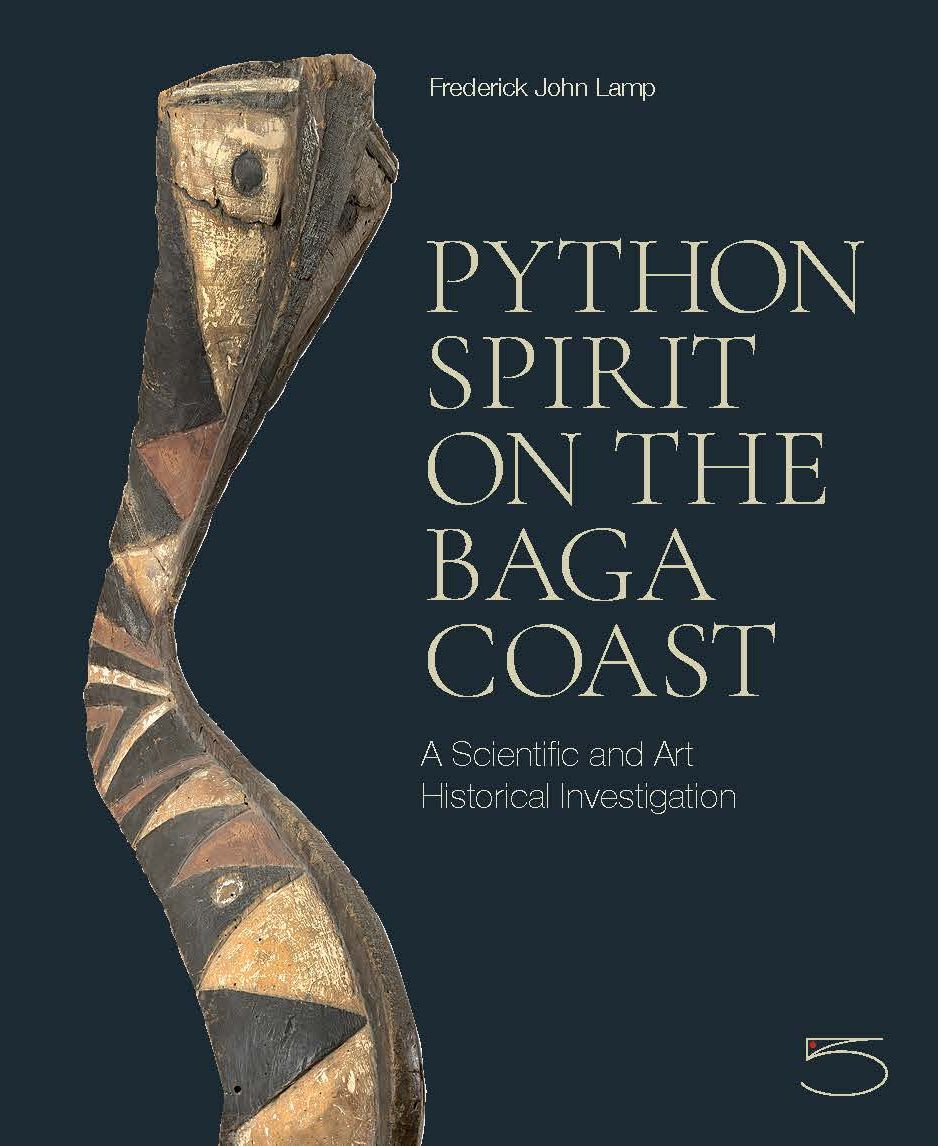
Python Spirit on the Baga Coast: A Scientific and Art Historical Investigation
Frederick John Lamp
An inter-disciplinary examination of the performance of the Serpent masquerade in Guinea, it presents extensive research on the relationship between ethno-zoology and art and ritual in Africa. It is a collaboration by the author, an art historian, with other art historians and preeminent scientists, including Roy Sieber, Robert Koestler, Dennis Stevenson, Mark Wypyski, and Peter Zanzucchi. The text begins with the historical and ethnographic evidence for the Serpent masquerade, bearing an immense wooden Serpent figure on top of the head. Never witnessed or photographed by an outsider in Guinea, it disappeared in the 1950s along with most ritual performance after an Islamic jihad. The ritual context is followed by an in-depth analysis of extant Serpent figures in collections in Europe, the Americas, and Africa, and of other representations of the python in the ritual art of the region. The final sections present a debate between art historians, dealers, appraisers, collectors, and curators, and specialists in botany, chemistry, physics, entomology, and conservation concerning one particular Serpent figure in question.
Purchase here
| |
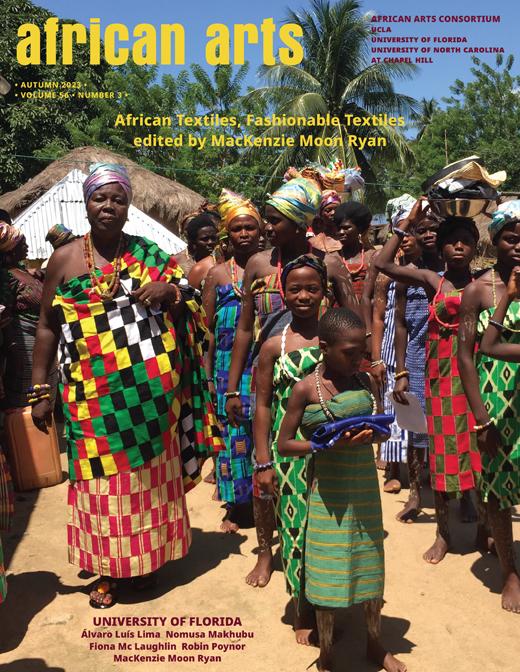
African Textiles, Fashionable Textiles
Announcing ‘African Textiles, Fashionable Textiles,’ a special issue of African Arts journal, 56.3 (Autumn 2023). Edited by MacKenzie Moon Ryan, the issue features new research from nine scholars & shows how the study of African textiles navigates the productive tensions between producers and consumers, commercial & artistic endeavor, skilled practice & items of fashionability, identity, and investment.
-
First Word: African Textiles, Fashionable Textiles: A Historiography – Sarah Fee
-
African Textiles, Fashionable Textiles: An Introduction – MacKenzie Moon Ryan
-
Unravelling Regional & Global Connections: Historical Kente & Related Textiles in Ghana, Togo, & Cote d’Ivoire – Malika Kramer
-
The Cloth That Eats Money: Segosen as a Symbol of Prestige – Tunde Onibode & Robin Poynor
-
Complex Geometries: Creativity, Motif, & the Study of Contemporary Handwoven Cloth from Cote d’Ivoire – Emma C. Wingfield
-
Motifs in Motion: Fes Belts (Ahzima) & Moroccan Design Innovation in the Mediterranean World – Morgan Snoap
-
Kanga Cloths at Vlisco: An Object-Based Study of Dutch Printing for the colonial East African Market, 1876-1971 – MacKenzie Moon Ryan
-
Igshaan Adams: A Body of Work – Alvaro Luis Lima
-
Textiles in the History of the History of African Art – John Picton
Read here
Image: Cover of 'African Textiles, Fashionable Textiles,' African Arts, 56.3 (Autumn 2023), featuring image of Manye Kwawudade II, Queen Mother Agotime-Kpetoe and young girls ready for the education day at the 2018 Agbamamevorza or Agotime Kente Festival. Agotime-Akpokofe (Ghana), October 2018. Photo: Malika Kraamer.
| |
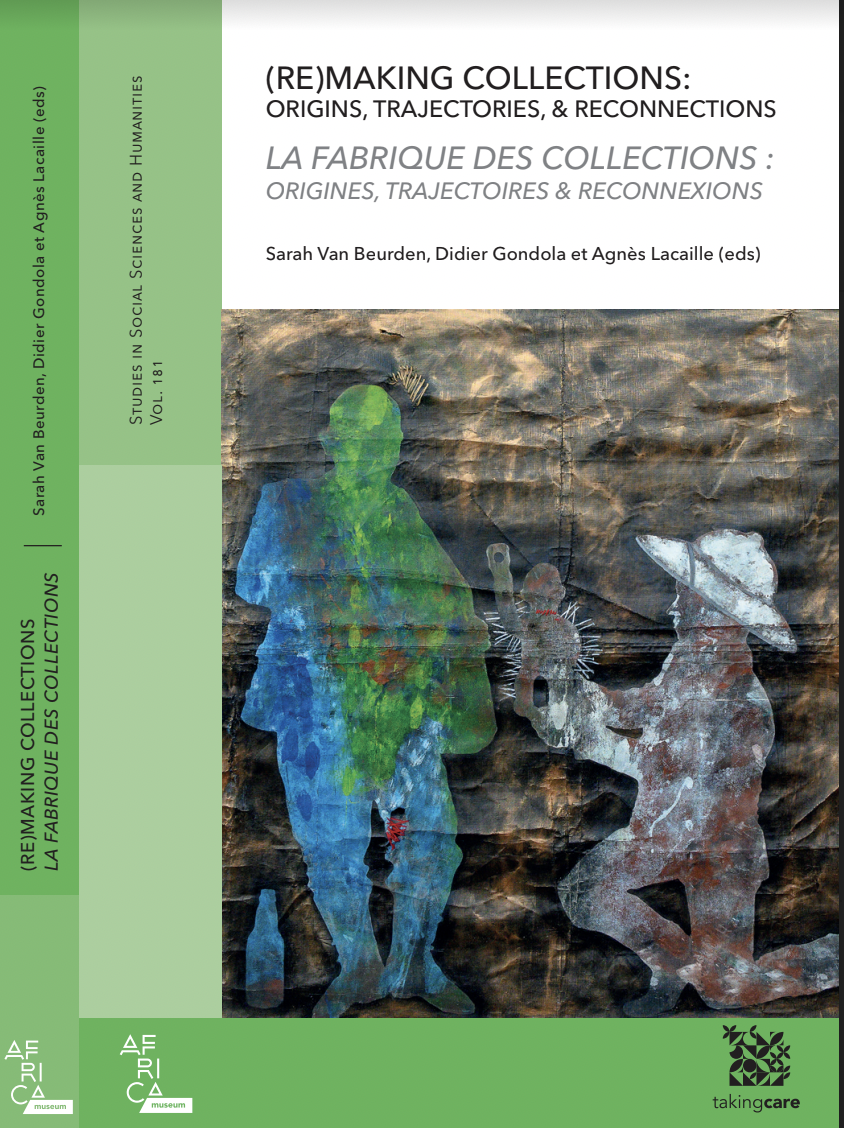
(RE)MAKING COLLECTIONS: ORIGINS, TRAJECTORIES, & RECONNECTIONS
LA FABRIQUE DES COLLECTIONS : ORIGINES, TRAJECTOIRES & RECONNEXIONS
Provenance research on collections from the Global South in Europe is now unavoidable in the fields of museum studies and cultural policy, yet no scholarly work has scrutinized the collections of the Royal Museum for Central Africa in Tervuren (Belgium) as a whole. While the institution’s history has been the subject of study, this book provides new frameworks for interpretation in light of current debates. Structured around two axes––the heritage field in historical and contemporary Belgian and Congolese contexts, and the more specific case of the Tervuren museum’s collections––this edited volume gives a broad overview, explores new trends, and presents the challenges facing museums today, with recent and unpublished research, interviews, and artistic contributions in English or French.
Editors: Sarah Van Beurden, Didier Gondola, Agnès Lacaille
Website
Image Courtesy of AfricaMuseum Belgium
| |
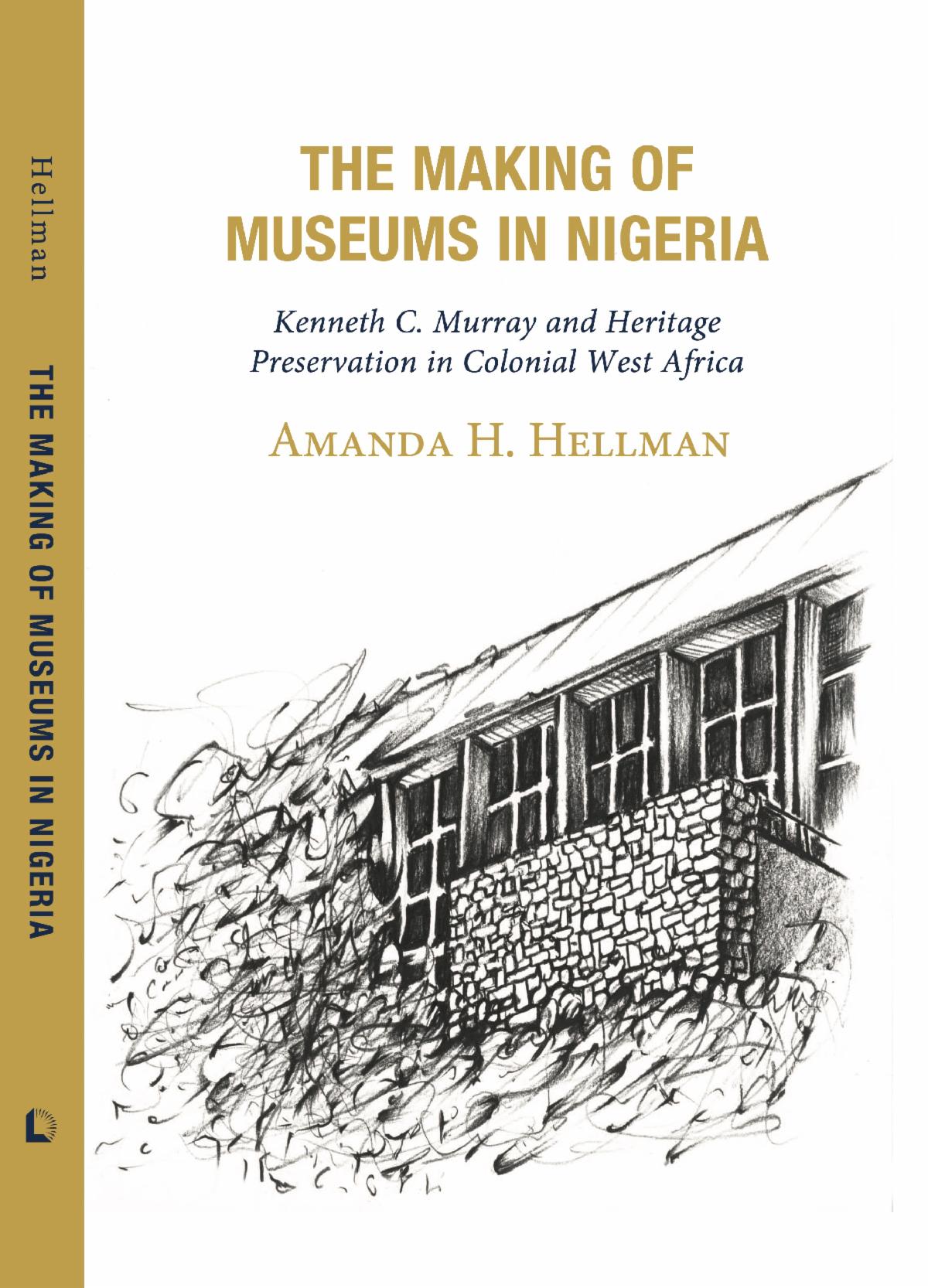
Amanda Hellman published The Making of Museums in Nigeria: Kenneth C. Murray and Heritage Preservation in Colonial West Africa
The Making of Museums in Nigeria: Kenneth C. Murray and Heritage Preservation in Colonial West Africa provides an in-depth look at the early history of museums in Nigeria through the letters and archives of Kenneth C. Murray, Edward H. Duckworth, Bernard E. B. Fagg, and Ekpo Eyo to uncover early efforts to preserve cultural heritage, repatriate stolen art, and build institutions that would help define a nation. The book captures the life and legacy of Murray, whose efforts helped foster an understanding of Nigerian art and culture for international audiences, but also explores the tension among the colonial government, officers, and Nigerians who sought to build these cultural institutions toward the end of the British Empire and in the transition to a newly independent Nigeria. By considering the personal accounts of key players, Amanda H. Hellman lays the historic groundwork for the discussions and actions our industry is currently reckoning with regarding repatriation, restitution, and building museums for the future to show that they are issues deeply embedded in the foundation of Nigerian cultural institutions.
290 pgs, 20 b&w images
Hardback ISBN: 978-1-66691-267-8
eBook ISBN: 978-1-66691-268-5
Lexington Books, October 2023
Purchase here
Image: Front cover of Amanda H. Hellman's The Making of Museums in Nigeria, drawing by Angus Galloway.
| |
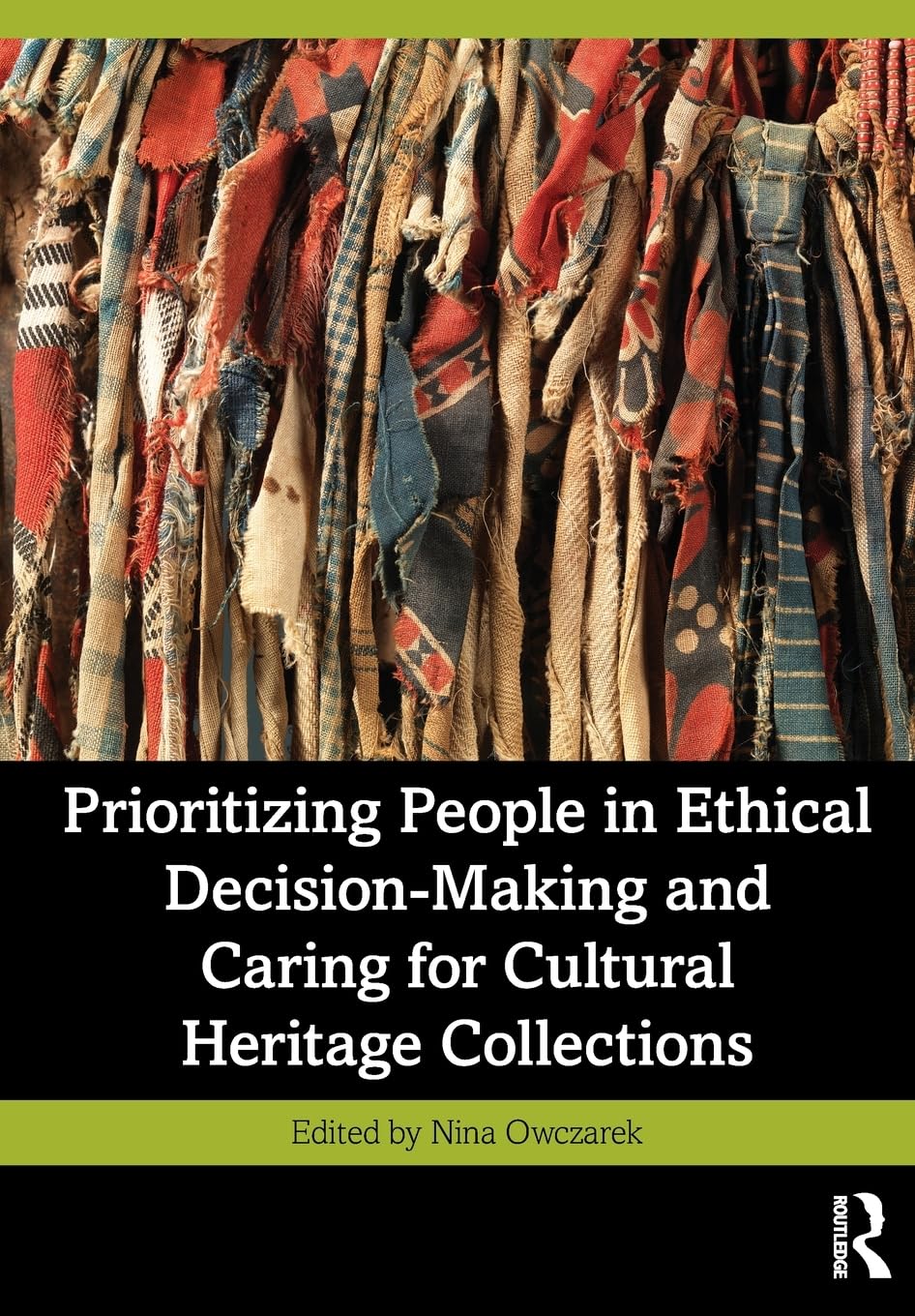
'Rethinking ‘Invasive:’ Approaches to Informed Analysis and Object Care with Spiritually Empowered Objects
Marci J. Burton, Christian de Brer, Carlee S. Forbes (ACASA Member), and Erica P. Jones (ACASA Member) published the chapter: “Rethinking ‘Invasive:’ Approaches to Informed Analysis and Object Care with Spiritually Empowered Objects” in Prioritizing People in Ethical Decision-Making and Caring for Cultural Heritage Collections edited by Nina Owczarek.
ISBN 9781032342504 / June 2023, Routledge / 226 pgs, 28 B/W Illustrations /
Purchase here
This chapter draws upon interdisciplinary research on an nkisi power figure—in the collection of the Fowler Museum at UCLA—from the Democratic Republic of the Congo, with no indication of the source community. The Fowler team consulted an advisory council to help determine an ethical course of action in studying the figure. The council was asked to help weigh two conflicting needs: understanding the technical elements of the figure to determine a long-term preservation strategy and aid in determining the community of origin, and respecting systems of secrecy and restrictions of knowledge within the community of origin. Our experiences demonstrate the need for ongoing conversations in the field of conservation to address questions concerning the ethical care of works in museums.
Cover image of Prioritizing People in Ethical Decision-Making and Caring for Cultural Heritage Collections.
| |
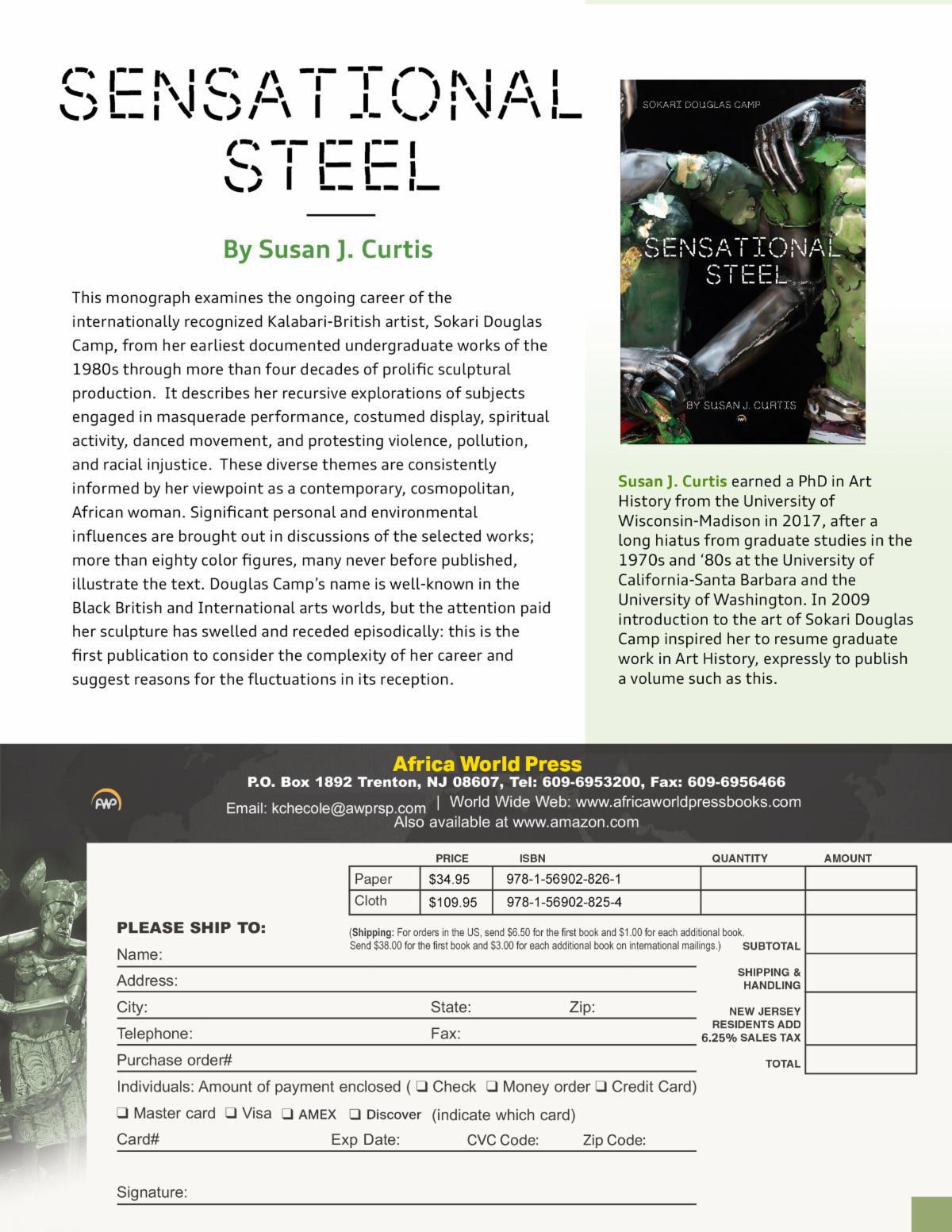
Sokari Douglas Camp: Sensational Steel
This new monograph by Susan J. Curtis surveys the career of the internationally recognized Kalabari-British artist, Sokari Douglas Camp. From her earliest undergraduate works in the 1980s through more than four decades of prolific sculptural production, it considers her recursive explorations of subjects engaged in masquerade performance, costumed display, spiritual activity, danced movement, or protesting violence, pollution, and racial injustice. These themes are consistently informed by her viewpoint as a contemporary, cosmopolitan, African woman. More than eighty color plates, many previously unpublished, are discussed in the text. Douglas Camp is well-known in the Black British and International Arts worlds, but attention paid to her sculpture has swelled and receded episodically; this monograph considers the complexity of her career and suggests reasons for the fluctuations in its reception.
ISBN: 978-1-56902-826-1; 230 pages.
Image: cover of Sokari Douglas Camp: Sensational Steel. Image courtesy of Jonathan Greet, Font courtesy of Jane Daniel"
| |
Intercultural Encounters, Historicity and Cultural Communication for Development in Nigeria
The book is a collection of essays on African indigenous knowledge systems (AIKS), ethnography, cultural dynamics, language, gender, and cultural avatars, especially among the Benin and Yoruba peoples in Nigeria. It is a fresh and refreshing look at intercultural encounters among ethnicities that provides a framework for scholars and researchers in African Studies to probe the issues of continuity and discontinuity in the sociology of indigenous African people and mobilise them for progress. Concretely, the articles explore power dynamics in societies through performance and cultural arts and permit the readers to demystify, deconstruct, and reconstruct Western ways of thinking and knowing influenced by dominant and oppressive social systems, structures, and knowledges. It is edited by Osakue Omoera and Stephen Okpadah.
ISBN 978-3-96203-291-3.Pages: 319. Published by Galda Verlag.
Buy here and here
| |
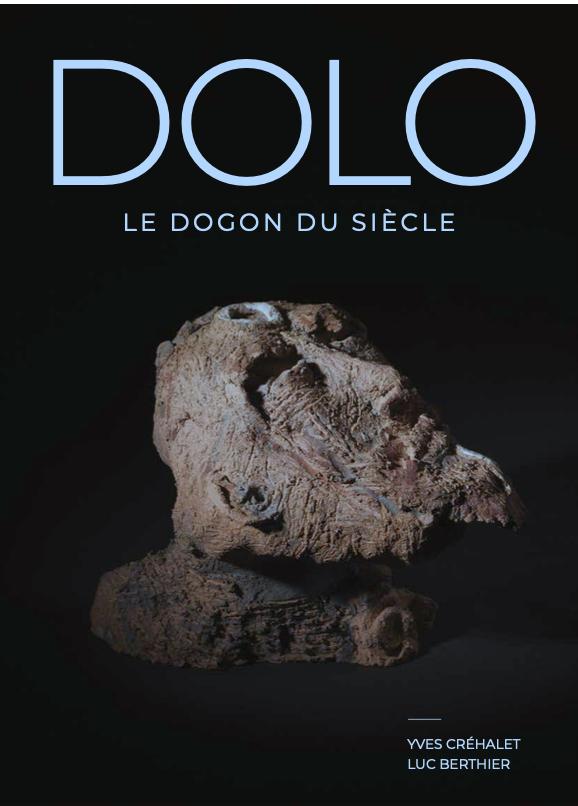
DOLO, LE DOGON DU SIÈCLE
A year ago, this August 21, 2022, Amahiguéré Dolo, the child of Sangha Gogoli left us. While he was living his last months, we promised to write a book about him.
Amahiguéré was able to listen to the reading of the texts that we intended for him. We know: time only erases the surface of the world. The work of this extraordinary artist remains in the consciousness and the history of enlightenment. –– Luc Berthier and Yves Créhalet
On this anniversary, we are happy to announce the publication in mid-October of DOLO, LE DOGON DU SIÈCLE, a monograph devoted to the entire work of the artist Amahiguéré Dolo. Authors: Luc Berthier (director, Galerie Luc Berthier) and Yves Créhalet (author, curator, cultural mediations) with text contributions from Yacouba Konaté (professor at Félix Houphouët-Boigny University and member of the Academy of Arts, Sciences and Cultures of Africa and the Diasporas of Abidjan), Chab Touré (professor of aesthetics, art critic, and writer), Jean-Paul Blachère (Blachère Bonnieux Foundation - France), and Jessica Hurd (curator, art historian, and ACASA member). A catalog raisonné will follow.
DOLO, LE DOGON DU SIÈCLE
ISBN : 978-2-9523144-0-4
Price : 40 Euros
contact@galerielucberthier.com
Tel: 0630703070
Image: Berthier, Luc, and Yves Créhalet. Dolo le Dogon du siècle. Paris: Editions Luc Berthier, 2023.
| |
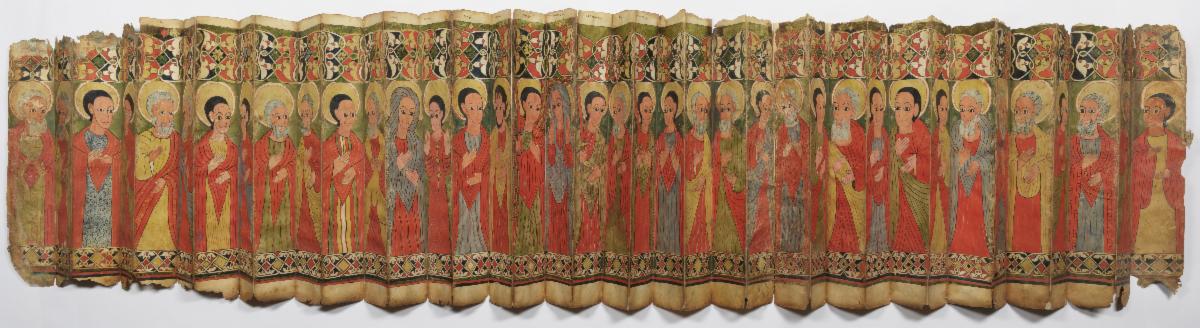
Ethiopia at the Crossroads
The Walters Art Museum presents an extraordinary exhibition celebrating the artistic traditions of Ethiopia from their origins to the present day. Ethiopia at the Crossroads will be the first major art exhibition in America to examine Ethiopian art in a global context. Curated by ACASA member Christine Sciacca, Ethiopia at the Crossroads presents these objects as representative of the nation’s notable history and demonstrates the enormous cultural significance of this often-overlooked African nation through the themes of cross-cultural exchange. The exhibition features more than 225 objects drawn from the Walters’ world-renowned collection of Ethiopian art augmented with loans from American, European, and Ethiopian lenders. Visitors will see historical works of Ethiopian art including coins, painted icons, illuminated manuscripts, and metalwork and carved wood crosses of various scales side by side with works by contemporary Ethiopian artists Wosene Worke Kosrof, Aïda Muluneh, and Elias Sime.
An illustrated catalogue (391 pages, 281 color images), edited by Christine Sciacca, Curator of European Art, 300–1400 CE, and published by the Walters, will accompany the exhibition, along with a robust schedule of programs.
Exhibition runs from 3 December 2023–3 March 2024
Website
Image: Folding Processional Icon in the Shape of a Fan (Detail), Ethiopia, late 15th century. Museum purchase with funds provided by the W. Alton Jones Foundation Acquisition Fund, 1996
| |
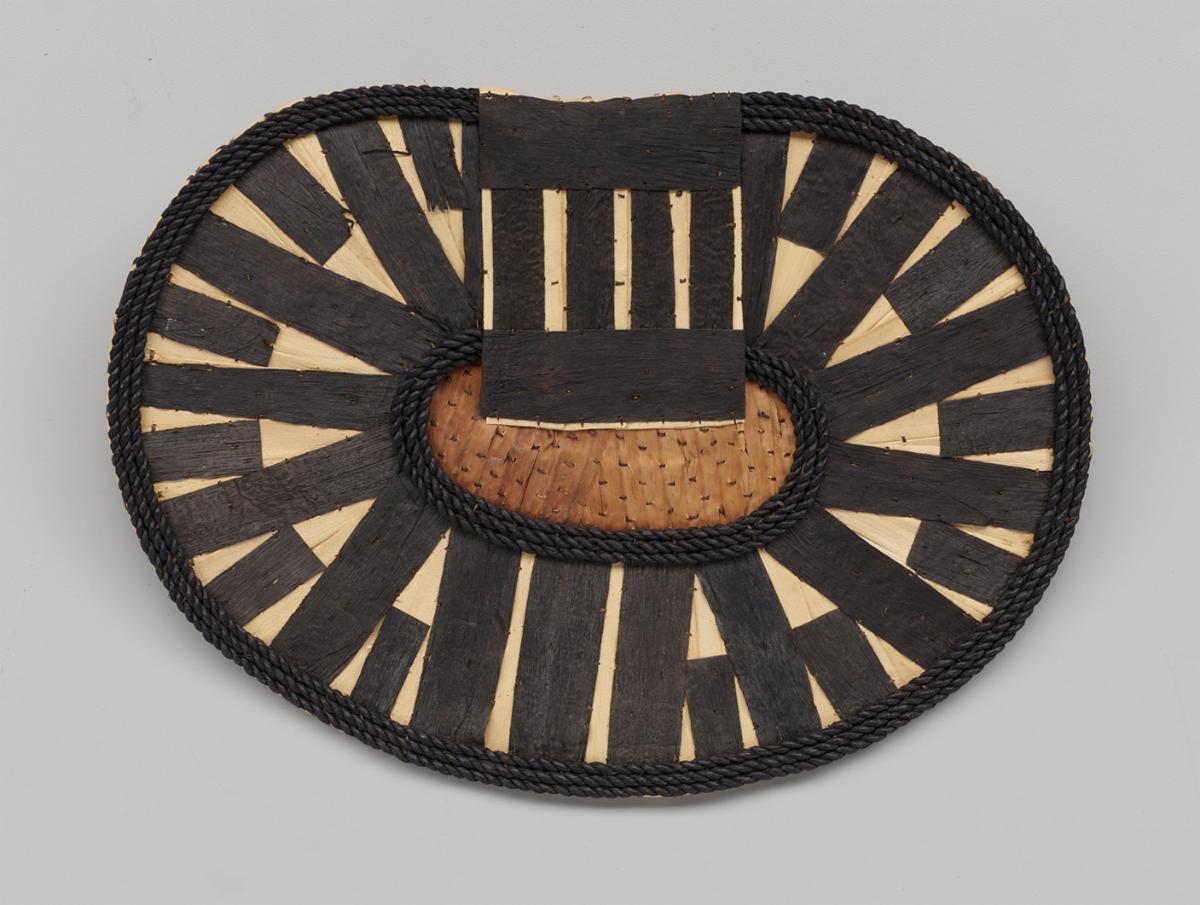
Backs in Fashion: Mangbetu Women’s Egbe
24 September 2023–3 August 2025
On view at the Dallas Museum of Art, Backs in Fashion: Mangbetu Women’s Egbe explores the art of the egbe, a back apron garment created by upper-class Mangbetu women. Organized by Dr. Roslyn Walker, Senior Curator of the Arts of Africa, the Americas, and the Pacific and The Margaret McDermott Curator of African Art at the DMA, this exhibition investigates the artistic process, essential function, and cultural role that egbe garments played in Mangbetu society.
This exhibition is included in the DMA's free general admission. Guests can learn more at dma.org.
Instagram
Website
Image: Back Apron (Negbe), 1930s. Mangbetu peoples. Democratic Republic of the Congo. Banana leaves, plant fiber, and natural dye. Dallas Museum of Art, Textile Purchase Fund, 2021.10.1.13.
| |
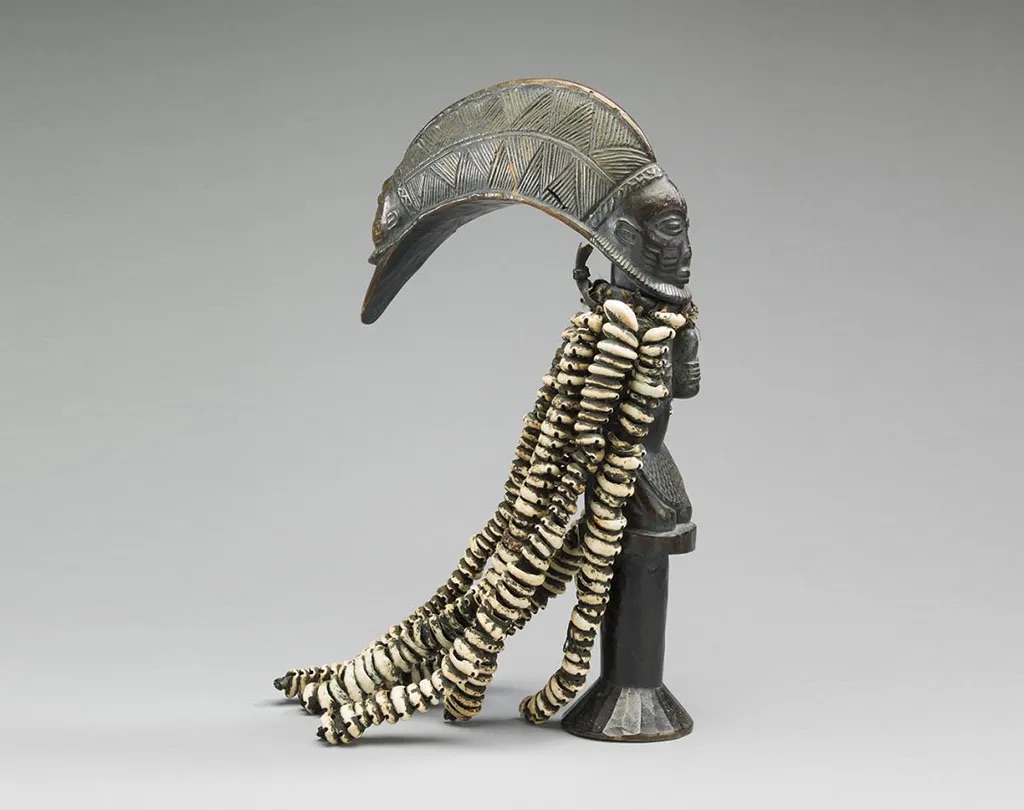
The House Was Too Small: Yoruba Sacred Arts from Africa and Beyond
October 29, 2023–June 2, 2024
The Fowler Museum at UCLA presents The House Was Too Small: Yoruba Sacred Arts from Africa and Beyond, an exhibition bringing together over 100 sacred works that trace the movement of people and their expressions of belief through the Yoruba Atlantic. Seen together, the objects speak to how religions are altered in the diaspora and how individuals are transformed through worship. For contemporary practitioner, artist, and abolitionist Patrisse Cullors, Yoruba religiosity is a mode of personal and collective empowerment. This aspect of her faith is realized in “Free Us,” a multimedia installation premiering within the exhibition. Cullors will also present a special live performance at the opening on Sat 28 October at 5pm.
Curators Erica P. Jones (ACASA member) and Patrick A. Polk worked alongside an advisory committee of practitioners, academics, and artists devoted to Yoruba and Yoruba-inspired faiths: Rowland Ọlá Abíọ́dún, Andrew Apter, Roberto Conduru, Patrisse Cullors, Amos Dyson, Ysamur Flores-Peña, and Elizabeth Pérez.
website
Image: Artist(s) unknown (Yoruba style, Nigeria), Ọ̀go Ẹlẹ́gbára (dance wand), late 19th–20th century; collected prior to 1958; wood, cowrie shells, leather, indigo; Fowler Museum at UCLA, X64.31
| |
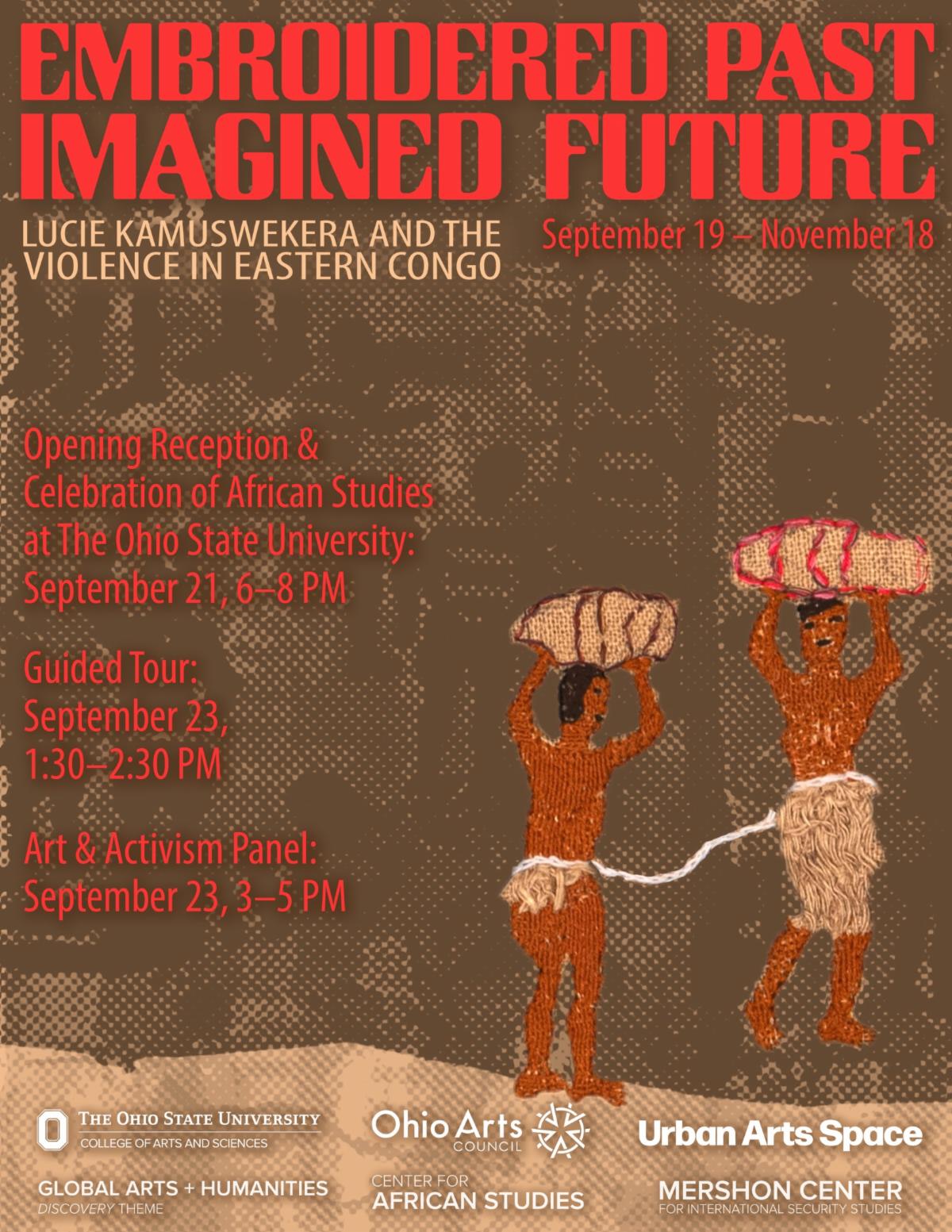
Embroidered Past, Imagined Future: Lucie Kamuswekera and the Violence in Eastern Congo
Urban Arts Space (50 West Town St. Suite 130, Columbus Ohio)
The exhibition introduces the work of Lucie Kamuswekera, an 80-year-old artist from the city of Goma in eastern DR Congo. By embroidering images about her country’s past and present on burlap sacks, Kamuswekera has visualized a regional history that reflects on the historical roots of its contemporary violence. Kamuswekera sees herself not only as an artist but also as a historian and educator who wants to help shape the future of her country. This exhibition will be the first introduction of Kamuswekera’s work to an American audience.
Website
Image courtesy of Urban Arts Space
| |
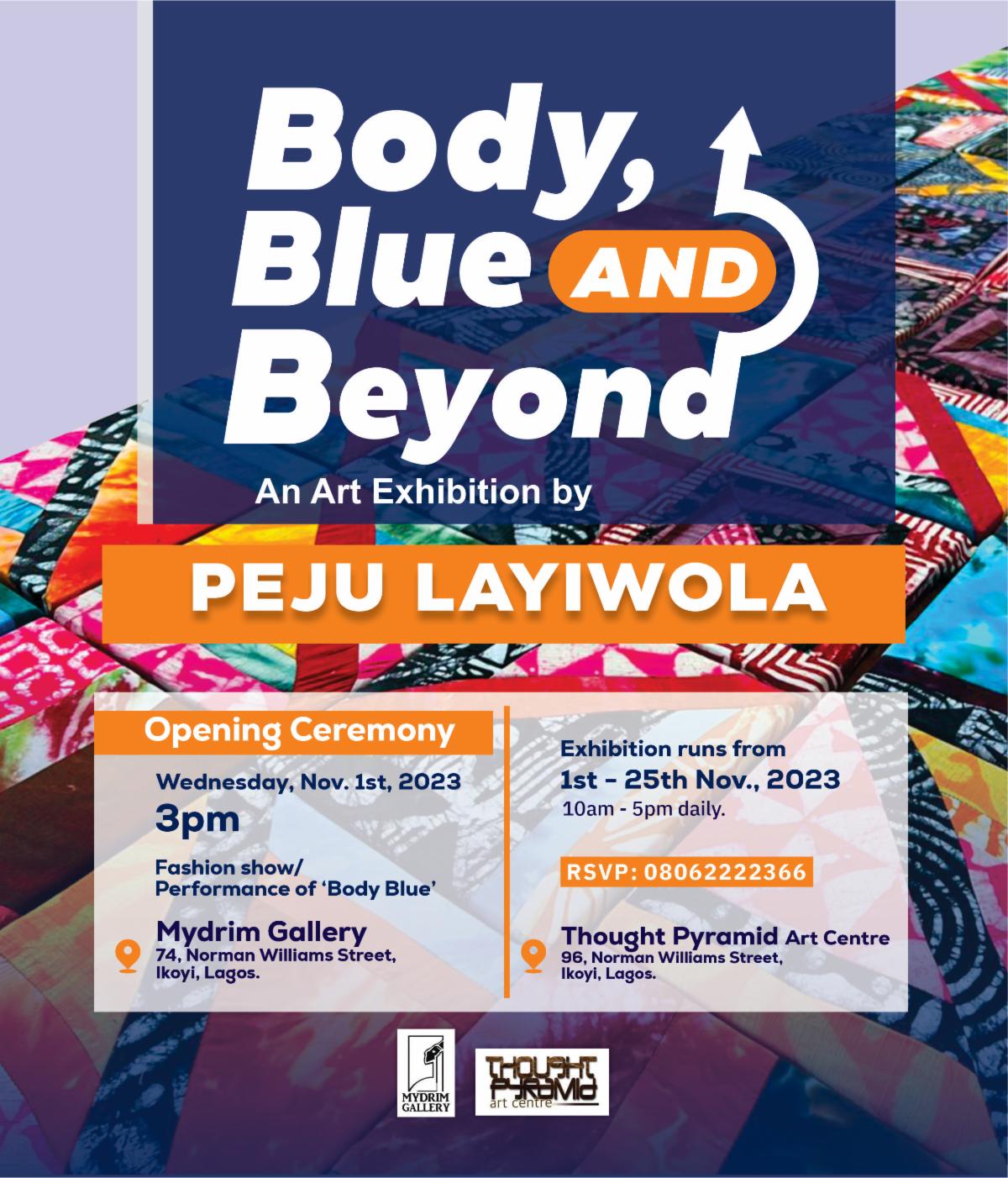
Body, Blue, and Beyond – Peju Layiwola
Body, Blue, and Beyond builds on my previous solo exhibition, Indigo Reimagined (2019), which explored the historical references to sartorial traditions and textile production processes in Southwest Nigeria.
This new iteration places the body as a canvas for adornment. The body also plays a pivotal role in the video and performance piece titled "Body Blue" which harnesses the effect of sounds such as running water, sewing machines, and laughter to convey the essence of the body in both labor and leisure.
Yet, within these seemingly busy spaces, profound expressions of the postcolonial condition emerge. The continuous ripping of fabric symbolizes the dismantling of colonial structures and the tearing of mass-produced copies of àdìre textiles flooding the local markets in Nigeria reserves as a poignant reflection of the existing tensions within today's marketplace. At the heart of this narrative is a profound commitment to addressing ecological concerns.
'Beyond' in the exhibition title serves as a projection into the future. This solo exhibition by Peju Layiwola provides a comprehensive experience that includes fashion, video, performance art, installations, and relief sculptures.
Website
| | Workshops, Symposia, and Lectures | |
2024 ACIP Workshop
The African Critical Inquiry Programme (ACIP) is pleased to announce that the 2024 ACIP Workshop will be Multispecies Stories from a Southern City. The project was proposed by organizers Shari Daya and Pippin Anderson, both in the Department of Environmental and Geographical Science at the University of Cape Town.
Website
Facebook
| |
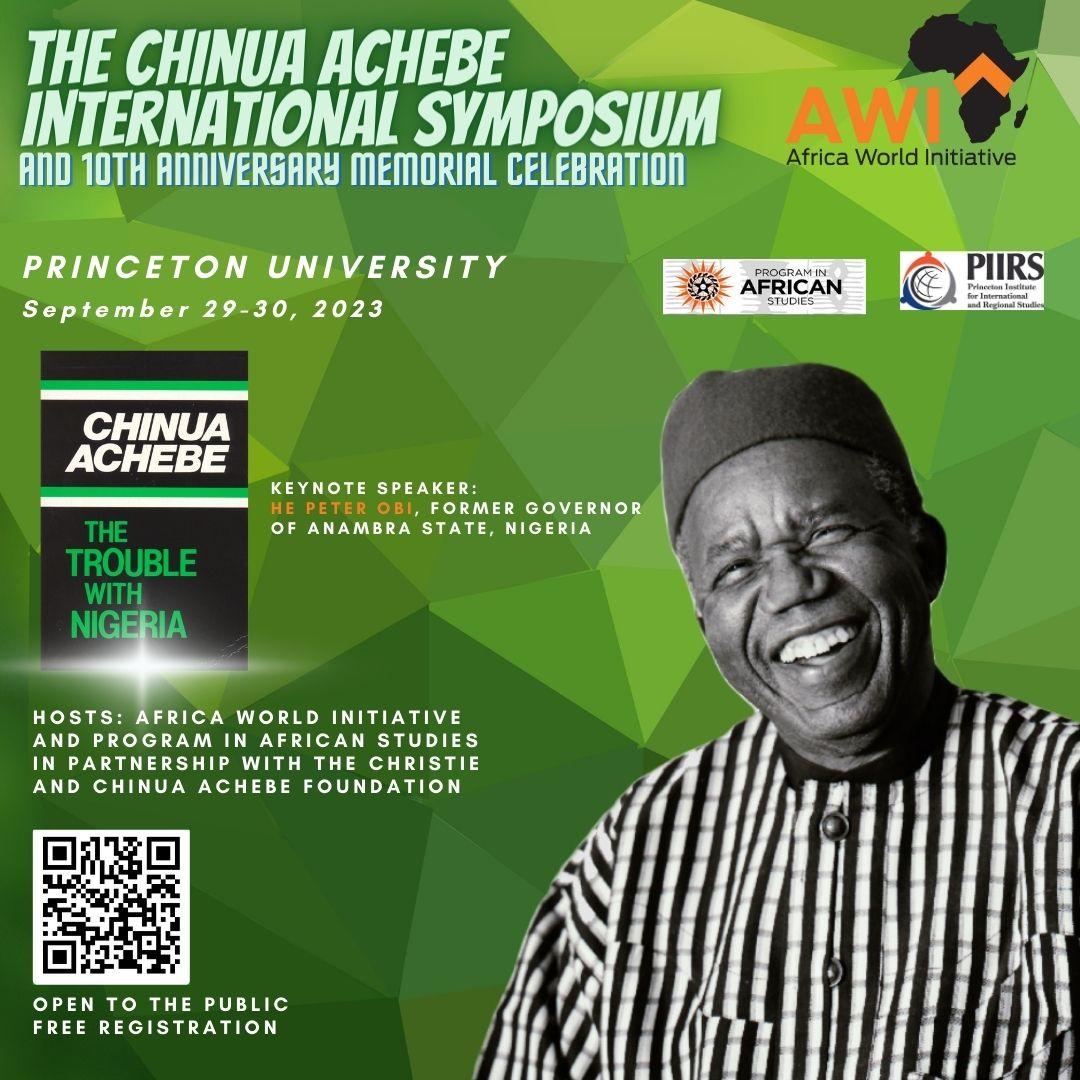
Chinua Achebe Symposium and 10th Anniversary Memorial
Princeton University’s Africa World Initiative and Program in African Studies in partnership with The Christie and Chinua Achebe Foundation will host the Chinua Achebe Symposium and 10th Anniversary Memorial celebration on Sept. 29th and 30th.
The symposium, with an international cast of senior and emerging scholars, marks the 40th anniversary of Achebe’s blistering political treatise The Trouble with Nigeria. Three panels will examine new directions in Achebe studies, the politics of canonicity, and African literatures in the age of historical reckonings, while a roundtable discussion focuses on leadership and statecraft in Nigeria and Africa. HE, Peter Obi will give the keynote.
The memorial celebration will be graced by HRM, Igwe Alex Onyido, and will feature tributes by Abena Busia, Toyin Falola, Simon Gikandi, Richard Joseph, Anthonia Kalu, Oseloka Obaze, Sonia Sanchez, and Obiora Udechukwu; readings by Patrice Nganang and Chika Unigwe, and more.
Submitted by ACASA member Chika Okeke-Agulu, Robert Schirmer Professor of Art & Archaeology and African American Studies, Director, Africa World Initiative and Director, Program in African Studies, Princeton University.
Website
| | New/Updated Resources and Research Platforms | |
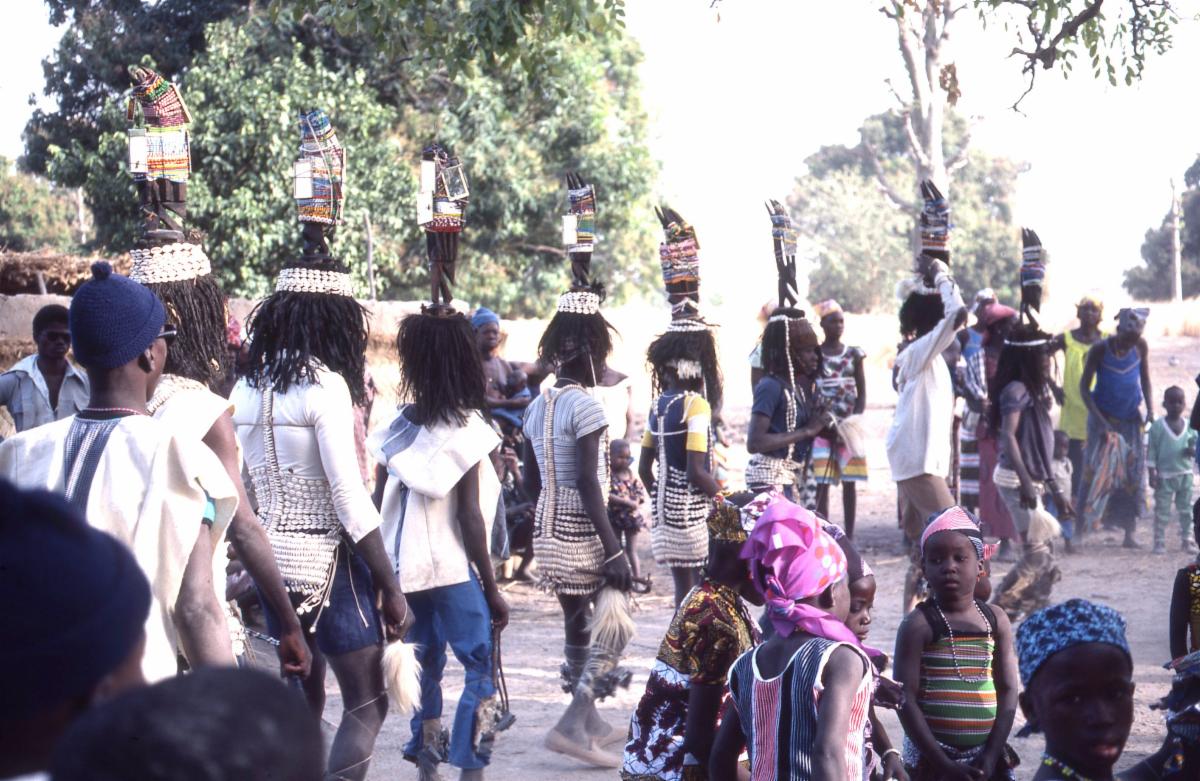
The National Museum of Mali receives a grant from the Modern Endangered Archive Program to digitize analog photographs in their collections.
The National Museum of Mali has been awarded a grant from the Modern Endangered Archive Program (MEAP). Project Leads: Barbara Frank (ACASA member), Daouda Keita, Joseye Tienro, & Safiatu Sangare.
The Museum's mission is one of collecting and conserving objects of cultural heritage and disseminating knowledge through exhibitions, public events, and school programs. Since the early 1980s, the Museum has documented performances, events, and traditional artistry through a variety of means, including analog photography. Many of the practices recorded in these images are threatened by current political and economic crises and insecurity in the region, while others have disappeared altogether. Engaging with this archive will provide scholars, teachers, and Mali's future generations a window into Mali's rich cultural patrimony. Making these materials available through UCLA's library will provide international educators, curators, and scholars with critical and ethically sourced materials created, collected and curated by Malian professionals, giving them credit where credit is long overdue. Encouraging scholars and museums to make use of these resources aligns with ongoing efforts to decolonize scholarly and curatorial practices.
Image: Joden performance. Dényékoro, Diöla cercle, Koulikoro region, Mali,1983. Photo by Chieck Oumar Keita for the National Museum of Mali.
| |
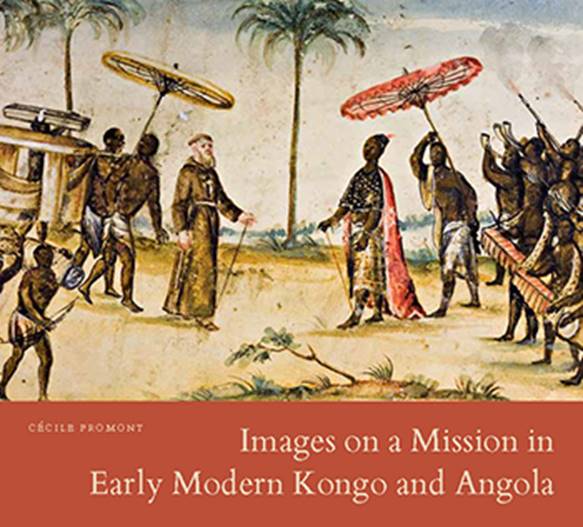
Spirited Arts: Religion and Expressive Cultures in Africa and its Diasporas
Yale University, New Haven – February 9, 2024
Organized by Jordan Fenton and Cécile Fromont
This colloquium seeks to explore new perspectives on the multivalent intersections between religion and expressive cultures in Africa and its diasporas. Scholarship on expressive culture has tended to focus on issues of power, identity, trade, global and local interactions, modernity and post-modernity, etc… However, it is clear that religion and spirituality have participated in and shaped every one of these aspects of lived experiences. We seek papers with renewed analytical attention to the intersections between expressive cultures, religions, and spirituality in Africa and its diasporas. It is our hope that the presentations will form the basis of a special volume in the Journal of Religion in Africa. Please find the full CFP with this link.
One-page proposals for 20-minute presentations should be sent to Jordan Fenton by 15 November 2023 with the subject “Spirited Arts Proposal.” Selected participants will be contacted shortly thereafter. Funding is available to support travel and lodging costs associated with participation in the conference.
| | Jobs, Fellowships, Internships, & Research Awards | |
Boston College –– Assistant Professor in African and/or African Diaspora Art History
The Art, Art History, and Film Department (AAHF) and the African and African Diaspora Studies Program (AADS) at Boston College invite applications for the jointly appointed position of full-time, tenure-track Assistant Professor in the field of African and/or African Diaspora Art History, to begin July 1, 2024. The successful candidate will be a core faculty member in the AADS Program, and their tenure home will be in AAHF. We seek candidates with robust and innovative research agendas and a commitment to undergraduate teaching. Applicants may specialize in any area of African and/or African Diaspora art or architecture, especially regions outside of the U.S. Each academic year, the appointee will teach five courses, including an introduction to African and African Diaspora art history, upper-level art history courses in the candidate’s areas of specialization, and self-designed courses that will also serve AADS.
For details and to apply please visit Interfolio
Applications due 1 November 2023
| |
Rollings College –– Asst. Prof. of Modern & Cont. Art History (1800-present), tenure-track, with a focus in African American or African diaspora, incl. Caribbean
The Department of Art and Art History at Rollins College (Winter Park, Florida) seeks an Assistant Professor of Modern & Contemporary Art History (1800-present), tenure-track, with a research & teaching focus in African American Art History or the African diaspora, which may include the Caribbean. Ph.D. & teaching experience required. Especially welcome applicants with interests in justice, interdisciplinary teaching, & the development of courses addressing cross-cultural themes. Preference to candidates from marginalized communities and applicants with experience in object-based teaching, community engagement, and/or digital humanities. Opportunities exist for robust partnership with curricular programs in African & African American Studies, Latin American & Caribbean Studies, American Studies, and Sexuality, Women’s & Gender Studies, as well as with the Rollins Museum of Art, which includes the Alfond Collection of Contemporary Art. Community engagement opportunities include the Hannibal Square historic neighborhood, nearby Eatonville, the Zora Neale Hurston Museum, and the Morse Museum of American Art. Duties include 3/3 teaching load, scholarly research & publications, advising & other service to the department & the college.
Deadline 15 November 2023
Apply here
| |
Tenure-Track Assistant or Associate Professor of African Art History ––
Tulane University New Orleans, Louisiana
Review of applications begins November 15, 2023
Apply here
| |
New Orleans Museum of Art ––
Curatorial and Programs Assistant
The New Orleans Museum of Art seeks a two-year, grant-funded Curatorial and Programs Assistant to support programmatic and exhibition activities for the major traveling exhibition and publication project New Masks Now: Artists Innovating Masquerade in Contemporary West Africa. Reporting to the Curator of African Art and Director of the New Masks Now project, this highly organized, collaborative planner and researcher will work closely with the exhibition core team, and with NOMA’s Curatorial, Learning & Engagement, Registration, and Marketing departments. Aimed at early career professionals preparing for museum or arts administration work, this hands-on position will collaborate with multiple departments in realizing all components of a major exhibition project.
Salary is $50,000 per year, plus benefits.
Please submit your resume or CV, graduate school transcript, writing sample, cover letter, and three letters of reference via email by 4:30 pm, Friday, 3 November 2023.
For the full job posting, click here
NOMA is an Equal Opportunity Employer and is committed to complying with all federal, state, and local equal employment opportunity laws.
| |
Michael C. Carlos Museum Emory University –– Curator of African Art
The Michael C. Carlos Museum at Emory University seeks an experienced professional and an accomplished scholar to serve as curator for its collections of African Art. The collection serves as a strong resource for thinking about the history of African art history and showing the dynamism of the continent, as well as questions of authenticity, provenance, representation, and display.
Apply here
| |
2023 Ivan Karp Doctoral Research Awards
The African Critical Inquiry Programme has named Nina Barnett and Tendai Ganduri as recipients of the 2023 Ivan Karp Doctoral Research Awards. Barnett, a South African student in the Department of Visual Arts, is working on her PhD at the University of Johannesburg. Ganduri, a Zimbabwean PhD student in Media Studies, is studying at the University of the Witwatersrand. Support from ACIP’s Ivan Karp Awards will allow each of them to do significant research for their dissertations. Barnett will do field trips and research for her project, The Intra-active Vaal Dam: Tracing Water to Landlocked Johannesburg. Ganduri will conduct fieldwork in Zimbabwe and South Africa for her project Communicating and Contesting Climate Change: The Zimbabwean and South African Twitterspheres.
Announcement made by ACASA member Corinne Katz (ACIP Director)
Website
Facebook
| | |
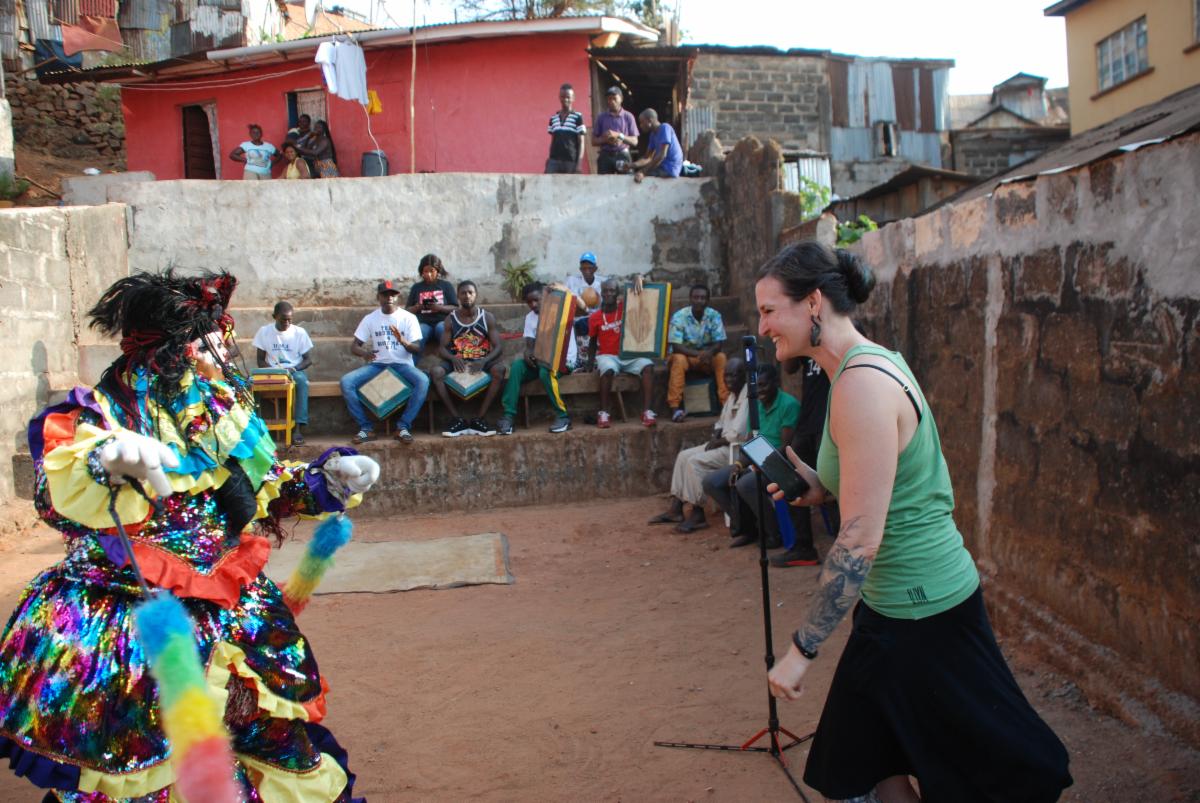
The New Orleans Museum of Art appointed Amanda M. Maples as Françoise Billion Richardson Curator of African Art. Maples will work to expand the geographic and chronological scope of the African art collection with a contemporary vision and lead installation and interpretive strategies for the museum’s significant collection of historic African art, considered one of the most important in the United States.
Maples comes to NOMA from the North Carolina Museum of Art, where she was Curator of Global African Arts and served as visiting faculty in the Department of Art & Art History at the University of North Carolina, Chapel Hill. She has curated a range of exhibitions and written essays, books, and articles on historical and contemporary African arts, decoloniality, museum policies, collecting practices, and restitution.
Maples is currently leading the team of curators organizing New Masks Now: Artists Innovating Masquerade in Contemporary West Africa, scheduled to open at NOMA in 2025. The exhibition examines West African masquerade as a fundamentally contemporary practice and marks a significant collaboration between North American and African institutions, including NOMA and the Museum of Black Civilizations in Dakar, Senegal.
Photo: Curator Amanda M. Maples participating in a Jollay Society performance with the Tabenu Cultural Group in Freetown, Sierra Leone, April 2022. Photo by Alpha Kanu.
| |
Looking for more?
Disclaimer: ACASA is not affiliated with these sites and is not responsible for their content
| | | |
With global membership, the Arts Council of the African Studies Association (ACASA) promotes greater understanding of African material and expressive culture in all its many forms, and encourages contact and collaboration with African and Diaspora artists and scholars.
ACASA is a 501(c)(3) tax-exempt organization.
| | | | |