The content in this preview is based on the last saved version of your email - any changes made to your email that have not been saved will not be shown in this preview.

WELCOME!

The Canadian squash community is indebted to individuals such as yourself who give their time and commitment to the betterment of the game. Thank you for your continued involvement in the Squash Canada Officiating program and your continued commitment to upholding the rules of our sport. 


Please enjoy this edition of the Behind the Glass Officials eNews. - Curtis Gillespie, Chair of the Squash Canada Singles Officiating Committee

TIME FOR GLORY

With the increased activity, we have some good news to announce this time around with the following promotions:


  • Amir Shemirani, Chris Doyle, Noman Ahmad, David Young, Thierry Lapointe, Rick Thiessen, Graham Allardice, George Yacoub, Michal Konopinski, Daniel Gana, Jay Schwartz, Jeff Cook, Kiowa Martin, Hengameh Habibpour, Timo Bolder, Sergio Andaloro, and Gwynne Bykowski: to LOCAL REFEREE
  • Rob Davies: to PROVINCIAL REFEREE
  • Randy Fransoo, Simon Bicknell, and Ted Horbulyk: to PROVINCIAL ASSESSOR
  • Ben Groot: to NATIONAL REFEREE


If we’ve missed you on promotion, or you would like more details on what you need to progress, or any other program questions for that matter - please contact Dave Howard at dave.squash@gmail.com or Geoffrey Johnson at geoffrey.johnson@squash.ca.  

SQUASH CANADA REFEREE FIELD OF PLAY CODE OF CONDUCT REPORT FORM


Squash Canada has revised the form as of September 2023 and now asks all referees to submit Field of Play Code of Conducts via the online form.


Field of Play Code of Conduct Form

REF DISPATCHES FROM NEAR AND FAR


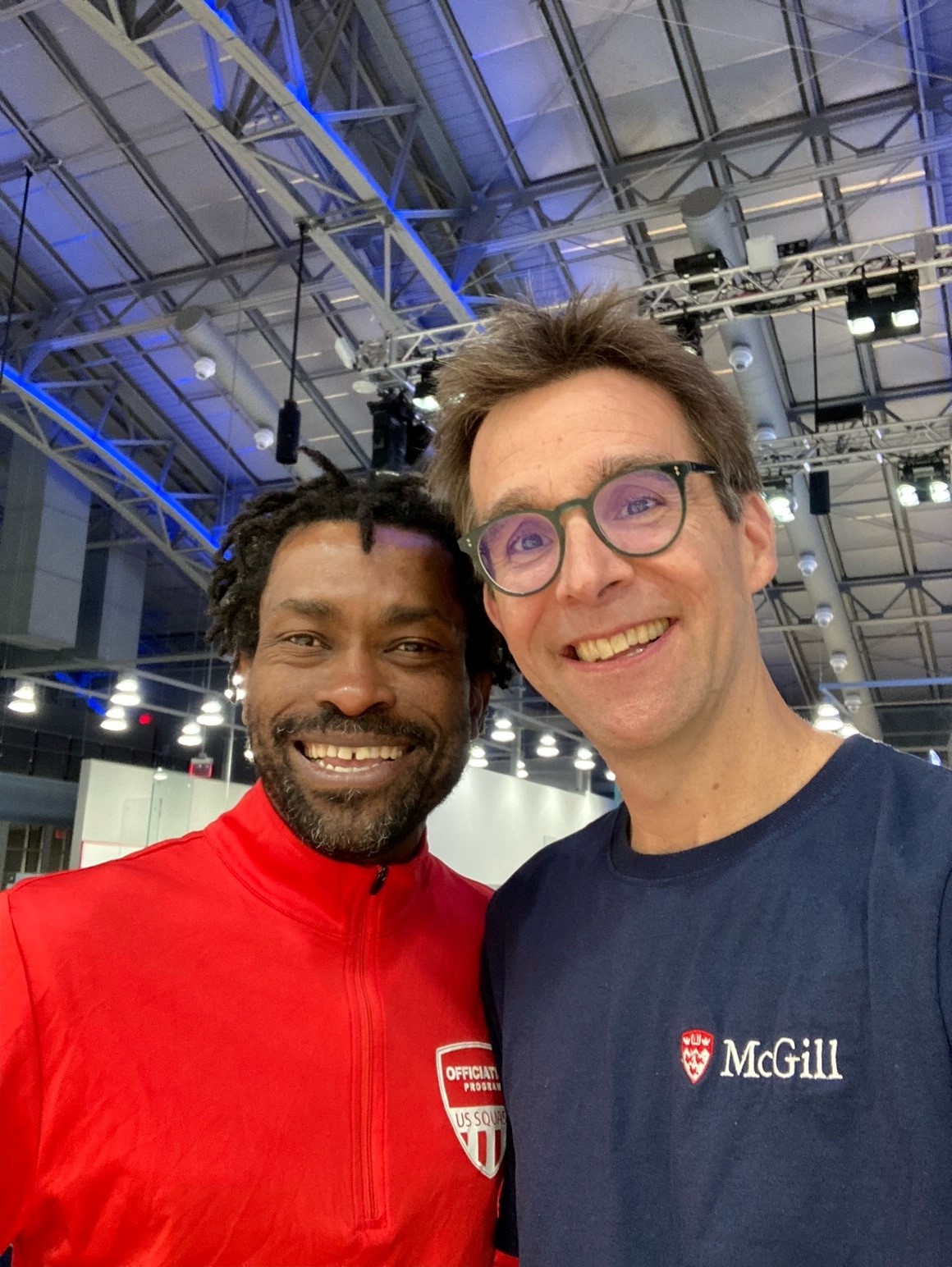
Viano Oghenekevwe was part of the officiating crew at the College Squash Association Team Championship in Philadelphia in March, and Simon Bicknell was simply a fan cheering on his daughter who attends Stanford.


"What an electric atmosphere! You couldn't help but get drawn in to almost any match especially if I came down to the last match to determine which team won." - Simon Bicknell, National Referee (BC)

RULES NITTY GRITTY


Clamping Down on Professional Behaviour (And What That Means For the Rest of Us)


In recent weeks and months, the PSA Tour has “clamped down” on negative player interaction with officials. Let us explain and we’ll try to keep it brief. After squash was accepted into the 2028 LA Olympics, US television executives met with some of the head honchos in the squash world to talk about how best to televise the tournament moving forward. These executives, who were not squash-savvy, attended a high-profile event in the United States and watched numerous matches. During those matches, there was player interaction with the officials that was less than respectful, to put it mildly. The TV executives said, to paraphrase, “If this is what squash is always like, we can’t put that on TV.”


The PSA leapt into action and produced a directive stipulating that, again to paraphrase, the players had to stop talking disrespectfully and in general stop talking so much, and that if they chose to persist, officials were not only empowered but encouraged to assign harsh penalties to the behaviour. There has been a rise in Conduct Strokes for Dissent on tour since that time, but also a decrease in negative player commentary. It remains to be seen how it will all play out, as it’s still early in the life of this new directive, but the broad point is clear—if squash wants a bigger audience, it has to make itself more enjoyable to watch. 


What this means for all of us working as referees in various other events and leagues, from National and Provincial championships to our local club league, is that there will be less and less tolerance for bad behaviour and poor sportsmanship. Too many potential refs don’t pursue it simply because they don’t like the confrontational nature of so many players. Lots of us, including most juniors, pick up our habits from watching the pros. Let’s hope that there is a “trickle down” effect of more respectful behaviour from the pros for all of us to model off of. And let’s also all remember that the hierarchy of the sport, in the form of the PSA Tour, is telling players to show some respect or expect to get penalized. This is yet another reason why the rest of us should simply enforce the rules and penalize dissent and poor sportsmanship. It will make the game better in the end!

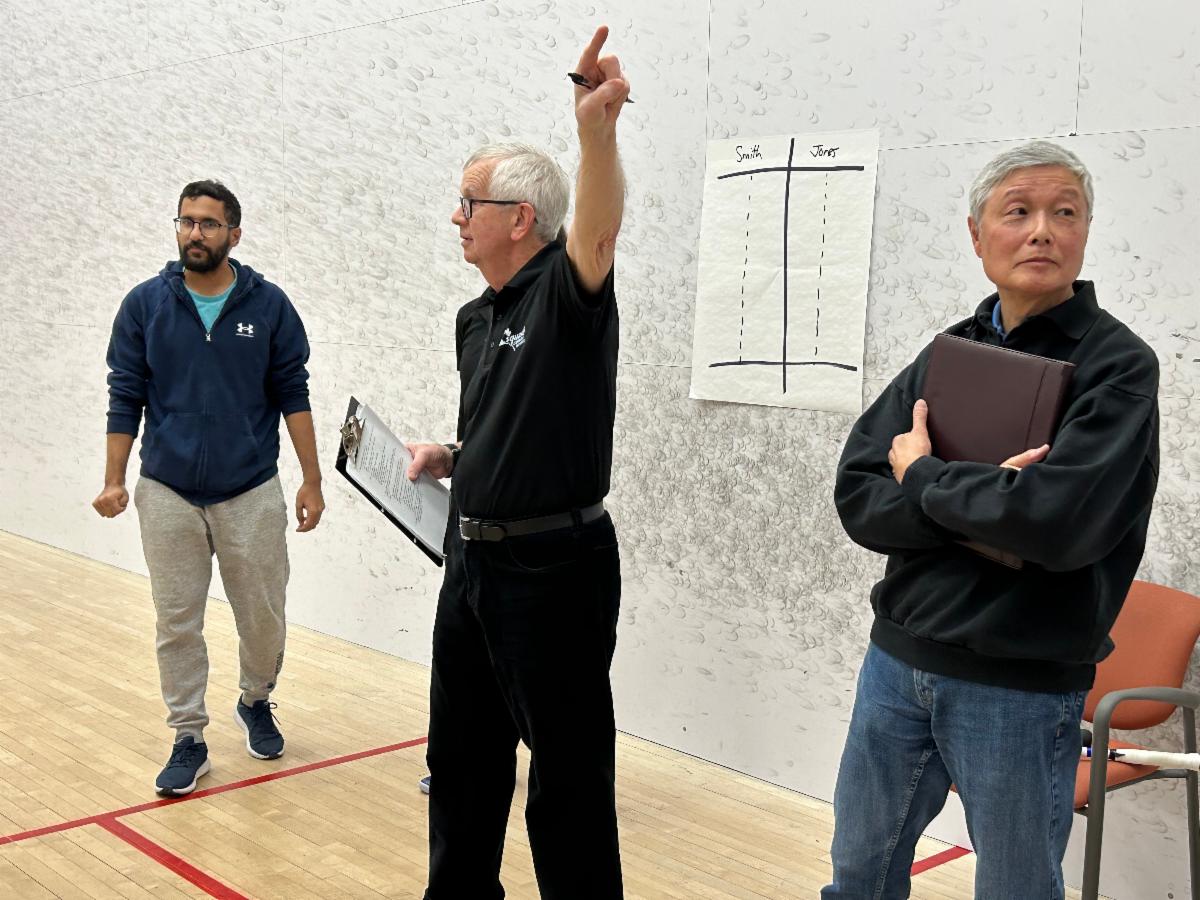
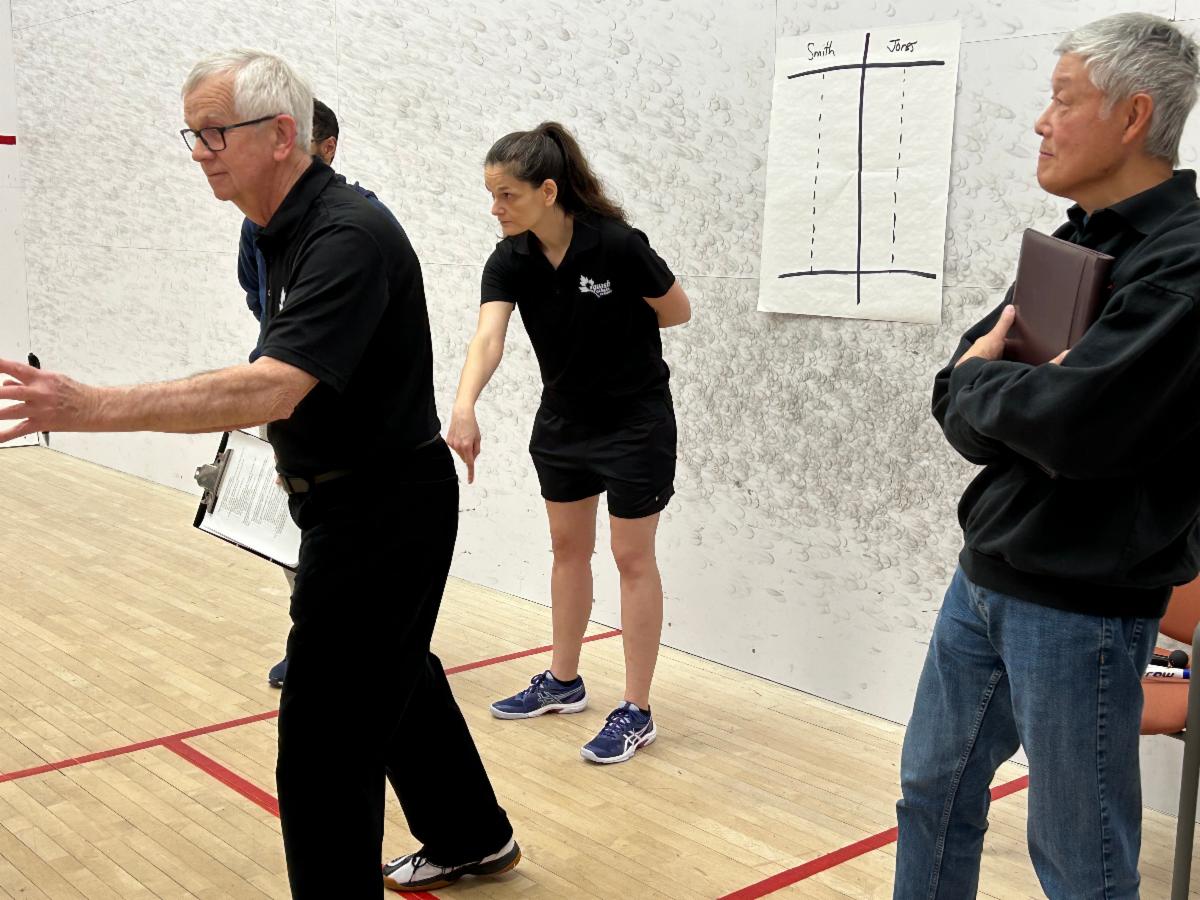
PROVINCIAL REFEREES IN NOVA SCOTIA HOSTED A BEGINNERS REF CLINIC ON LADIES NIGHT


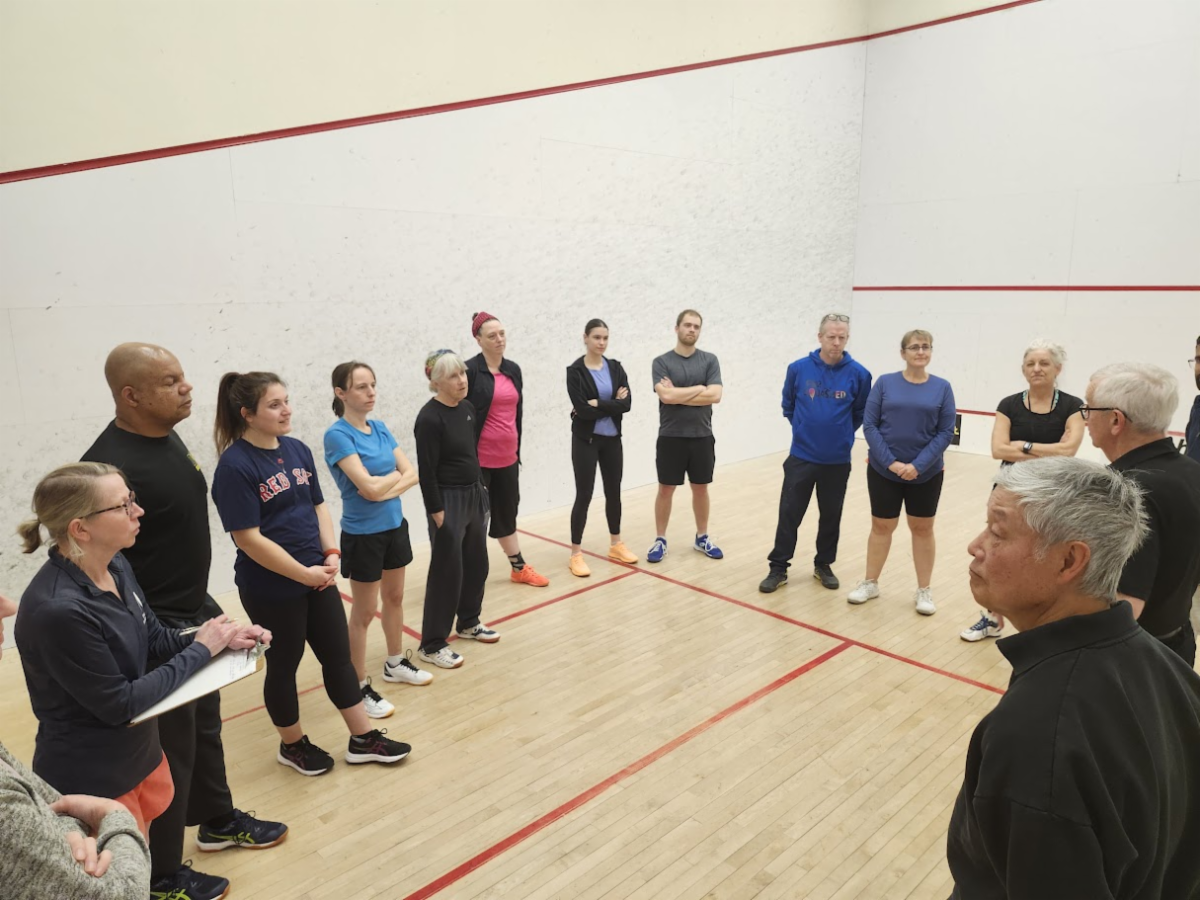
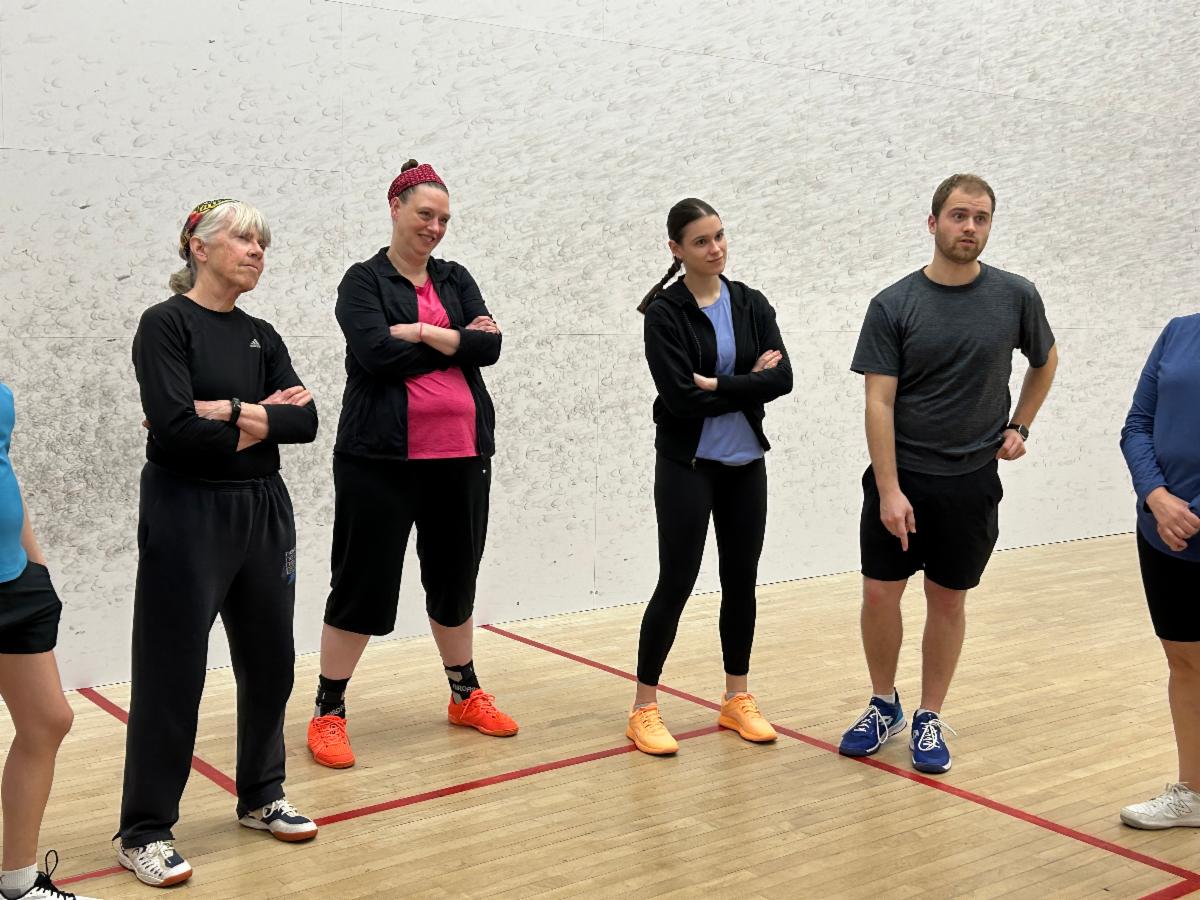
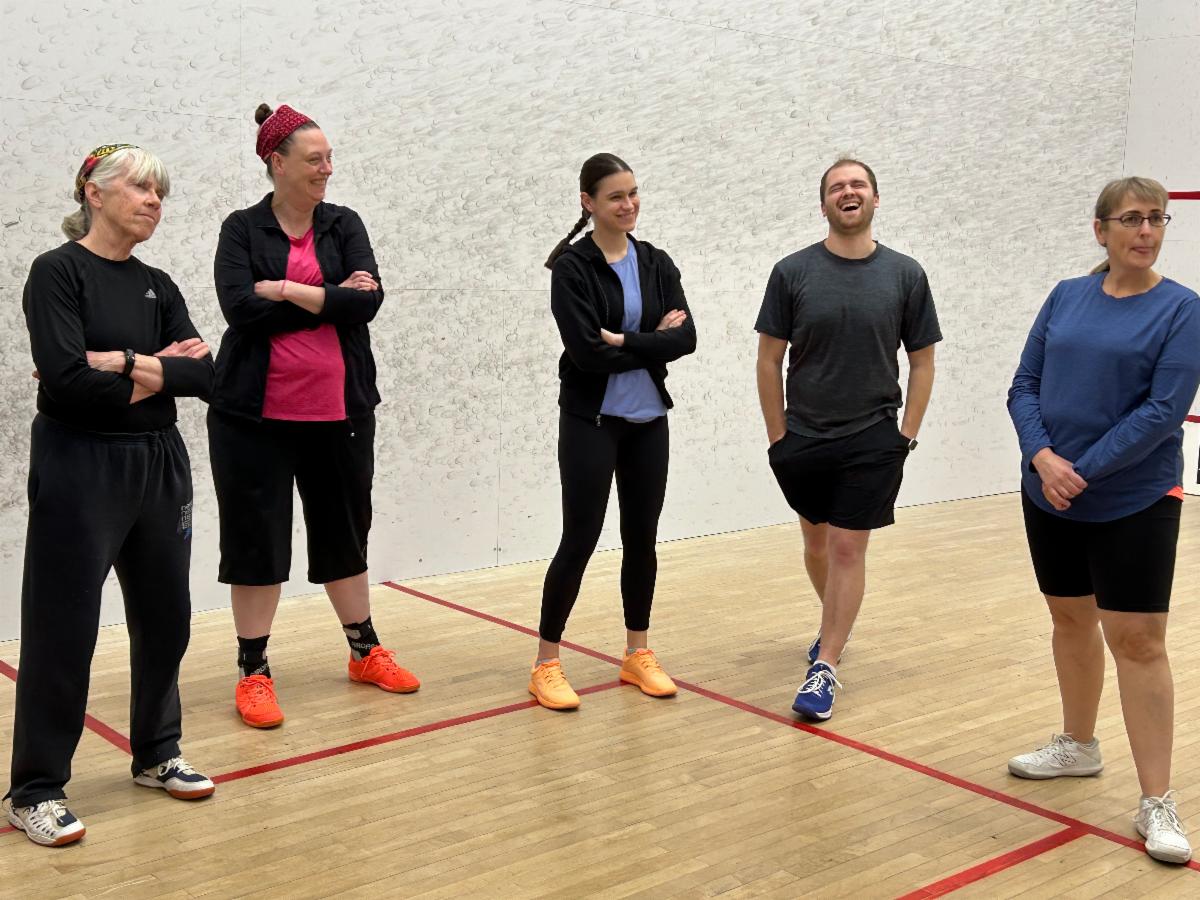
Four provincial level referees hosted a ref clinic for beginners, on Monday, March 18 at SMUfit (Saint Mary's University) in Halifax, NS. Everybody was welcome to join and Craig Potts set up the Club Locker registration. Monday is usually Ladies Night, organized by Judy Myrden, but everyone was welcome to join the ref clinic.


The four officials were: Lee Kirby (lead and organizer), Thom Hori, Abdelrahman (Abdo) Abdallah and Elvira Mitraka. We had a turnout of 15 participants for a 60 minute session.


The format was informal but informative, with emphasis on basic calls (i.e. what is down, not up etc.) as well as some hypothetical scenarios. The participants had lots of good questions and were engaged throughout.


After the 60min session, Ladies Night was in full swing and Elvira stayed behind to make calls and explain the reasoning behind the decision. 


Overall, it was a very good night and everybody learned something. We plan on having another session with more advanced topics and want to include the scoring rules and how to use the tablet and the software.


Photos below courtesy of Judy Myrden.

SQUASH CANADA and ABUSE-FREE SPORT

Introduction to the UCCMS eLearning Module


Learn about the UCCMS (Universal Code of Conduct to prevent and address maltreatment in sport) by completing this short education and training module.

SQUASH CANADA'S QUALITY COTROL PROCESS (QCP) FOR NATIONAL LEVEL REFEREES AND ASSESSORS


The purpose of our QCP processes is to make sure that our National level Referees and Assessors maintain their skills. Feedback from other high level Referees enables us to fine tune our skills in both the Refereeing and Assessing areas and keep up with high level trends in officiating even if we are unable to get that training at high level events. The process involves mandatory annual activity reporting to make sure you’re keeping active, periodic assessments while refereeing, and , if you’re an Assessor, periodic assessments in your role as an Assessor. This process is meant to be a positive experience, not punitive, and can allow you to continue to operate at a high level as a Referee and/or Assessor . Without this process in place, there would be larger inconsistencies in the Refereeing across Canada.

SQUASH CANADA OFFICIALS WEBSITE / DATABASE 


We have to repeat that this is the site for Canadian refs to find out pretty much everything about our program.


Check out the ‘Reports’ menu option to find the information on all our Referees, the status of your overall match assessments, individual competency assessments, and assessments you have done on others if you’re an Assessor. As well, PT Administrators can view all of this information for members of their association. These reports can be sorted by any of the column headings (Name, Province, Referee Level,…) and can also be downloaded to an Excel compatible file.


There have also been some enhancements to information in your profile (Click on your Name in the upper right corner next to ‘Log off’). To keep your P/T association current, please take this opportunity to update your profile, especially your contact information.


Linked here

INITIAL CERTIFICATION


If you have friends interested in becoming certified as a ref, remember that for a couple of years now – there is only one way. Local clinics as vehicles for initial certification are now a thing of the past, making the online course the only option – which standardizes the process nationwide. So now, to become a certified Referee (i.e., Club Referee), a candidate will need to successfully complete the Online Referee Certification Course and its exam. All this can be found at the LOCKER section of the CAC (Coaching Association of Canada).


Along with this change, Squash Canada makes available to P/Ts, through our database, a selection of teaching materials – including the revised PowerPoint Rules Clinics and related video modules designed to ensure uniformity of content across the country.

Squash Canada’s Officiating Program is consistently recognized as one of the best in the world. We regularly produce top-tier Referees who are invited to work at some of the world’s biggest tournaments, including such events as the Commonwealth Games, the Pan Am Games, the Tournament of Champions and the World Championships. We have a long history of skilled and passionate volunteers who dedicated countless hours to creating, refining and implementing a huge variety of programs for Referees and Assessors. This list includes such people as Graham Waters, Adeline Clements, Barry Faguy, Guy Vigneault, Wayne Smith, Gerry Poulton, Dave Howard, Bob Mansbridge, Penny Glover, Denise Ferry, Joe Ellis, Chris Yap, Grant Currie, Rod McDougall and so many more. 


Having said that, Squash Canada is always looking for ways to evolve its officiating program where and when evolution will make it better and make squash reffing better around the world. One of the ways we’ve chosen to do this is to become a member of the WSO (World Squash Officiating). For a long time, officiating around the world was heavily siloed and inconsistent. The goal of the WSO is to harmonize this world and bring a set of common standards to the practice. A meaningful discussion with the WSO across a number of years worked both ways—the WSO was able to benefit from the expertise of Canadian officials and assessors, and now Canada will benefit from aligning itself with the WSO as it modernizes officiating around the world. The WSO has standard development pathway available and has a wide array of resources, including an excellent video library with visual examples of interference associated with different rules.  


Squash Canada will maintain control of progression up to and including our National level (WSO Level 3).  The WSO offers a development pathway through its Levels 0, 1 and 2 that roughly conform to our Club, Local and Provincial levels. WSO has training modules and associated exams for each of their 6 levels.  To participate in PSA events on the World Tour, Squash Canada Referees will need to be qualified at least to WSO Level 3, even if they are National Level in Canada. After achieving National status and WSO 3 status an official who wishes to work at increasingly bigger events can migrate directly to the WSO pathway to pursue WSO 4 and WSO 5.


The WSO is evolving and Squash Canada is pleased to be part of the work that will result in a higher and more uniform standard of squash officiating around the world. Decades of hard work by numerous volunteers and great refs resulted in a strong reputation for our officials, a reputation that allowed us to play a role in the development and ongoing refinement of the WSO.  

In case you’ve never been there, our Officiating Program has its own YouTube site where video modules (listed in the ‘Resources’ area of our Squash Canada Officials website / database) are available for immediate playback – without any time-consuming download time unless of course, you want the module stored on your own computer). TIP FOR USE: Simply click on the camera icon to the right of the title.  

IN THE CHAIR


Profiling Canada’s Squash Officials

David Fishburn


Dave Fishburn has been reffing regularly around Canada for many years now at a high level, and if you’ve been lucky to be at an event with him, you’ll probably also know that he’s a pretty savvy card sharp. “Fish” as he is known to many, got involved in reffing like many other refs before him—by playing the game first. He began playing in university and was soon hooked. Years later, he introduced his eight-year-old daughter to squash and started watching her play. He was also playing in a local league, and he began to question the calls of his own teammates on league nights but had no idea how to explain or articulate why they might have been incorrect.


Enter Simon Warder, an experienced southern Ontario ref. Dave was watching his daughter play in provincial events that had official referees in attendance and when Dave had a question, he approached Simon, who patiently walked him through various lines of reasoning, rationales for calls and how to address different types of situations. This planted the reffing seed in Dave.


Sadly, Simon passed away, but Dave decided that if he was going to be attending tournaments with his daughter, he might as well make himself useful anyway. That was the start of his journey to where he is today as an experienced National official.


Dave, thank you for sharing your story with In The Chair!

My pleasure.


Just off the bat, tell us what you like about being a squash ref?

The goal of a referee is for a fair outcome. Most matches are exactly that, but for those situations where a player looks for an advantage, a good referee can keep things balanced. Keeping matches free flowing and fair is a great reward. Referring is not easy, but it has been a very satisfying road to date and has brought me many experiences I treasure. As a referee, I also get to see some pretty amazing squash all from the best seat in the house! I have had some great opportunities while referring. Some of the Pan America Games with referees all over North and South America have been a real highlight.


You’re known for being both professional but also fun to work with. What are some of the fun or dramatic moments you’ve had?

Refereeing can be a stressful experience, which means it is nice to balance it with fun. After being done for the day, most referees I have worked with like fun banter and not taking each other too seriously. We play squash together and sometimes lots of cards.

You’ve no doubt seen a lot of things as an official. What stands out as a peak moment for you or just something you'll always remember?

In the Cayman Islands, I learned the true cost of being a world class squash player. Conditions were incredibly hot, and all players needed ice baths to continue during the week. Playing at such a ferocious physical level requires an amazing investment.


Do you remember any difficult matches and how you managed to control them?

Many, many difficult matches, that is why National referees get paid the big bucks! Each match, each tournament, we always see something new. That slowly gets added to our experience. We draw from that experience to decide how and when to step into a match. The best referees see a problem coming, and deal with it before it becomes a problem. That said, where matches have a lot of line, you still need to use all the tools you have learned over the years.


There is a lot of pressure in squash reffing. How do you handle it and what advice do you have for others on how to deal with it?

Player reactions / behaviours are an excellent feedback mechanism. If players are happy on court, it is some combination of an easy match or the referee making good calls. As matches get more difficult, we can use that feedback to help understand where the players are with each other, and the referee.

What rule would you most like changed?

I would say the rule about players deciding when they want to hit the ball on swing interference calls. Which means they can wait until the other player is in their swing to get a stroke awarded to them. I find this particular rule is abused and shows poor sportsmanship. I would like to see that as a let or no let to allow the game to continue to flow freely.


Are there any players you’ve reffed who stand out? And why?

Mohamed El Shorbagy (former world number 1), I think he is a true champion. Even when he loses in an early round, though devastating, he understands it is usually a highlight of the other player's career. He always takes the time to have a short conversation with that player. It is remarkable when compared to many other players who storm off the court, or barely shake hands. He just shows how all athletes should behave, when winning or losing.


If you could say one thing to players, with no filters and no blowback, what would you say to them?

When refereeing players who have been playing most of their life, who ask for ridiculous lets, I would love to say to them, "Are you serious? You are actually asking for that? How long have you been playing squash?". But of course, the goal of the referee is to stay in the background in a match and be invisible. Egging on a player, though appealing, would never be good for the game!


You learned your craft mostly in Ontario. Who mentored you when you were starting out? What is the best advice you have been given?

The Ontario referees have been an unbelievably supportive group. Every referee has had some matches that make them think of hanging up the shirt. Learning how to accept your role in the match, where you went wrong and address it for future matches is invaluable. That process takes time and support at all levels. I have been very lucky to have many mentors, but David Howard and Greg van Staveren have provided me some key moments during my development.


What advice would you give to emerging Referees?

Refereeing is very rewarding. Having a good mentor (or many in the beginning) and time in the chair reffing as many matches as possible is the fastest way to pick up the skills and patterns of referring. Anything valuable in the long run is worth the effort to get there.


Along those lines, how can we get more people interested in officiating?

A lot of people are afraid of being a referee. I think if people understood how supportive our group of referees are, they would be less fearful of starting up.


You’ve achieved a lot. Do you still have ongoing goals as a Referee?

Yes, I definitely have some goals. I would like to referee on the glass court at the Tournament of Champions and some of the other majors in North America.


Dave, thank you so much for sharing your story with us!

It’s been my pleasure. I hope we keep drawing more and more emerging refs into the fold. The more the merrier! More victims at the card table!

FEEDBACK AND INPUT


So that’s it for the spring 2024 edition of the BTG newsletter. We are all grateful to the gods of squash who it seems, have looked down favorably on us and have allowed our beloved sport to pretty much return to normal. Meanwhile, if you’ve got something to say, email Geoff Johnson (Squash Canada Chief Operating Officer) at: geoffrey.johnson@squash.ca  


View BTG Newsletter as Webpage

The SCOC wish to thank Dave Howard, Curtis Gillespie, Geoffrey Johnson, and Emily Hall for the great work in getting this issue of BTG out!

LinkedIn Share This Email

Squash Canada

Proctor Field House

Glendon Campus, York University

2275 Bayview Avenue, Suite 106B

Toronto, ON, Canada  M4N 3M6

Contact us: info@squash.ca

Facebook  Instagram
Squash Canada Partners