The content in this preview is based on the last saved version of your email - any changes made to your email that have not been saved will not be shown in this preview.

June 12, 2026 | 27 Sivan 5786 Candle Lighting in Miami 7:54 pm

Email not displaying correctly? View in your web browser

The Blacklist No One Wants to Discuss  

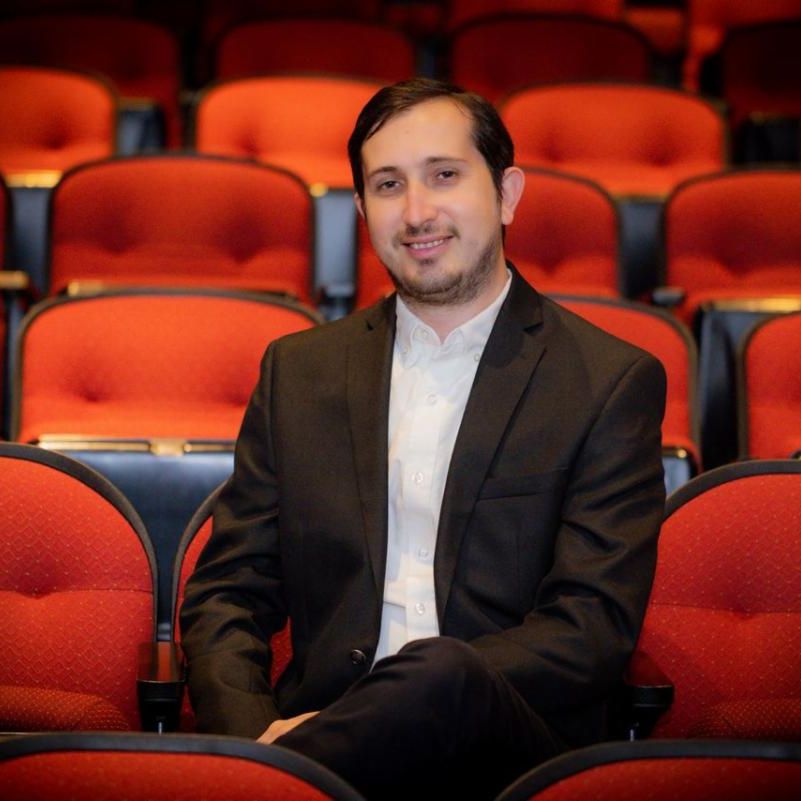
By Igor Shteyrenberg, Executive Director of the Miami Jewish Film Festival

Over the past week, one of the most troubling stories in the international film community has unfolded largely outside public view.


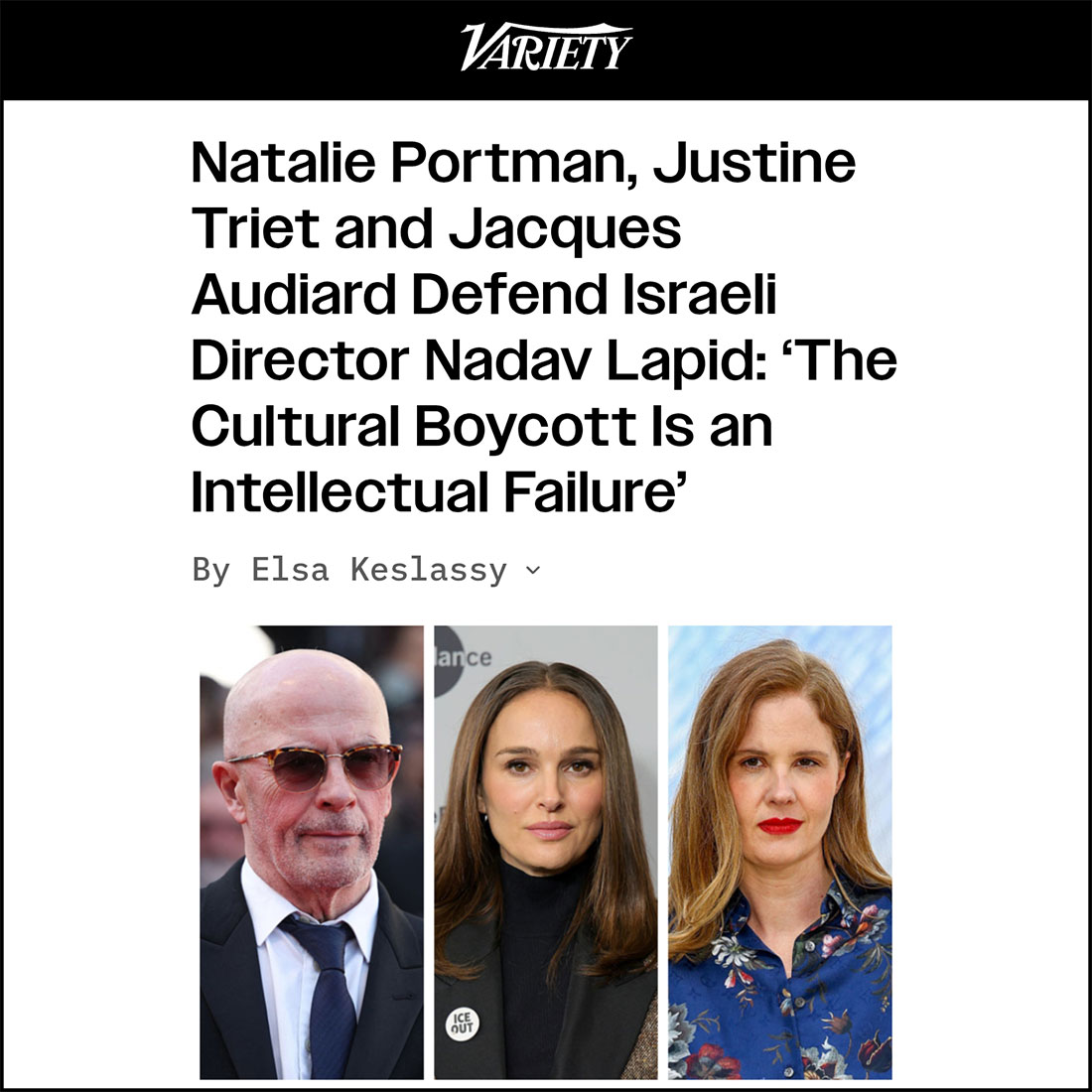
Israeli filmmaker Nadav Lapid — an acclaimed and internationally recognized director in his generation-- withdrew from the FIDMarseille film festival following a campaign of pressure surrounding his participation.


Several filmmakers reportedly withdrew their own work in protest of his inclusion, prompting a broader debate about artistic freedom, cultural boycotts, and whether artists should be judged according to their work or according to their nationality.


In response, an open letter signed by Natalie Portman along with numerous prominent filmmakers and cultural figures defended Lapid and warned against what they described as a campaign to exclude an artist not because of his films, but because of who he is.


Before anyone rushes to debate Nadav Lapid's politics, or even the merits of his films, a more fundamental question deserves our attention.


What principle is being established when an artist’s participation in cultural life becomes conditional not on their work, but on their identity?


I have no interest in framing this around whether one likes or dislikes Nadav Lapid’s films. That question is secondary.


The only question that matters here is whether cultural institutions are still governed by artistic judgment, or whether they are increasingly willing to judge artists according to their nationality, identity, or association with a country.

I encourage everyone to read the reporting and, in particular, consider one passage from the letter circulated in his defense that puts the issue plainly:


"In what way does the presence of a filmmaker on a jury or the screening of one of his films make him a representative of a state? Inviting an artist to a festival is not about elevating him to the status of a cultural ambassador, but about recognizing a body of work, a career, and a cinematic vision."


That question deserves a serious answer.


A film festival's responsibility is to evaluate films. A theater's responsibility is to present cinema. A cultural institution's responsibility is to foster engagement with art.


None of those responsibilities require judging artists according to their nationality, ethnicity, religion, or the actions of governments over which they have no control.


At this point, it is important to make a distinction that is too often blurred in these discussions.


Cultural institutions have every right to make programming decisions based on the content, quality, themes, or artistic merits of a work.


Every festival, theater, and museum exercises curatorial judgment. No institution is obligated to program every film simply because it exists.


Curation is not only legitimate; it is necessary.


But that is not what is at issue here.


A festival declining a film because it finds the work itself objectionable is making a judgment about art.


A festival declining participation because of a filmmaker's nationality, ethnicity, religion, or identity crosses the line from curation into discrimination.


That distinction matters.


The moment identity becomes the determining factor, artistic merit ceases to be the standard.


The artist becomes the subject of judgment rather than the work. And the consequences extend far beyond any single filmmaker.


For years, filmmakers -- both emerging and established -- have described patterns that are rarely acknowledged publicly: invitations that are rescinded without explanation, projects that quietly lose support, opportunities that evaporate with no reference to the work itself.


Since October 7, these patterns have become more visible and more difficult to ignore.


Many of us in the film community have been sounding the alarm about this long before it became a mainstream conversation.


What many of us have observed is not merely criticism of Israeli government policy. Criticism of governments is legitimate, necessary, and entirely compatible with artistic freedom.


The concern arises when that criticism begins to attach itself not to governments, but to artists.


Not to policies, but to identities.


When filmmakers find themselves scrutinized, excluded, or subjected to standards that are not applied to others because they are Israeli, we are no longer discussing political disagreement. We are discussing unequal treatment.


And when that unequal treatment is directed at individuals because they are Israeli --or, in some cases, because they are Jewish-- it becomes entirely reasonable to ask whether prejudice is playing a role.


Not every criticism of Israel is antisemitic. It would be intellectually dishonest to suggest otherwise.


But it is equally dishonest to pretend that antisemitism cannot manifest itself through the selective exclusion of Israeli and Jewish artists from cultural life.


When standards are applied unevenly, when individuals are judged according to identities they cannot change, and when participation itself becomes contingent upon nationality, the question of antisemitism is no longer inappropriate. It becomes unavoidable.


What makes this more troubling is that it occurs within institutions that routinely present themselves as champions of diversity, inclusion, dialogue, and artistic freedom.


Yet diversity that excludes people based on nationality is not diversity. Inclusion that excludes people based on identity is not inclusion.


Artistic freedom that exists only for approved artists is not artistic freedom, as we saw at the Toronto Film Festival just last year.


Our Miami Jewish Film Festival has screened Nadav Lapid's work numerous times over the years. These are not easy films.


They are demanding, provocative, and often deeply uncomfortable. They ask difficult questions. They unsettle audiences. They inspire debate.


In other words, they do exactly what serious cinema has always been expected to do.


These are also films that have been recognized at Cannes, Berlin, and throughout the international film community because of their artistic significance.


Their merit was never in question. So the obvious question remains: What changed?


If the films were worthy before, why is the filmmaker now considered unacceptable? If the answer is not the films themselves, then the answer necessarily lies elsewhere.


And if an artist’s eligibility is increasingly being determined by identity rather than work; if Israeli filmmakers are being subjected to standards not applied consistently to others; and if Jewish artists are encountering barriers that cannot be explained by artistic judgment alone, then the burden is on cultural institutions to explain the principle guiding these decisions.


The easiest response is to insist that this is solely about politics.


But if politics were truly the standard, cultural institutions would be applying that standard universally.


They would be excluding artists from every nation engaged in controversial policies, military conflicts, territorial disputes, or human rights controversies. They do not.


What increasingly appears to be emerging is not a universal principle, but a selective one. And selective standards deserve scrutiny.


At some point, the distinction between political opposition and ethnic or national prejudice becomes impossible to ignore.


The arts have historically been strongest when they resist precisely this kind of thinking --when they insist that artists be judged by the quality of their work rather than by assumptions attached to their identity.


That principle is worth defending regardless of one's views on Israel, Nadav Lapid, or any other political question.


The issue is larger than Nadav Lapid. It is larger than any individual film.


History is clear on what happens when artistic merit is displaced by ideological or identity-based tests. Cultural life narrows. Institutions become less willing to take risks. And art loses its essential function: to challenge, provoke, and expand what is thinkable.


Anyone who genuinely cares about cinema, artistic freedom, and the future of cultural institutions should find this deeply troubling.


What is perhaps most disturbing of all is not the censorship itself, but the persistent silence that too often surrounds it.

AROUND CAJE

For up-to-date information and resources regarding CAJE and its programs, visit us at CAJE-MIAMI.ORG.

CAJE RECOMMENDS

The Ades Scholars Fellowship supports Jewish Day School educators in Miami-Dade, Broward, and Palm Beach counties in pursuing advanced degrees to deepen their expertise and community impact. We invest in teachers’ growth because, when teachers thrive, so do their students. By honoring educators’ commitment to lifelong learning and providing targeted financial support, the fellowship helps them achieve their professional aspirations.

Learn More & Apply at

https://theadesfoundation.org/programs/continuing-education

Application Deadline: June 30th.

Jewish Heritage Alliance Spain Heritage & Discovery Tour 2026 | Register Now!

Jewish Museum of Florida: Free Miami Beach Jewish History Talk | Saturdays

Jewish Museum of Chile: It Was No Game, FIFA Weekend Exhibit, Soccer and the Holocaust | June 26

32nd Annual AMIA Commemoration at Beth Torah Benny Rok Campus | July 27

WORDS OF WISDOM

Dr. Mijal Bitton is the Rosh Kehilla of The Downtown Minyan and Scholar in Residence at the Maimonides Fund. This Dvar Torah was edited from her weekly Torah Substack on living Jewishly, dedicated to the memory of those lost on 10/7 and all who have given their lives defending our people since.

The Jewish Formula for Resisting the Crowd

In the 1950s, a psychologist named Solomon Asch ran one of the most unsettling

experiments in social science.


Asch brought subjects into a room with other individuals seemingly just like them.


The group was shown two cards – one with a single line, one with three lines of different lengths – and asked which line matched. The answer was obvious. A child could see it.


But Asch had actually filled the room with actors. And the actors, who always answered first, unanimously chose the same wrong line. And then it was the real subject’s turn to choose.


When I first read about Asch’s experiment, I told myself confidently that I would always speak the truth my eyes saw. But this is not what happened to most of the subjects.


Asch ran each subject through the gauntlet multiple times. Seventy-five percent of them went along with the obviously false answer at least once.


Asch’s work showed how much we are wired to treat social consensus as evidence of reality.


When everyone around you sees something differently, a voice inside you whispers: Maybe I am the one who is wrong.


Now read Parashat Shelach with that in mind.


Twelve leaders, one from each tribe, are handpicked by Moses and sent to scout the land of Israel. Ten return and deliver a catastrophic report: The land devours its inhabitants. The people there are giants. We were like grasshoppers in our own eyes.


Caleb is the first spy to object and say, “We can go to the Promised Land.”


The people of Israel listen to the catastrophic report. They weep all night and beg to return to Egypt. God punishes them and decrees that this entire generation will die in the wilderness.


The traditional commentators ask how the ten spies who were distinguished leaders could have failed so completely.


Inspired by Asch, I think that is the wrong question.


Most people read Asch’s experiment as a story about conformity.


But the real mystery is not the seventy-five percent who followed the crowd. It is the twenty-five percent who didn’t. How did they resist?


The ten spies are not a mystery. Caleb is the mystery.


The question that should keep us up at night is this: how did Caleb resist the crowd? And what can we learn from him to do the same?


The Torah does not give us Caleb’s origin story. But the rabbis offer us an illuminating detail.


According to the midrash, during their trip Caleb slipped away to Hebron and prostrated himself on the graves of the patriarchs and matriarchs. He said to them: pray for me, that I be saved from the counsel of the spies.


What strikes me about this episode is that Caleb does not behave like someone confident in his own independence. He does not assume that when the pressure comes, he will somehow rise above it.


He assumes he is vulnerable. He knows how easy it is to confuse consensus with truth.


Instead of relying on willpower, he does something shrewder.


Before the pressure arrives, he anchors himself in something the crowd cannot reach: the memory of his ancestors and the long faith of people who had trusted God through worse.


This is psychologically profound.


We like to imagine that nonconformists possess some rare inner steel that the rest of us lack. Caleb seems to have believed the opposite.


The secret to standing alone in a crowd isn’t believing that you are immune to social pressure. It is knowing that you are not.


Caleb did not trust himself to resist the crowd. That is precisely why he was able to resist it.


Then there is Joshua, who also plays a role.


Caleb speaks first, putting his reputation on the line before anyone stands with him.


Joshua is quiet at first; but he eventually stands with Caleb, and they become a fellowship of two dissenters. This matters more than we realize.


Asch’s own data hints at why.


When even one other person in the room gave a different answer from the group, the pressure to conform collapsed almost entirely.


The presence of a single dissenter — not a majority, just one — was enough to free people to trust their own eyes.


Asch ran his experiment in a controlled university setting. We are living ours in public, at scale, with our people’s safety and wellbeing on the line.


Since October 7th, we have experienced immense pressure to deny what our eyes have seen, to accept obvious double standards, and to repeat dangerous libels that would once have been dismissed out of hand.


The pressure is not going away. In that environment, the silence of good people is not a mystery. The question is what we do with that.


First, we must learn from Caleb to prepare ourselves before the pressure arrives.


Do not assume you are strong enough to resist alone. Find community, spiritual fellowship, and Jewish wisdom to anchor you before the crowd closes in.


Second, never underestimate the power of a single voice.


Asch showed what Joshua and Caleb lived: when even one person stands against the crowd, it becomes possible for others to trust what their own eyes see. You do not need to convince the room. You need to make it possible for the person across the room to stop doubting themselves.


Third, we must sustain the dissent even when it gets exhausting.


Asch found that when the lone dissenter gave up and rejoined the majority, the conformity effect returned in full.


Those arrayed against Israel and the Jewish people are counting on exactly that — on crowds and fatigue wearing down the few who are still telling the truth.


A single act of courage is not enough. We have to keep it up.


That’s what Caleb and Joshua did. They held their ground when it was unpopular and stayed stubbornly loyal to a future the majority could not see.


And forty years later, when a new generation stood at the border of the land, it was Caleb and Joshua who led them in.

Shabbat Shalom!

Follow CAJE on Facebook and Instagram... don't forget to  and share!

BECOME A CAJE SUPPORTER

Community is more important than ever. Your contribution supports Jewish education and combats antisemitism in Miami-Dade County and beyond through CAJE's innovative programs and professionals.