The content in this preview is based on the last saved version of your email - any changes made to your email that have not been saved will not be shown in this preview.
East Asia and Pacific Gender Innovation Lab
LATEST FROM EAPGIL
Conditional Cash Transfers and Gender-Based Violence—Do Impacts Differ by the Type of Violence? 

Prior research examining the relationship between Gender Based Violence (GBV) and cash transfer programs largely focuses on intimate partner violence (IPV). Most studies find that cash transfers reduce intimate partner violence.

An EAPGIL study recently published in Social Science & Medicine examines the effects of a conditional cash transfer program in the Philippines (Pantawid Pamilyang Pilipino Program or 4Ps) on violence against women as perpetrated by three types of individuals: intimate partners, other relatives (such as relatives and husband’s relatives), and individuals outside the home. While the study detects no evidence of a decrease of IPV or violence outside of home, it finds a measurable decline in emotional domestic violence. Notably, the 4Ps program increased help-seeking behaviors among beneficiaries who have experienced violence. Click on the link below to read the journal article.
GRAPH OF THE MONTH
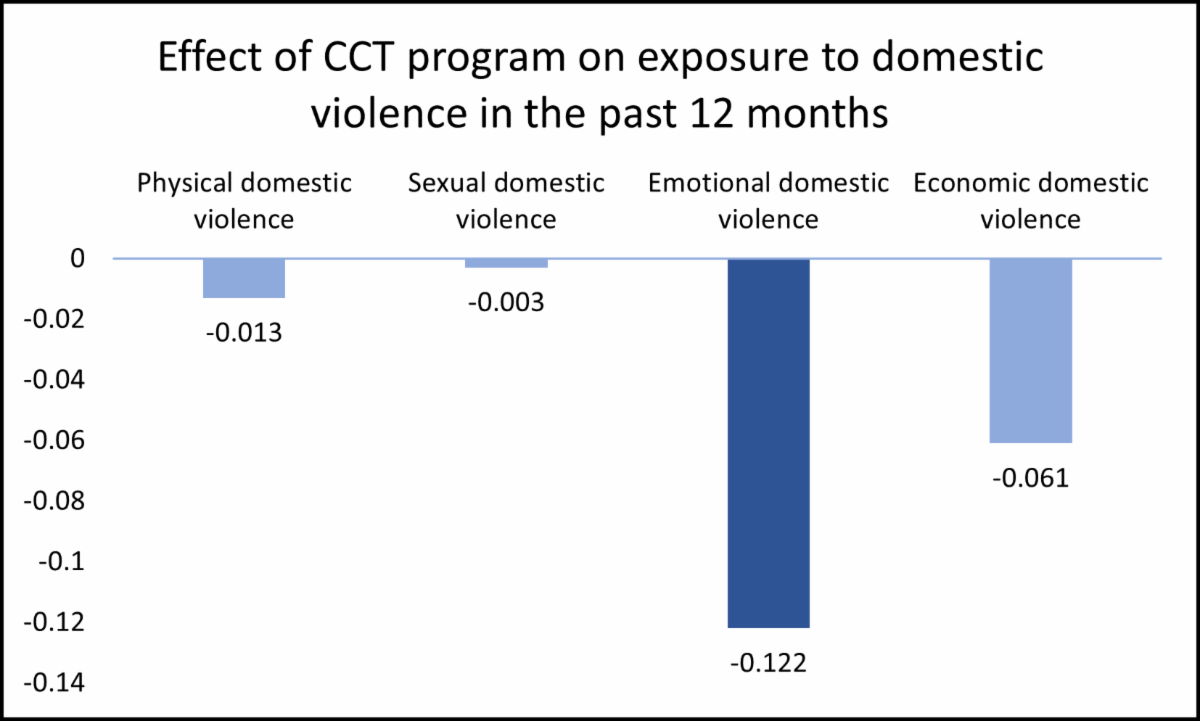
Participation in the 4Ps conditional cash transfer (CCT) program led to a decrease in emotional domestic violence against women. This type of violence includes any form of humiliation or insult perpetrated by victim's family, her in-law's family, or other relatives. 
Note: Darker blue represents statistically significant results. The study uses a regression discontinuity design.
RELATED EAPGIL WORK
 An EAPGIL paper finds impacts of the Pantawid Pamilyang Pilipino Program (4Ps) in the Philippines on men and women in their twenties who were enrolled in the program for up to 1.5 years in their adolescence. Even short exposure to the program in a formative period of their lives (12.5 to 14 years old at the time of participation) is associated with a delay in marriage and first birth for women of approximately one year and six months, respectively.
About East Asia and Pacific Gender Innovation Lab
Part of the East Asia and Pacific Office of the Chief Economist, EAPGIL carries out impact evaluations and inferential research to generate evidence on what works in closing gender gaps in assets, economic opportunities, and agency, and how closing these gaps can help achieve other development outcomes. Ultimately, EAPGIL seeks to increase the welfare of women and men in East Asia and the Pacific by promoting the uptake of effective policies and programs identified based on evidence. We gratefully acknowledge funding from the Umbrella Facility for Gender Equality (UFGE) to carry out this work. EAPGIL is supported by UFGE in partnership with the Australian Department of Foreign Affairs and Trade. UFGE has received generous contributions from Australia, Canada, Denmark, Finland, Germany, Iceland, Ireland, the Netherlands, Norway, Spain, Sweden, Switzerland, the United Kingdom, the United States, the Bill and Melinda Gates Foundation, and the Wellspring Philanthropic Fund.