East Asia and Pacific Gender Innovation Lab | |
Opening Opportunities: The Economic Cost of Gender Gaps in Entrepreneurship in Indonesia
Women in Indonesia are less likely than men to own small and medium enterprises (SMEs), and female micro-entrepreneurs are not as profitable as their male counterparts. A new collaborative study* analyzes the gender gap among microbusinesses and small and medium enterprises (SMEs), which account for over 99 percent of Indonesian firms. The study draws on multiple household and firm-level surveys, qualitative interviews with male and female entrepreneurs, and analysis of relevant laws, policies, and regulations. The findings reveal that female-owned firms have much lower levels of physical and financial capital, significantly fewer employees, and are more likely to rely on unpaid labor, when compared with businesses owned by men.
These gender gaps are explained by gender norms and market failures that hinder women’s access to entrepreneurial inputs (such as time for own labor, hired labor, business skills, and capital), including discriminatory lending practices toward women. Female entrepreneurs interviewed for the study report that gender norms in Indonesian society, which emphasize women’s primary role in the household and stigmatize work outside of the home, further restrict their ability to operate and grow successful businesses. Limited childcare options additionally impose constraints on women’s time and necessitate that their place of business be located near or within their homes.
Closing the gender gaps in entrepreneurship could provide a major boost to Indonesia’s economic growth. The study estimates that the annual economic benefits could reach IDR 6.5 trillion (US$ 428 million) if women-owned firms’ revenues reach the level of their male peers’ businesses. Addressing the gender gaps in access to capital and hired labor would likely boost Indonesia’s economy even further. Harnessing this untapped potential would require interventions that enhance women’s skills, increase access to capital, facilitate hiring and training workers by women-owned businesses, and decrease women’s domestic care burden.
*The study was jointly produced by EAPGIL, the Finance Competitiveness and Innovation Global Practice, and the Social Sustainability and Inclusion Global Practice.
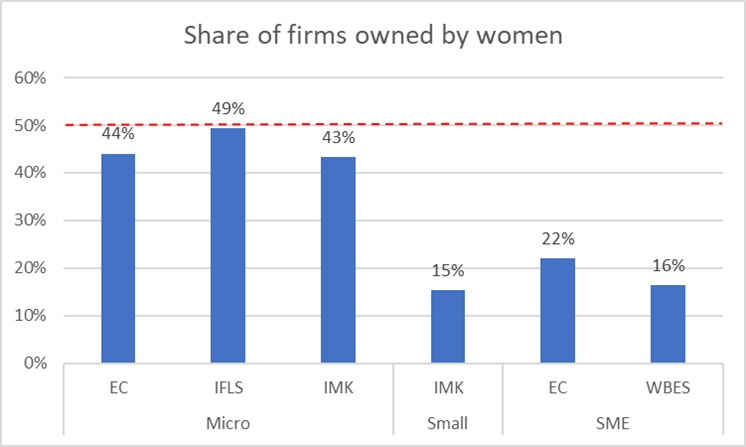
| | Women own or run microbusinesses at similar rates as men but are much less likely to own or operate SMEs. While the share of firms owned or run by a female entrepreneur varies based on the data source, the overall trend is consistent: women in Indonesia own or operate between 43 percent and 49 percent of microbusinesses, but less than a quarter of SMEs. | |
Note: Dotted red line indicates gender parity in business ownership. IFLS data does not reflect firm ownership, but rather the share of firms for which women are primarily responsible.
Data sources: the 2016 Economic Census (EC); the Indonesian Family Life Survey (IFLS); the 2015 Survey of Micro and Small Enterprises (Survei Industri Mikro Dan Kecil, or IMK); the World Bank Enterprise Surveys (WBES).
| |
Enterprising Women: Toward Equal Business Opportunity in Southeast Asia
Removing barriers to female entrepreneurs can unleash untapped potential for economic growth and foster equality of opportunity. This EAPGIL report systematically analyzes factors associated with gender differences in opening and growing micro, small and medium enterprises (MSMEs) in Southeast Asia. It combines a review of existing evidence with new analysis from five Southeast Asian countries: Cambodia, Indonesia, Lao People’s Democratic Republic, Timor-Leste, and Vietnam.
The report finds significant gender gaps, which differ by the scale of the enterprise. Women are less likely than men to own SMEs; while they are as likely as men to run microbusinesses, their profits are lower. Gender gaps in microenterprise performance and SME ownership are linked to lower levels of inputs in women-owned enterprises, including time for own labor, hired labor, capital, and skills. Gender norms, legal inequities, and market failures constrain inputs that are available to women and shape their preferences on how to allocate limited resources. The report reviews global evidence on policies that can address the gender gaps identified in Southeast Asian countries.
| |
Can Boosting Savings and Skills Support Female Business Owners in Indonesia: Evidence From a Randomized Controlled Trial
There is broad evidence of gender gaps in the productivity of microenterprises, which are in part linked to financial and human capital constraints. Existing literature suggests that interventions simultaneously addressing skills and capital constraints faced by women-owned businesses can be effective, but there is little evidence to date exploring the combination of skills and savings interventions. This study took place in 401 villages in East Java, Indonesia, where it tested the relative effectiveness and cost effectiveness of providing supply-side incentives to promote agent banking savings accounts, business and financial literacy training for female entrepreneurs, and the combination of the two on women’s businesses and agency.
While the trial found only small positive effects on the take-up of branchless banking services, both the supply-side and demand-side interventions positively impacted women's profits. Notably, the business and financial literacy training boosted women's profits by 15.2% and their savings by 11.3% over 12 months.
| | About East Asia and Pacific Gender Innovation Lab | | Part of the East Asia and Pacific Office of the Chief Economist, EAPGIL carries out impact evaluations and inferential research to generate evidence on what works in closing gender gaps in assets, economic opportunities, and agency, and how closing these gaps can help achieve other development outcomes. Ultimately, EAPGIL seeks to increase the welfare of women and men in East Asia and the Pacific by promoting the uptake of effective policies and programs identified based on evidence. We gratefully acknowledge funding from the Umbrella Facility for Gender Equality (UFGE) to carry out this work. EAPGIL is supported by UFGE in partnership with the Australian Department of Foreign Affairs and Trade. UFGE has received generous contributions from Australia, Canada, Denmark, Finland, Germany, Iceland, Ireland, the Netherlands, Norway, Spain, Sweden, Switzerland, the United Kingdom, the United States, the Bill and Melinda Gates Foundation, and the Wellspring Philanthropic Fund.
| | | | |