The content in this preview is based on the last saved version of your email - any changes made to your email that have not been saved will not be shown in this preview.
East Asia and Pacific Gender Innovation Lab
 
In about half of the 90 countries where World Values Surveys were administered between 2017 and 2022, half of the respondents either agree or strongly agree with the statement that a preschool child suffers when her or his mother works. The rate of agreement ranges from 9% in Denmark to 88% in Bangladesh. In three quarters of the countries surveyed at least 30% of respondents agree with the statement that a mother working before her child reaches primary school is detrimental for the child. But what does the rigorous evidence say? 

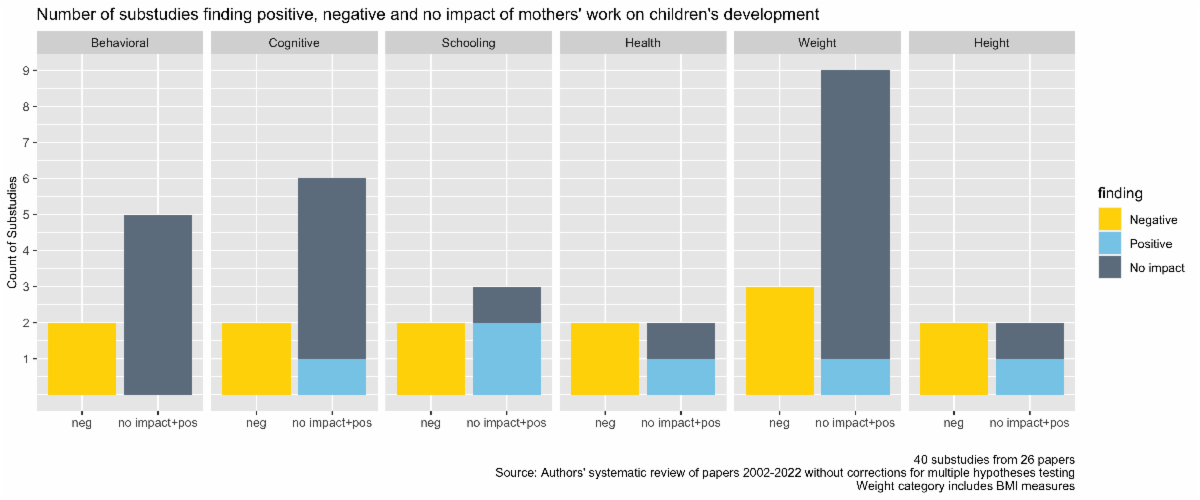
A new EAPGIL paper reviewed 312 studies from the past 20 years that examined the links between mothers’ work and a wide range of children’s outcomes: cognitive, behavioral, health, schooling, and anthropometric outcomes. Twenty six of 312 studies identify causal impacts through diverse econometric strategies. Out of these 26 studies covering 10 countries, the overwhelming majority find that maternal work does not hurt children’s development. The EAPGIL paper also discusses 7 cases from the causal literature in which maternal work has been found to impact children’s development negatively and discusses policies which may reduce this possibility.
GRAPH OF THE MONTH
Note: Some of the 26 studies covered several groups of outcomes: for example, schooling and health. Each outcome was considered separately as a substudy - the 26 causal studies reviewed thus yielded a total of 40 substudies.
About East Asia and Pacific Gender Innovation Lab
Part of the East Asia and Pacific Office of the Chief Economist, EAPGIL carries out impact evaluations and inferential research to generate evidence on what works in closing gender gaps in assets, economic opportunities, and agency, and how closing these gaps can help achieve other development outcomes. Ultimately, EAPGIL seeks to increase the welfare of women and men in East Asia and the Pacific by promoting the uptake of effective policies and programs identified based on evidence. We gratefully acknowledge funding from the Umbrella Facility for Gender Equality (UFGE) to carry out this work. EAPGIL is supported by UFGE in partnership with the Australian Department of Foreign Affairs and Trade. UFGE has received generous contributions from Australia, Canada, Denmark, Finland, Germany, Iceland, Ireland, the Netherlands, Norway, Spain, Sweden, Switzerland, the United Kingdom, the United States, the Bill and Melinda Gates Foundation, and the Wellspring Philanthropic Fund.