East Asia and Pacific Gender Innovation Lab | |
LATEST FROM EAPGIL:
Conditional Cash Transfers and Gender-Based Violence—Do Impacts Differ by the Type of Violence?
Prior research examining the relationship between Gender Based Violence and cash transfer programs largely focuses on intimate partner violence. Most studies find that cash transfers reduce intimate partner violence. This EAPGIL study examines the effects of a conditional cash transfer program in the Philippines ( Pantawid Pamilyang Pilipino Program or 4Ps) on gender-based violence as perpetrated by three types of individuals: intimate partners, other relatives (such as parents, parents in law or siblings), and individuals outside the home. The results indicate a measurable decline in emotional violence perpetrated by relatives other than partner. However, the study does not find impacts on other types of GBV, such as physical violence, or GBV perpetrated by intimate partner or outside home.
This may be due to the fact that the size of transfers provided under the 4Ps program (a maximum of $24 per month) was relatively small compared to other programs, which have shown to mitigate risks of physical violence by Intimate Partners, such as the Bolsa Familia, Familias en Acción and Juntos programs in Brazil, Colombia and Peru (where the size of the transfers is $35, $38 and $61, respectively). The impacts of the 4Ps program could probably be also strengthened by inclusion of well-coordinated and consistent behavioral change component. Such behavioral change components have been shown to strengthen impacts of cash transfers in Bangladesh.
Notably, the 4Ps program has increased help-seeking behaviors among beneficiaries who have experienced violence.
Follow the link below to our new working paper.
| |
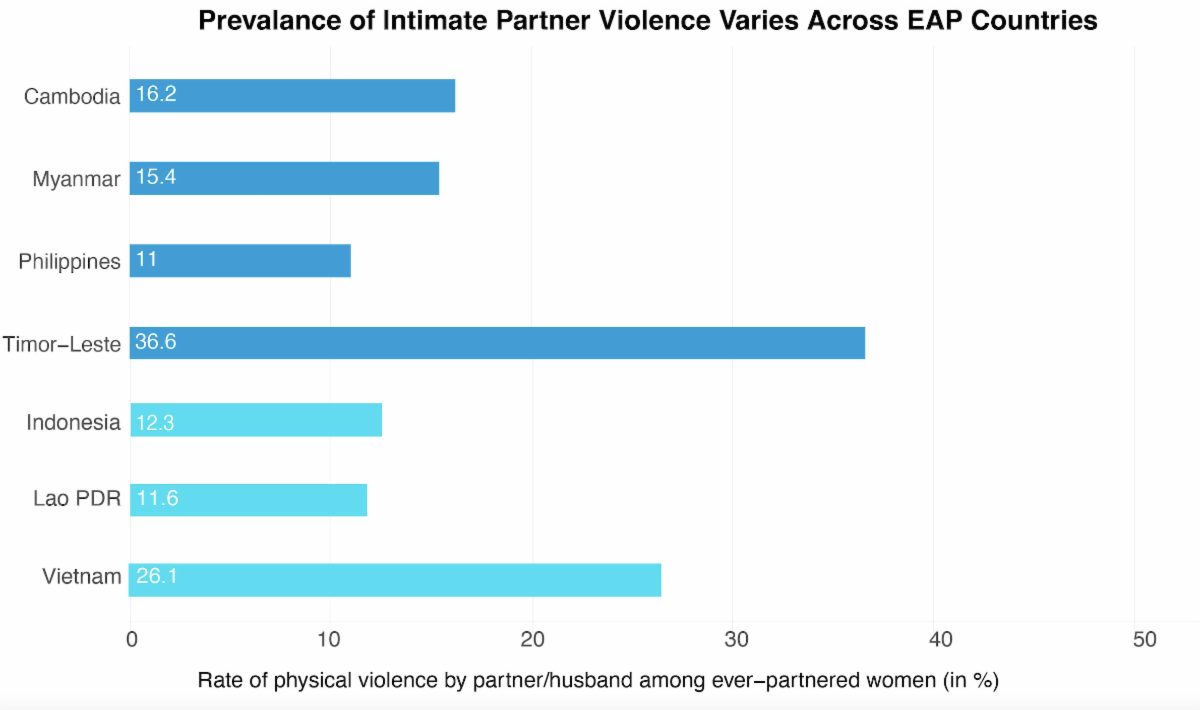
Sources: 2014 Demographic and Health Survey (Cambodia), 2015-2016 Demographic and Health Survey (Myanmar), 2017 National Demographic and Health Survey (Philippines), and 2016 Demographic and Health Survey (Timor-Leste), 2016 Indonesian National Women’s Life Experience Survey, 2014 Lao National Survey on Women’s Health and Life Experiences (Lao PDR), and 2019 National Study on Violence Against Women (Vietnam)
Note: Darker blue bars represent countries for which women surveyed are in the 15-49 age range; lighter bars represent an age range of 15-64. Definitions of intimate partner violence are comparable for both groups of countries. The selection of countries is based on availability of comparable data.
| | ABOUT THE EAST ASIA AND PACIFIC GENDER INNOVATION LAB: | | Part of the East Asia and Pacific Office of the Chief Economist, EAPGIL carries out impact evaluations and inferential research to generate evidence on what works in closing gender gaps in assets, economic opportunities, and agency, and how closing these gaps can help achieve other development outcomes. Ultimately, EAPGIL seeks to increase the welfare of women and men in East Asia and the Pacific by promoting the uptake of effective policies and programs identified based on evidence. We gratefully acknowledge funding from the Umbrella Facility for Gender Equality (UFGE) to carry out this work. EAPGIL is supported by UFGE in partnership with the Australian Department of Foreign Affairs and Trade. UFGE has received generous contributions from Australia, Bill & Melinda Gates Foundation, Canada, Denmark, Finland, Germany, Iceland, Latvia, Netherlands, Norway, Spain, Sweden, Switzerland, United Kingdom, and the United States. | | |