| |
Happy National Breastfeeding Month!
By Stacy Miller and Rickie Wolfinsohn
| |
Yep, it's that time again if you can believe it… Happy National Breastfeeding Month!
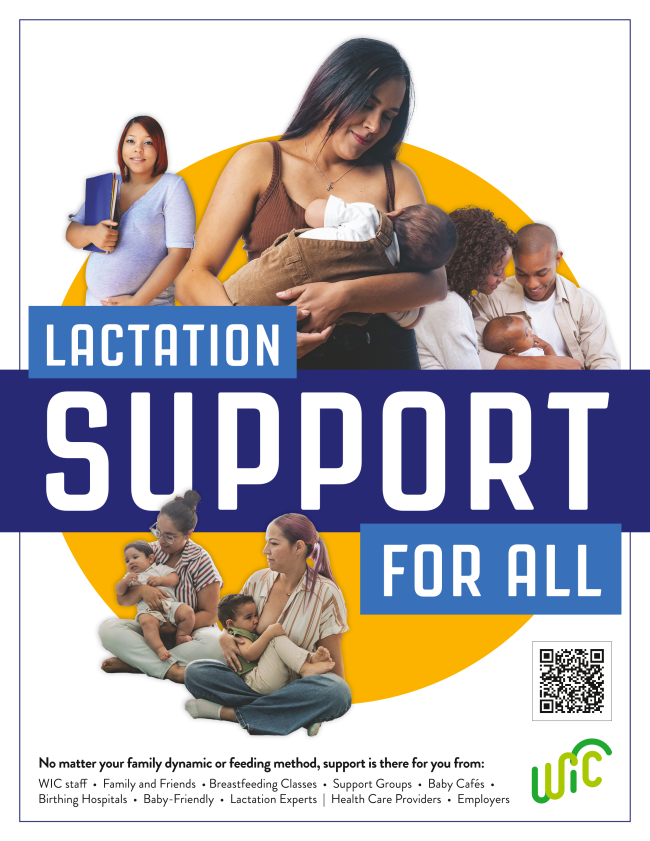
Every year in August National Breastfeeding Month provides an opportunity to celebrate and promote breastfeeding. This year’s Colorado theme plays off the world theme and focuses on how everyone’s breastfeeding journey is different:
Lactation Support For All!
Please view and share all of our 2024 World Breastfeeding Week/National Breastfeeding Month (WBW/NBM) materials! Materials include:
Promoting evidence-based policies and practices known to support breastfeeding - such as Lactation-Friendly workplaces, Baby-Friendly certified hospitals, etc. - helps families to breastfeed.
Breastfeeding has a population and health equity impact by:
-
Saving lives and money - research estimates that if 90% of Americans breastfed exclusively for six months, greater than 3,330 lives and over $3 billion in health care costs could be saved each year!
-
Keeping families healthy - Studies from the American Academy of Pediatrics show that breastfed infants have ~50% reduced risk of sudden unexplained infant death syndrome (SUIDS or SIDS) and many other acute and chronic diseases.
-
Providing peace of mind - Human milk provides optimal infant nutrition, protects the environment (requires no manufacturing/packaging), can be done safely anywhere, anytime (during emergencies, snow storms, etc.), and is not susceptible to infant formula recalls or shortages.
- CO birth certificate data shows that all families breastfeed at or above 90% at hospital discharge regardless of maternal race/ethnicity when delivering at a Baby-Friendly certified hospital. However, if a hospital is not Baby-Friendly certified, statistically significant maternal racial/ethnic disparities persist, with Black/African American, American Indian, and Other/Unknown/Mixed Race individuals breastfeeding at significantly lower rates at hospital discharge compared to white, non-Hispanic individuals.
Many groups around the state support breastfeeding. The Colorado WIC Program provides breastfeeding education and support to Colorado families with low-incomes, as well as lactation training for staff and community partners. The Colorado Breastfeeding Coalition advocates and supports breastfeeding, including the statewide recognition of Lactation Friendly Workplaces and health care providers/medical offices. Healthy Child Care Colorado assists and recognizes child care programs/providers around the state for implementing lactation-friendly policies and practices. MCH funded LPHAs and local breastfeeding coalitions and task forces assist breastfeeding families and increase resources and support at the local level.
New breastfeeding resources to highlight (please share with your networks):
- Materials within the 2024 World Breastfeeding Week Folder, including posters and social media images and posts - all of which can be shared electronically with families!
- Promote and attend the Colorado Lactation Conference on Sept. 13, 2024 at CDPHE or virtually via Zoom.
- Share the Breastfeeding for Providers training series information with health care providers, especially physicians, in your communities. This free, self-paced, 8 module series provides CME credits and basic breastfeeding information that meets Baby-Friendly hospital requirements.
- Coming soon - new WIC Lactation Specialist training series will be available for free on COTrain in fall 2024. This training is for anyone interested in receiving free advanced lactation trainings. It will meet Baby-Friendly nursing training requirements and will be marketed to mostly WIC, LPHA and community health worker staff.
- New WIC breastfeeding materials and handouts available on the Colorado WIC website. All are available electronically to share easily within your networks.
Join the nation and world in celebrating and promoting breastfeeding during NBM the entire month of August!
| | | |
Unpacking the PRAMS Social Determinants of Health Supplement
By Erika Iisa, MCH Epidemiologist
| |
The Colorado Pregnancy Risk Assessment Monitoring System (PRAMS) is a surveillance system used to monitor behaviors and experiences of pregnant and postpartum people before, during, and after pregnancy. The survey is administered at 2-4 months postpartum, and responses are weighted to be representative of all live births in Colorado. The 2022 PRAMS survey included a twelve question social determinants of health supplement that focused on housing stability, food security, transportation, mental health, and discrimination. You can find the full list of questions included in the supplement on the CDC website. Some key findings are highlighted below, but additional data as well as data disaggregated by race/ethnicity, insurance, region of residence, or other demographic factors is available upon request.
Housing stability:
- At two to four months postpartum, 5.5% of postpartum people either did not have a steady place to live, or had a place to live but were worried about losing it, and 14.5% of postpartum people were unable to pay their rent, mortgage, or other bills.
Food security:
- Furthermore, 9.2% of postpartum people were usually or always unable to afford to eat balanced meals, and 2.7% reported that the food they bought just did not last, and they did not have money to get more.
Mental health:
- In the first few months since their new baby was born, 31.7% of postpartum people needed mental health services. Of those who needed mental health services, 32.3% were unable to get the services they needed.
- Common barriers to care included financial hardship and stigma: 64.9% did not have time to seek care due to a job or childcare; 26.3% could not afford care; and 9% did not want others to find out about treatment.
- On a more positive note, 78.5% of postpartum people reported usually or always getting the social and emotional support they needed.
Discrimination:
- While 30.8% of postpartum people experienced any frequency of discrimination due to their race or ethnicity across their lifetime, Black, Hispanic, and multiracial individuals were the most likely groups to report experiencing discrimination (79.0%, 46.0%, 46.1%).
- Data around discrimination for American Indian/Alaska Native and Asian/Pacific Islander birthing people is not available at this time.
The social determinants of health supplement was only included in PRAMS for one year, but questions around food security, transportation barriers, and discrimination will continue to be included in future years. You can also find additional data around maternal behaviors and experiences, access to prenatal care, pregnancy intendedness, and health care delivery for pregnant and postpartum people on the PRAMS website.
Please contact me (Erika Iisa) for questions about PRAMS or for any data requests.
| |
Tax Credit Outreach and Newcomer Communities
Adriana Botic, Community Grants Coordinator, shared her insights from working with newcomer-serving organizations and newcomer communities and how best to engage on tax credit outreach work. There was a robust discussion about identifying trusted organizations in local's communities, what messaging resonates with newcomers, and how to use our multilingual materials on the GetAheadColorado.org / HaciaAdelanteColorado.org website to address common concerns newcomers may have. Adriana also shared some success stories and challenges as part of the Tax Credit Community Outreach Grant. View the presentation slides, and the outreach materials tailored to newcomers in the partner toolkit on GAC / HAC:
- 2024 Tax Information for Newcomers (8 languages);
- ITIN Basics (English and Spanish);
- 2024 Steps to File your Taxes (8 languages);
- Tax Credit Videos for Newcomers (12 languages with captions);
- 2024 Tax Credit Basics (English and Spanish); and
- Updated 2024 Tax Document Checklist (19 languages).
| | | |
2024 Pulse Poll: Initial Results
Upcoming brief sharing results of the annual Colorado Health Foundation poll:
Deep Dive on Responses from Hispanic and Latino People in Colorado (Presented in Spanish and English. Simultaneous interpretation will be available)
Data available online at 6 a.m. on Tuesday, September 3
Briefing at 5:30 p.m. MT on Monday, September 9 | Register
|
Project Succeed Training Series
We are inviting you to register for our sixth training series for Project SUCCEED (Supporting Colorado Children’s Early Emotional Development) being offered by JFK Partners, University of Colorado Anschutz Medical Campus, and the Colorado Association for Infant Mental Health (CoAIMH). SUCCEED is a Mental Health Awareness Training grant funded by the Substance Abuse and Mental Health Services Administration (SAMHSA), Department of Health and Human Services (DHHS), that is intended to help increase our state’s capacity to address the unmet mental health needs of Colorado’s children.
The first of eight sessions will launch on Wednesday, September 18, from 10:30am to 12:00pm (Mountain Time). The remaining sessions will run weekly at this time from September 25 through November 06. All sessions are free. All sessions are virtual. You can find registration details and more information here:
https://medschool.cuanschutz.edu/jfk-partners/projects/project-succeed
- Setting the Stage for Shared Meaning of Infant and Early Childhood Mental Health. September 18, 2024.
- Cultural Sensitivity and Diversity Considerations. September 25, 2024.
- Identifying and Understanding Developmental Differences in Young Children. October 2, 2024.
- Strategies for Managing Mental Health Symptoms. October 9, 2024.
- Caregiving Relationships and Early Brain Development. October 16, 2024.
- Child and Family Development. October 23, 2024.
- Early Adversity and Toxic Stress. October 30, 2024.
- Resources and Referrals. November 6, 2024.
|
Transforming Community Coalitions to Unlock Upstream Investments in Health
Do you want to help your department’s community coalition partners find more funding for their health equity priorities? Are you interested in shaping your community health planning activities and power building efforts so residents can become drivers of their financial future? We’ve heard interest in this topic from across the U.S., so we’re expanding our new community of practice to serve public health departments across the country! This three-month national program will help your department to leverage planning processes to:
-
Attract investment in upstream health solutions, such as housing justice, economic well-being, and culture.
-
Develop powerful multi-sector collaboratives that are positioned to harness new funding opportunities.
-
Ensure local voice in investments via strong community governance.
The community of practice kicks off in September with optional office hours in August. All sessions are 10am-11:30am PST.
Questions? Contact BARHII’s Anita Kumar or Deya Zavala. Register for the community of practice.
|
2024 Health Links Webinar Series
Join us for our upcoming webinar series! We're covering highly-requested topics ranging from psychological preparedness to ageism in the workplace.
| | | |
Grant Opportunity
Disabling Barriers is a non-profit that provides grants to address the unmet needs of Southern Colorado’s children and young adults with intellectual or developmental disabilities (IDD). They currently are accepting grant applications for programs (discrete projects), equipment only, and capital requests for serving folks with IDD. Grant applications will close on August 31st, 2024. Go to online grant for Disabling Barriers by contacting info@disablingbarriers.org or call Laura (719) 644-0622
|
It’s not too late to get your tax credits!
Coloradans are still able to file their taxes to receive tax credits and their TABOR refunds. You can help connect families to resources by encouraging them to file by the extension deadline of October 15th, 2024. If they haven’t filed their federal and/or state tax return yet, help them get started at GetAheadColorado.org.
| | | |
Equity 2.0 - Targeted Universalism Learning Journey
In December 2023 Melissa Leal (moving upstream strategic anchor lead) began sharing learnings about targeted universalism (TU). Last month we continued to take a deeper dive into the action steps of the TU framework, which we will continue for the next few months.
| |
Deeper Dive: Targeted Universalism Stages
- Co-create a universal goal.
- Assess the general population’s performance relative to the universal goal.
- Assess all segment groups’ performance relative to the universal goal and situatedness.
- Assess and understand the structures and systems that support or impede each group from achieving the universal goal.
- Develop and implement targeted strategies so all groups reach the universal goal.
- Develop bridging stories and messaging that support strategies.
- Conduct ongoing evaluation/measurement of impact relative to the universal goal.
Steps 6 and 7 were added to the targeted universalism stages more recently because of how essential they are to move towards belonging, which is the ultimate goal of TU. It is common to see media stories that sow fear, dehumanize, exclude, disconnect, create distrust, and trigger people’s hierarchy of needs (safety, belonging). These kind of stories lead to breaking and othering.1
Bridging communication:
- Treats all people with dignity and humanity.
- Focuses on systems and structures when describing a problem.
- Is most powerful when combining data, a universal goal or policy solution, and storytelling.1
Questions to consider when creating communication:
- Who are the narrators or creators?
- Who is the audience?
- How are you framing the problem?
- Where are the sources or origin stories?
- How are you sharing out about the solution?
- Do you have a shared future vision?1
Communication best practices that contribute to belonging:
- Use accessible language - avoid jargon and technical terms
- Multilingual communication - translate all communication into relevant languages
- Accessibility - share materials in multiple formats to reach individuals with disabilities and limited internet access
- Culturally sensitive messaging - tailor communication to resonate with each community
- Use multiple communication channels - consider how different groups prefer to receive communication2
- “Session 7: Communications + Measurement” by Seed Collaborative and The Belonging & Cocreation Lab, March 2024
- “Communication Guidelines & Best Practices For Fostering Bridging and Belonging in the Targeted Universalism Process” by Seed Collaborative and The Belonging & Cocreation Lab, March 2024
Come back next month to continue diving deeper into the last action step of the TU framework. Please reach out to Melissa Leal with any questions about targeted universalism, moving upstream, or change management.
| | |
The Title V Maternal and Child Health Program (MCH) works with statewide partners and local public health agency representatives to improve the health of Coloradans using population-based and infrastructure-building strategies. Our mission is to optimize the health and well-being of mothers and children by employing primary prevention and early intervention public health strategies.
This project is supported by the Health Resources and Services Administration (HRSA) of the U.S. Department of Health and Human Services (HHS) under the Colorado Maternal and Child Health Block Grant 6 B04MC45202. This information or content and conclusions are those of the author and should not be construed as the official position or policy of, nor should any endorsements be inferred by HRSA, HHS or the U.S. Government.
| | | | |