Note from the Chair
Welcome to our May newsletter. In addition to our announcements below about our May 28 webinar on scaling municipal urban wood utilization programs and our new online marketplace, in this issue we’re also featuring thought-provoking articles on nail-laminated wood and new research that is helping to answer a perennial question in our community: If the value proposition is so compelling, why have municipal-scale urban wood reclamation programs been so slow to emerge? Meanwhile, we continue to focus on our three core priorities for the year:
-
Building markets. You can read below about our new online marketplace for members, which is now live, and how to join it. We know this free, members-only service is not going to transform your business, but it is one more way to reach your audience through our 2,500-member mailing list and the 10,000 visitors who come to our website each year. Meanwhile, we continue to grow our outreach and education surrounding the built environment, including an April virtual panel discussion about engaging and collaborating with design professionals.
-
Building community. We continue to expand the breadth and depth of the topics for our now free educational offerings, along with the organizations we’re collaborating with to deliver them. This helps to increase the size of our audiences, and provide more targeted content. We’re also reconstituting our Advisory Council, an important move that will:
-
Expand the UWN network by engaging with all sectors of the urban wood community.
-
Provide input and insights to make sure UWN is operating in the capacity most beneficial to developing urban wood utilization and supporting urban wood processors.
-
Retaining institutional knowledge.
-
Refining and implementing standards. Working closely with Urban Salvaged and Reclaimed Woods, Inc., we are continuing to advance the USRW Certified Urban Wood Standards and certification pathway. The initiative continues to gain momentum as outreach efforts expand within both the AEC (Architecture, Engineering, and Construction) and urban forestry communities. The USRW Task Force recently met to review major updates to the standards as a result of piloting and industry feedback, including a new tiered certification structure designed to improve accessibility and adoption while strengthening tools and resources for municipalities, mills, makers, and design professionals. USRW is also collaborating with partners on a potential grant opportunity to help further advance implementation and industry engagement, with additional updates expected later this summer.
As always, if you’d like to get in touch, drop us a line at info@urbanwoodnetwork.org. And above all, thank you for your support of urban wood utilization, and the Urban Wood Network.
| |
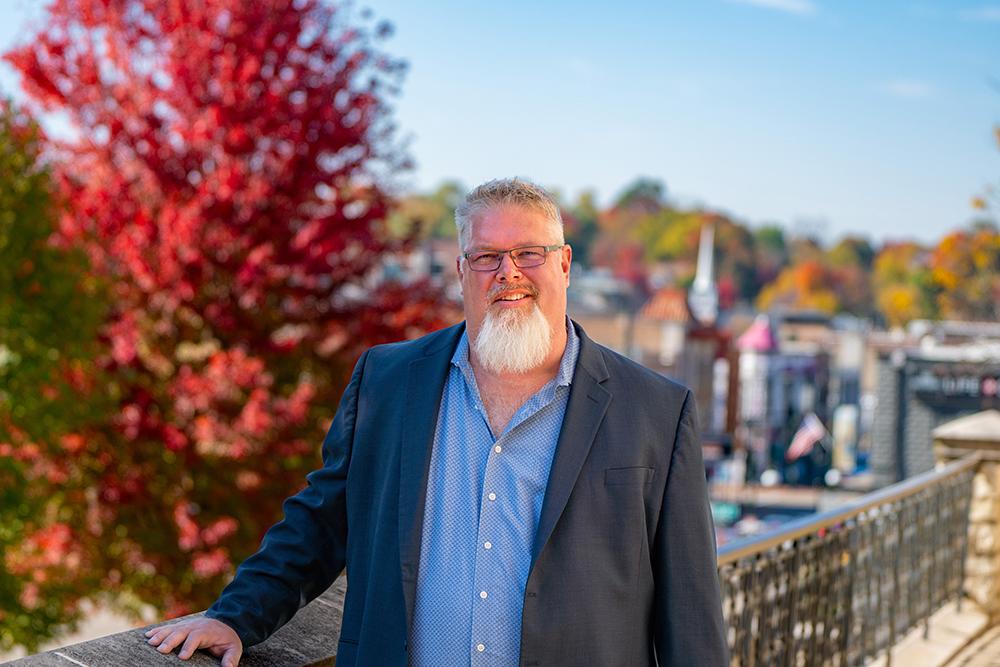
Scott Ward
UWN Board Chair
| |
Speak Up for Urban Wood Before May 31
The federal council shaping Forest Service urban forestry policy is accepting public comments for its 2027–2037 Action Plan through May 31, 2026—and this may be one of the last chances to ensure urban and salvaged wood businesses are recognized at the federal level. Current programs and sourcing requirements continue to leave our industry out, despite Forest Service research showing the significant economic value of urban wood utilization.
If you are a sawmill, wood business, arborist, recycler, maker, or advocate, your voice matters. Even a short comment sharing your experience, challenges, or recommendations can help push for recognition of urban and salvaged wood in future federal programs and policy. Submit comments here.
| |
Free Webinar THIS THURSDAY
Rooted in Community: The Harrisonburg Urban Wood Partnership
What: Municipal urban wood programs are a cornerstone of the urban wood industry. Across the country, cities have built partnerships with local urban wood processors. At this educational webinar, audience members will learn about Harrisonburg, Virginia urban wood projects and collaborations with Rocktown Urban Wood.
When: Thursday, May 28, 12 p.m. Eastern, 9 a.m. Pacific
Presenters:
Jeremy Harold, City of Harrisonburg Virginia Green Space Manager
Ned Gearing and Rhett Miles, Rocktown Urban Wood
Questions? Email membership@urbanwoodnetwork.org
ISA CEUs available
Co-presented with The Urban and Community Forestry Society
| Learn more about successul municipal partnerships in our publication Urban Wood Utilization: Municipal Case Studies. | | |
New Online Marketplace for Members!
We're live! Sign up today!
The online marketplace provides
- Promotion through our website, with 10,000 visitors per year, and our 3,000-member mailing list
- No fees
- Increased traffic to your online inventory
- More visibility for your products
- Free support creating your Marketplace listing
| | The Gap Between Research and Reality in Urban Wood | | |
By Jeff Perkis
Architect and UWN Board Member
The urban wood movement has long argued that fallen city trees are more than waste—they are an underutilized resource with environmental, economic, and cultural value. A recent dissertation by Bradley C. Almond at Southern Methodist University takes a deep look at a question many in the industry have quietly asked for years: if the value proposition is so compelling, why have municipal-scale urban wood reclamation programs been so slow to emerge?
The research paints a picture familiar to many practitioners. Across the United States, millions of urban trees are removed annually due to storms, disease, development, and infrastructure conflicts. Historically, most of this material has been chipped, burned, mulched, or sent to landfills despite decades of research demonstrating the environmental and economic advantages of higher-use recovery. Almond’s work highlights estimates that urban wood waste could produce billions of board feet of usable lumber each year—potentially supplying a meaningful percentage of domestic lumber demand while simultaneously extending carbon sequestration through long-lived wood products.
| | |
Yet the dissertation argues that the challenge has never been about the lack of raw material or even the lack of market demand. Instead, the obstacle appears to lie in the disconnect between municipalities and the growing private-sector infrastructure already capable of processing urban wood. Through surveys of municipal officials, researchers, advocates, consultants, and urban wood practitioners, the study found that successful programs are rarely built by government alone. Public-private partnerships consistently emerged as the critical factor separating stalled concepts from functioning programs.
Read More
| | |
A Perfect Woody Union:
Nail-Laminated and Urban Wood
By Kathryn B. Reis, North Carolina Certified Environmental Educator
While perusing my LinkedIn feed today, I saw a post by one of our esteemed urban wood leaders, Jennifer Alger. The U.S. Forest Service Truckee Hotshots recently partnered with Tahoe Prosperity Center, Berkeley Wood Lab, and Tahoe Earth Institute to host an affordable housing workshop in Truckee, California. These four partners showcased how a 150-year-old construction technique can transform national forest harvests into panels for floor, wall, and roof installation.
We all know how our national forests are decades-old tinderboxes for wildfires that break annual records year after year. As the U.S. Forest Service conducts land management techniques to thin and restore these forests, the agency needs a disposal plan for the large volumes of wood coming off its public lands. Rather than burning the woody debris or shipping it elsewhere for processing, innovative people have opened their history books to create a more sustainable solution.
And this is where nail-laminated wood meets urban wood.
Read More
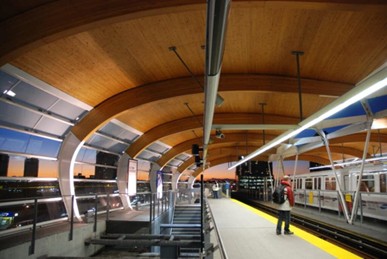
| Photo credit: Brentwood Town Center, Burnaby, British Columbia; Tae Ik Hwang | |
Would You Buy Wood from Municipal Trees?
Homeowners are interested in buying products made from municipal trees, say agency researchers surveying residents of six communities, revealing an untapped economic opportunity. Over the past two decades, the number of trees annually removed from municipalities—mostly due to tree death and disease—exceeded national forest timber harvests, yet this wood ended up as waste rather than turned into products sold to consumers. Survey respondents were most interested in low value products, like mulch or firewood, though study authors note a growing interest in high-value products like furniture. Study results can guide tree care companies, mill operators, city governments, and others as they find better ways to use this wood. Study authors note that a small sample size limits the scope of their work and encourage others to continue the line of research.
|
Meeting Customer Needs--
Collaborating with the Built Environment Roundtable
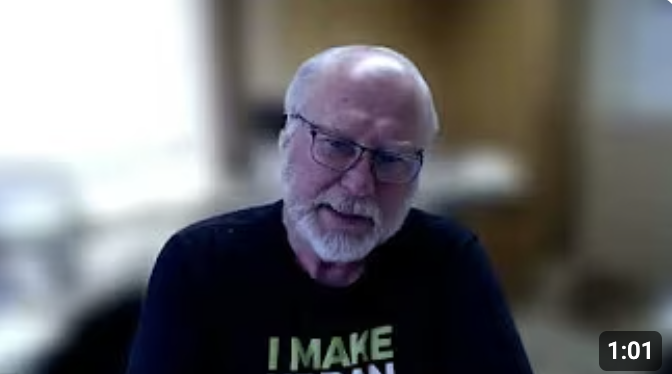
Get UWN Board member Rick Siewert's take on meeting customer needs when working with built environment professionals. This is from our recent online conversation with members and supporters. Check out the whole roundtable on our YouTube channel.
| | |
THANK YOU
Thank you for your ongoing support of the Urban Wood Network.
If you have any questions or are looking for additional information, please don't hesitate to reach out and connect with us via email at info@urbanwoodnetwork.org.
| | |
Scott Ward
(Chair)
Fifth Estate Communications
| |  | |
Thaddeus Driscoll
Colorado State Forest Service
| | |
Rick Siewert
(Vice Chair)
Wood From The Hood
| | | |
Frederik Laleicke
North Carolina State University
| | |
Jennifer Flynn (Treasurer)
SEEDS EcoCorp
| | | |
Jeff Perkis
Trotter and Associates / Story Wood
| | |
Jennifer Alger (Secretary)
Far West Forest Products & Urban Salvaged and Reclaimed Woods Inc.
| | | | A Special Thanks to Our UWN Sponsors | | | | |