Connect 2035 Network Assessment and Outreach Updates | | |
STA continues to develop its next 10-year strategic plan, Connect 2035. Once completed, the strategic plan will list initiatives, capital projects, routes, and programs that will improve and expand transit service to the region.
An important step in that progress was the network assessment conducted last fall. Areas for improvement identified by the network assessment analysis include expanded commuter service, increased service in Spokane Valley as it grows, and on-demand service.
“The assessment emphasized that STA’s system overall works very well,” observed Karl Otterstrom, Chief Planning & Development Officer at STA. “With the trust and support of the local community, STA has extensively expanded and improved its transit network and service.”
On Wednesday, March 6, STA’s Board of Directors will hold a workshop revisiting the results of the network assessment and identifying future action to implement themes that emerged from that effort.
In addition to engaging with internal stakeholders to develop its strategic plan, STA will also promote many opportunities for input from the public. Public outreach plays a necessary role for a fuller picture of how riders would like to see STA’s service grow. As part of its ongoing public outreach, STA has been meeting with community-based organizations (CBOs) to gather feedback relevant to the strategic plan.
“We’ve already met with a number of them and will continue to do so throughout the spring,” remarked Brian Jennings, Deputy Director for Community Development at STA. “The feedback so far has been very positive and constructive.”
STA has also installed displays on the second floor of the Plaza introducing the new strategic plan to the public and inviting their feedback.
From discussions with CBOs and other stakeholders, public outreach will continue to shape how Connect 2035 will build on the improvements made in STA’s current strategic plan, STA Moving Forward. Several notable projects delivered under STA Moving Forward have been Eastern Washington’s first Bus Rapid Transit service, City Line, as well as improvements to Cheney Line and Mirabeau Park and Ride.
In order to stay informed on the latest developments for Connect 2035, visit spokanetransit.com/connect2035 and sign up for email updates as well as surveys on the strategic plan.
| | Section 5310 Grant Award Recipients for 2023 | | |
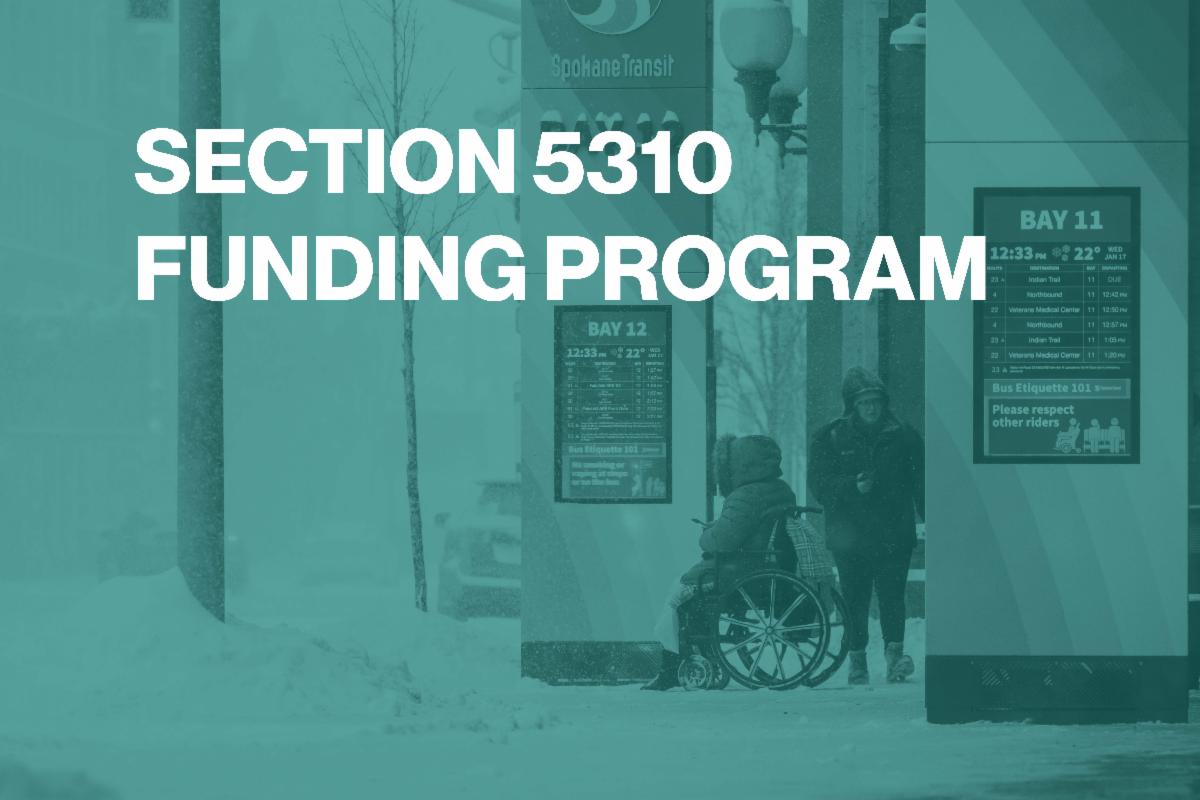
At their February 15 meeting, the STA Board of Directors selected recipient organizations for the Section 5310 grant awards.
Section 5310 is a federal grant program provided for by the Federal Transit Administration. Its purpose is to improve mobility and access for seniors and individuals with disabilities by removing barriers to transportation services as well as expanding transportation mobility options.
STA serves as a pass-through entity for federal dollars specifically allocated for this grant program. Private nonprofits, local governments, and other providers of public transportation are eligible recipients of grant awards. In October 2023, STA announced a call for projects in order to make up to $805,296 available, including $615,296 in federal funds and $190,000 in STA local funds. Eligible projects were to assist with organizations’ capital and operating expenses that are aligned with the grant program’s purpose.
“It’s an important program that allows organizations doing excellent work in the area to serve those in a specially focused manner,” commented STA’s Chief Planning & Development Officer, Karl Otterstrom.
After reviewing and evaluating applications through an ad hoc committee, comprised of individuals from STA, Spokane Regional Transportation Council, and Washington State Department of Transportation, STA is happy to announce that the Board selected five agencies that will implement seven different projects to receive Section 5310 grant award money.
These agencies are: Cancer Can’t, SNAP Resources Rides, Special Mobility Services, Project id, and Southside Community Center.
All of the projects vary in scope. For example, one project will help train individuals with disabilities on how to properly use the bus system in the Spokane area. Another project will assist those going to cancer treatment appointments. And a third project will bring shopping assistance to those who are homebound.
Notices of the award went out on February 21. STA plans on executing final agreements with the recipient organizations in the spring.
“It may surprise some to see just how many different agencies in the area are tackling the issues faced by people without access to the resources one might take for granted,” Otterstrom said. “But we are really glad to be a part of helping these organizations secure funds to continue doing the work that they do.”
| | Adoption of 2024 Service Revisions |
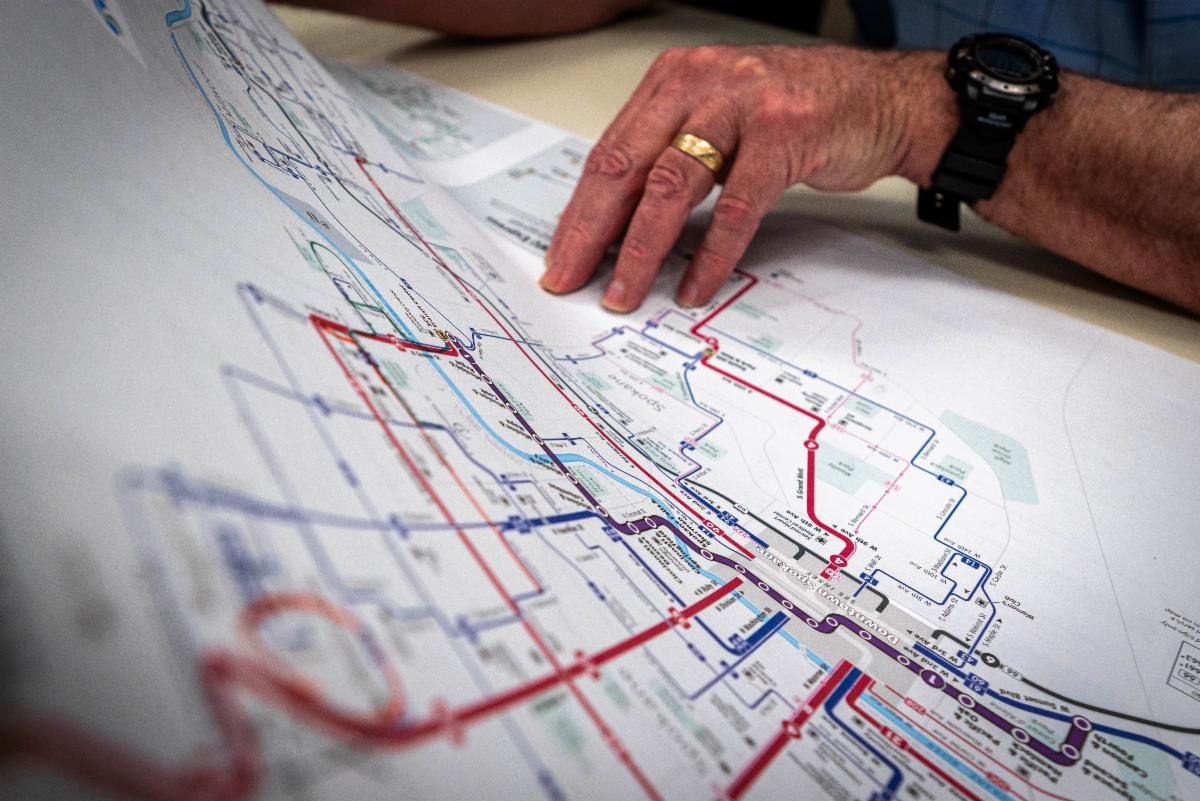
| Above: Looking over STA’s system map | | |
The STA Board of Directors adopted the 2024 Service Revisions Final Recommendation at their February 15 meeting. STA has been planning with the community for changes to bus routes that will take place over the course of 2024. These changes include:
- More direct service between Airway Heights and the West Plains Transit Center
- Extended weeknight and weekend service between North Bank and downtown Spokane
- Route and frequency improvements in northeast Spokane, Hillyard, and East Central
- Additional adjustments to improve performance and respond to community input
“A notable aspect of the entire process,” highlighted STA Principal Transit Planner & Service Development Manager Emily Poole, “is the extensive public outreach STA conducts and how seriously we take that feedback into our analysis and planning.”
Outreach began in October when the preliminary proposal was formed. The outreach process involves coach operator tabling, internal Agency discussions, online rider surveys, social media postings, signage at potentially affected bus stops, and other targeted outreach events.
After a draft recommendation was reviewed by the Performance Monitoring & External Relations Committee on December 6, that draft recommendation was presented to the public for additional feedback in a second survey. A public hearing was held on January 18 before a final recommendation was put together and presented to the Board for its February meeting.
With the Board having adopted the recommendations, these service revisions will be implemented in the May and September service changes.
Among the significant revisions is the service frequency increase on City Line. In May, weekday midday (9 am - 3 pm) frequency will increase to 10 minutes, and Sundays/holidays will feature 15-minute frequency. This expanded frequency will fulfill the committed levels for City Line’s full service.
New night and weekend service for the Route 11 Downtown/Arena Shuttle responds to rider, community organization, and other stakeholder feedback for improved service to the North Bank of the Spokane River and downtown Spokane. Once in place, STA will be closely monitoring the implementation of the new service and make any necessary adjustments as early as this September.
“Community feedback truly drives many of the changes that we make, and all of it matters,” Poole emphasized. “We’re pleased to be able to provide these continual improvements to the system, which ultimately serve our riders.”
To review the service revisions in fuller detail, please visit spokanetransit.com/2024service.
| | |
STA has launched an online survey on the Division Street Bus Rapid Transit (BRT) project. The purpose of the survey is to ask for community feedback on station locations.
“We’re in the early design phase of a multi-year project,” commented Senior Project Manager at STA, Don Skillingstad. “We want to hear from the public about station locations and transportation habits.”
When selecting station locations for the Division Street BRT project, there are many considerations to factor in, for example, connections with other bus routes, nearby housing and services, access for community members who historically rely on transit, minimizing the impact on adjacent property owners and businesses, and much more.
The survey is being promoted through STA’s website, social media, digital monitors throughout the bus system, posters at the head of buses, a postcard to residents who live within a half mile of the route, and on the Division Street BRT project webpage.
“The more feedback we receive, the better,” Skillingstad added. “More responses can help inform design decisions so that we construct what the public, particularly the riders, want to see and where.”
The survey closes on Tuesday, March 5. Take the survey here.
To stay informed about ongoing developments in the Division Street BRT project, subscribe to the Division Street BRT email list and receive news and updates delivered directly to your inbox. An email sign-up form may be found on the Division Street BRT project page: spokanetransit.com/divisionbrt.
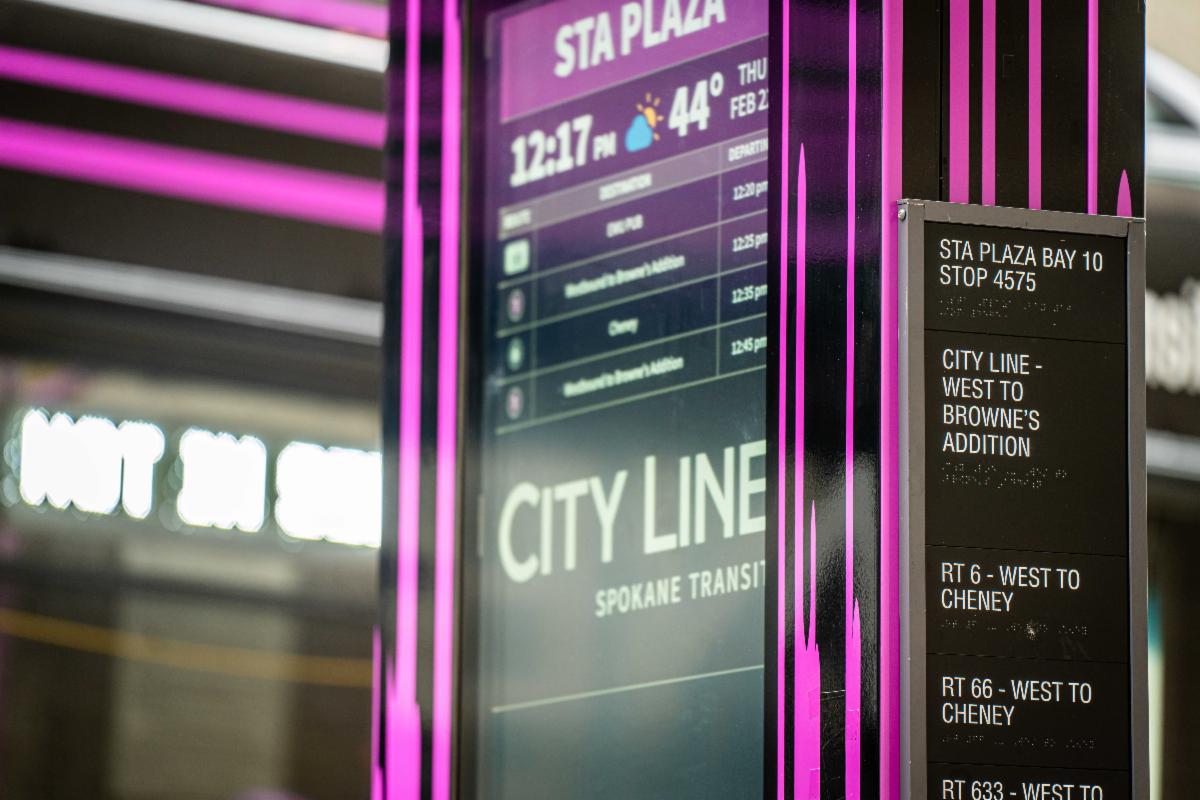
| | City Line Braille Signage Installed | | Above: New tactile and Braille signage on a City Line marker at STA Plaza | | |
STA has finished installing tactile and Braille signage at its City Line stations. As an investment that goes beyond what is required by law, the signage demonstrates STA’s mission to provide safe, inclusive, convenient, and efficient public transportation services.
Tactile and Braille signage has raised lettering in all capitals along the top of the sign with the Braille equivalent underneath. STA underwent an extensive, cooperative process with multiple organizations and nonprofits to ensure that its Braille signage would improve accessibility for riders with visual impairments.
During the design process, STA identified the need to aid visually impaired persons with navigating stations placed in the center of roads, where boarding the correct bus depends on being on the proper side of the station.
“We needed a way to assist individuals with visual impairments to easily get to the side that had their bus,” commented Carly Cortright, STA’s Chief Communications & Customer Service Officer “But what we discovered is that there isn’t concrete guidance for applying Braille signage to Bus Rapid Transit systems like City Line.”
STA’s signage designers looked to the existing body of guidelines and adapted these as best as possible for City Line.
“The end result is truly innovative, and we hope helpful for improving accessibility for one of the most important routes of our system,” Cortright said.
Consultation included Lighthouse for the Blind and Lilac Services for the Blind, and the Braille transcriptions were developed in assistance with the Washington State School for the Blind. STA also looked at what other transit agencies across the country have done to incorporate Braille at bus stops.
“These efforts are part of STA’s work to make public transit more accessible,” Cortright emphasized. “Extensive conversation and research has allowed our agency to produce stations that are truly state of the art and accessible.”
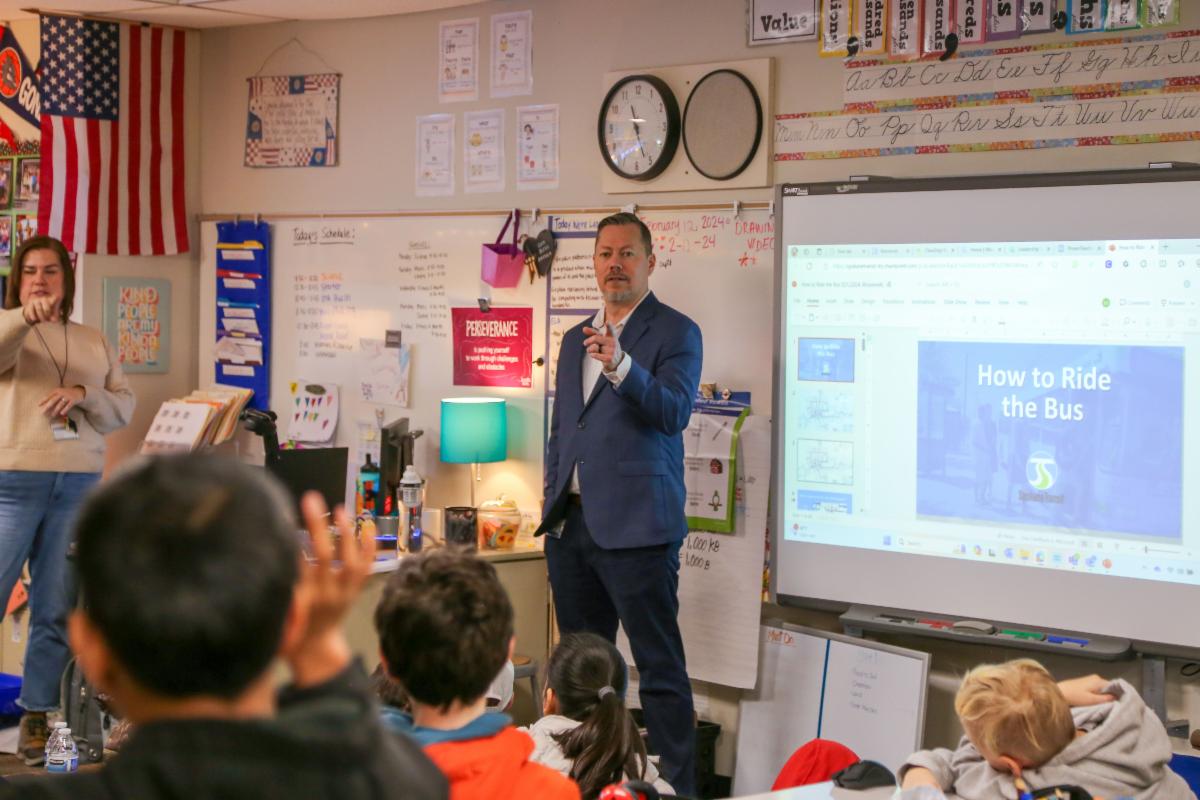
| | Above: Dainon Setzer calls on a student | | |
Roosevelt Elementary invited STA’s Business Development Manager Dainon Setzer and Customer Support & Outreach Coordinator Alyssa Bashor to give an introduction to fifth graders on all the ins and outs of riding the bus with STA: everything from planning a trip to how to alight.
“They’re Roosevelt students today, but next year they’ll be Sacajawea middle schoolers,” pointed out Setzer. “Then they’ll be in high school, and before you know it, they’re college students. And we want to equip them to be lifelong, confident transit users.”
With the assistance of the fifth-grade teacher, Setzer and Bashor were able to bring preloaded and activated Rider’s License Connect cards to hand out to each student. The students were split into two groups of 30 and received a 45-minute presentation, teaching the life skills that will make the young riders able to use public transit effectively and comfortably.
Afterward, the class proceeded on foot to catch a bus downtown for a field trip.
“Several stops in the area took the students to the same place and at about the same time,” Setzer observed. “It was a very real demonstration for the students of how integrated our routes are. And I think the opportunity to go to Roosevelt and educate the students highlights how strong the partnership is between STA and Spokane Public Schools.”
Spokane Public Schools (SPS) and STA formed a unique partnership to provide co-branded school identification and Connect cards to SPS high school students. Additionally, STA added tripper routes (a route or service that provides additional capacity for high-demand times of day) to accommodate the increase in students on those routes.
In October 2022, the STA Board of Directors approved zero fare for youth 18 and under. Since then STA has widely promoted “Youth Ride Free” through print and television advertising, social media campaigns, and specially designed bus wraps.
While only SPS high school students currently receive the co-branded student ID and Connect card, younger SPS students, any student in other school districts, or any youth 18 and younger can use a Rider’s License Connect card.
STA encourages youth to obtain a Rider’s License Connect card as it empowers them to be savvy transit riders while also helping STA collect important information for service improvements. Youth can also board any route by showing their current, valid school ID; absent that, they will not be refused service and can simply tell the driver their age.
“It was great to be able to hand out these preloaded Rider’s Licenses to the students because otherwise they would have to go to either the Plaza, a library, or online to sign up for a Rider’s License,” Setzer explained. “Ideally the students will hold onto their Rider’s License until they reach high school when they receive that SPS student ID that also works as a bus pass.”
Setzer has been working to promote educational and outreach opportunities in the SPS district, especially to elementary and middle schools. STA has also reached out to other school districts within the Public Transportation Benefit Area, such as West Valley, Central Valley, East Valley, Mead, and Cheney, to discuss the feasibility of co-branded ID and Connect cards or other outreach opportunities.
“We’re working hard to get to more places and partner with more schools,” Setzer said. “It takes a lot of people coming together to make it happen, but it’s worth it because these are our future riders.”
| | |
Join one of the best employers in the region and advance your career.
Visit our careers page for all open positions.
New open positions
| | |
Upon request, alternative formats of this document will be
produced for people who are disabled.
Contact (509) 325-6094 (TTY Relay 711)
or ombudsman@spokanetransit.com
| | | | |