Welcome to our new subscribers this month. If this is your first newsletter, you can find the archive of our previous newsletters here. There is a link at the top of this email to open it in a browser in case it doesn't display properly in your email. If you haven't already, please join our Facebook discussion group. We would love to get to know you! | |
- Back to Our Regular Programming...
- Rusted Gate Farms Klamath Basin Project
- Refuge Report
- Species Spotlight - Wilson's Phalarope
- Event Calendar
- Guest Articles Wanted
| | Back to Our Regular Programming... | |
After taking a much needed break last month, I'm back and the newsletter is in its regular format this month.
Your ongoing support through purchases of my fine art prints and greeting cards is appreciated, as always. And a big thank you to those who used the "donate" button on the website to help me cover the cost of producing these newsletters and hosting the website. Feel free to contact me if you have comments or suggestions about the website or newsletter.
| |
Rusted Gate Farms Klamath Basin Project
-by Loree Johnson
| | |
This month, I was fortunate to be invited to visit Rusted Gate Farms ranch property in Klamath County. Rusted Gate is a 501(c)(3) non-profit with a stated mission to experiment with traditional, alternative, and innovative farm practices, in order to identify a mix of income producing activities that will increase average farm income, promote environmental health, and insure long term financial security for small farms. You can learn more about their other properties and activities on their website.
On many farm and ranch properties surrounding Upper Klamath Lake, the long-time practice was to pump excess water into the lake to facilitate agricultural activity. When regulations were put in place in 2010 limiting the amount of phosphorus allowed in water pumped into the lake, farmers and ranchers were forced to find alternative solutions. One such farm and private hunt club, Lakeside Farms, has been successful in utilizing wetlands (both permanent and seasonal) to address high phosphorus levels. You can read about Lakeside Farms' innovative solutions in the August 2023 issue of this newsletter, in case you missed it.
As a result of the volcanic composition of the surrounding landscape, phosphorus is a naturally occurring element in the Klamath Basin. Before the hydrology of the Basin was extremely altered, natural wetlands filtered and absorbed this and other minerals before the water flowed into Upper Klamath Lake and eventually, the Klamath River. The prolific draining of wetlands above and around the lake and in the Lower Klamath/Tule Lake drainages, released some of these sequestered elements and also caused deep subsidence in some areas. When the naturally occurring phosphorus is not absorbed by wetlands, and additional phosphorus is added by cattle grazing, crop production, and other non-naturally occurring sources, the result is diminished water quality and ideal conditions for algal blooms. These blooms reduce available oxygen in the water, which adversely impacts fish and other water-dwelling species. Of particular concern are the endemic C'waam (Lost River Sucker) and Koptu (Shortnose Sucker), both of which have been on the endangered species list for decades and are precariously close to extinction.
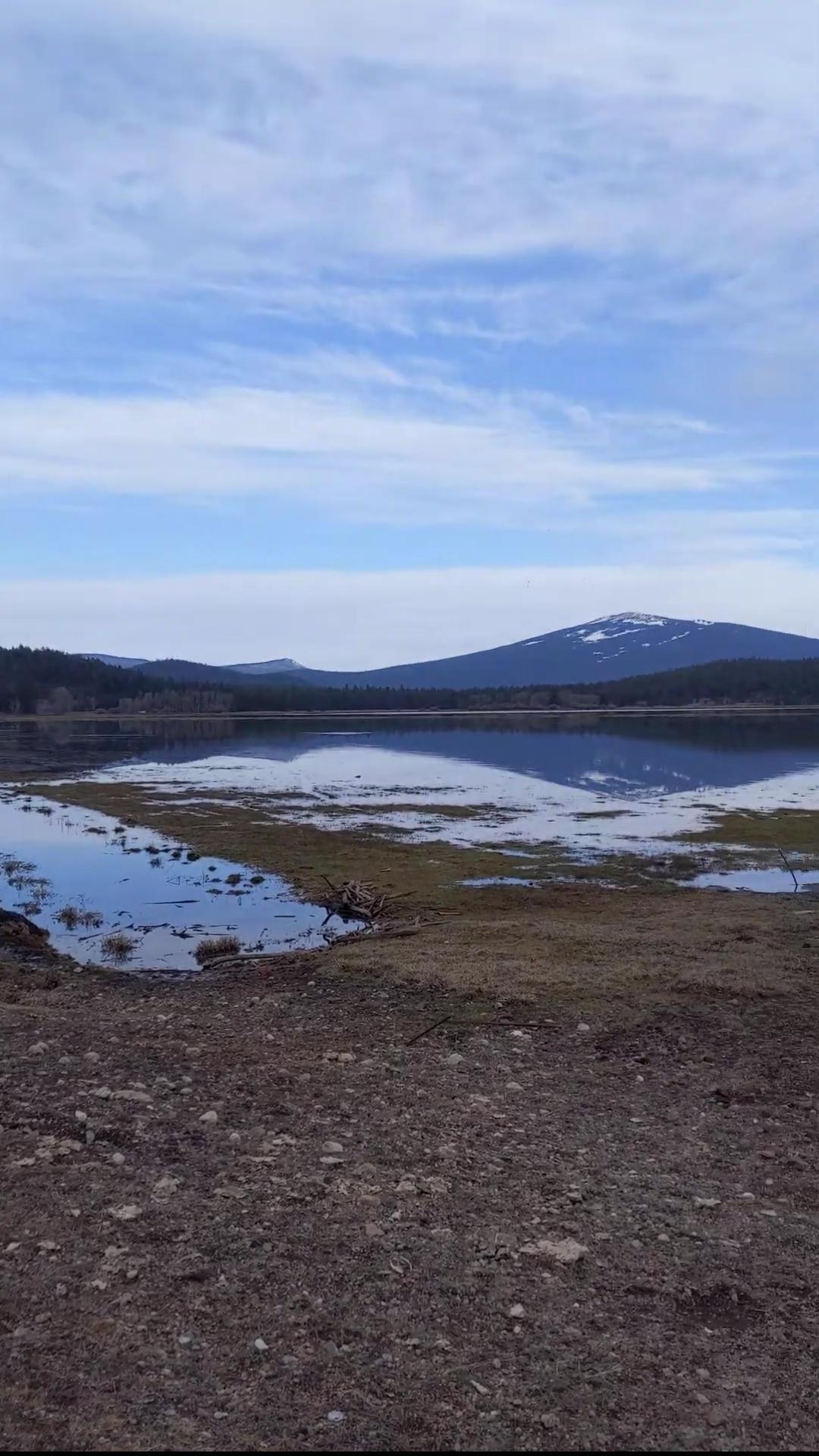
In 2020, Rusted Gate Farms purchased 669 acres of the former Wampler Ranch on Upper Klamath Lake. Like many agricultural properties adjacent to the lake, it was originally a fringe wetland that was diked and drained for agricultural use in the form of cattle grazing. Since acquiring the property, Rusted Gate has continued to raise beef cattle there while developing a land use plan. Currently, 32 acres of the property have been identified for restoration as a permanent wetland, which will have direct connection to Upper Klamath Lake, providing refuge areas for juvenile suckers. Most of the property is a natural seasonal wetland, being inundated with snow melt and runoff from late winter to late spring.
| | “The Ranch in Spring” Photo courtesy of Rusted Gate Farms | | |
It's estimated that 75-95% of naturally occurring wetlands in the Upper Klamath Basin have been lost in the last century. In 1908, President Teddy Roosevelt sought to mitigate the loss by establishing the Lower Klamath National Wildlife Refuge as the first waterfowl refuge in the nation. In 1928, Tule Lake National Wildlife Refuge was established by President Calvin Coolidge for the same reasons. While the benefits of wetlands for birds was obvious, it wasn't well understood at the time how the loss and disconnection of wetlands from rivers and lakes would affect water quality, and subsequently, fish populations. And I don't think anyone could imagine these last remaining remnants of wetland habitat would be completely dried up, as happened in 2022.
Now, Rusted Gate is building on the proven practices of Lakeside Farms (a grain farm), by developing similar concepts specific to cattle ranching. Not only is Rusted Gate setting out to address environmental problems, but, like Lakeside Farms, they aim to develop practices which can be replicated by other farmers and ranchers, while still operating a financially viable business. Rather than draining phosphorus-laden water directly into the lake (which is prohibited), it will be drained into the newly-restored wetland to naturally filter out unwanted nutrients before being returned to the lake. These and other so-called "demonstration projects" are vital to the future of sustainable agriculture here in the Klamath Basin and throughout the country.
One of the practices Rusted Gate intends to implement is what is known as "regenerative grazing." While this concept has been around for quite some time, implementation is difficult and labor-intensive since it requires frequently moving cattle from one parcel to another in order to allow the plants to regenerate between grazings. In most cases, this has been accomplished through the use of temporary electric fencing, which must be moved and set up often to accomplish desired results. Rusted Gate hopes to streamline this time-consuming process by utilizing new technology, using electronic collars and satellite coordinates, to move cattle between five distinct pastures. The process is similar to the way "virtual" dog fences work.
Other notable goals on their agenda include education and access through public tours, and allowing the harvest of first foods by members of local Tribes. (We noted a huge patch of Wocus thriving while I was there.) They hope to implement all of these goals within the next 12-24 months.
Knowing there are hard-working people dedicated to discovering ways to restore our fragile ecosystem while maintaining the viability of our agricultural economy gives me hope in trying times. We can all use some good news these days, so feel free to forward this newsletter to anyone you think may be interested.
| |
July Refuge Report
-by Loree Johnson
| | |
Refuge Report - July 2025
I don't have a July report for Tule Lake Refuge. The last time I visited was the end of June. At that time, there were numerous (more than I saw last year) Western and Clark's Grebes in pairs with chicks. There was a good amount of water in both sumps, although it did appear to be going down at the time. Shorebirds and wading birds were present, and although I didn't spot any chicks, I feel confident nesting and hatching was happening. Since then, the USFWS has issued a warning on their Facebook Page regarding toxic algae blooming on the refuge. No reports of avian botulism as of this writing, but it's still early in the season.
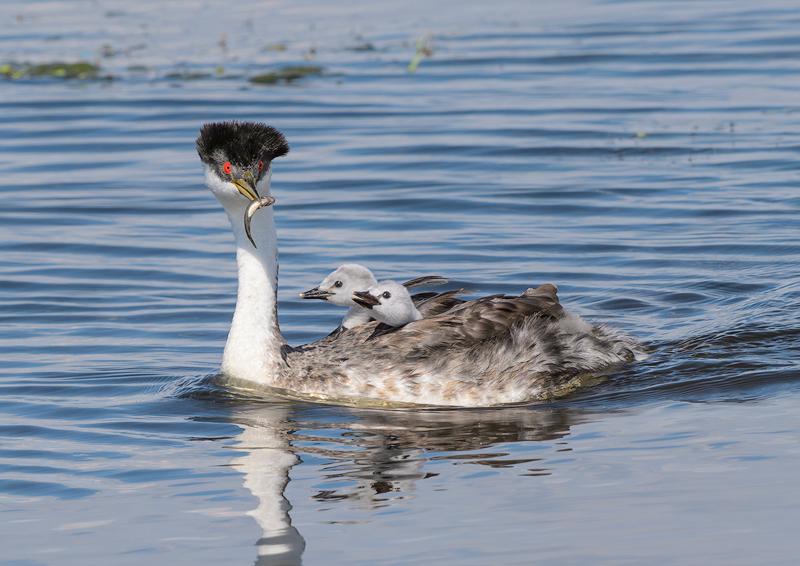
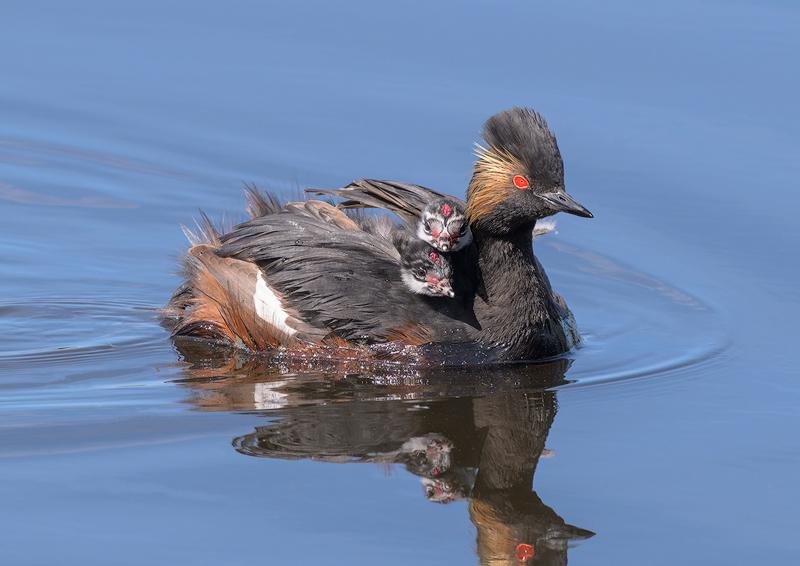
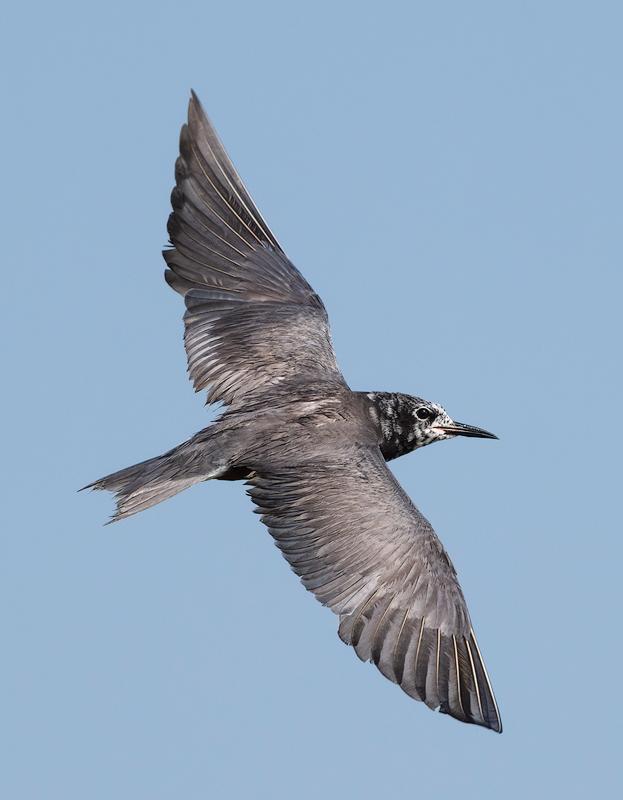
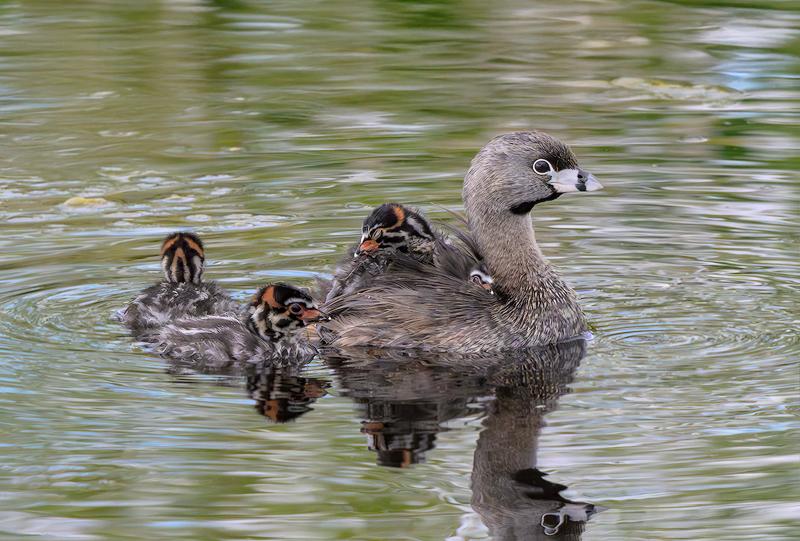
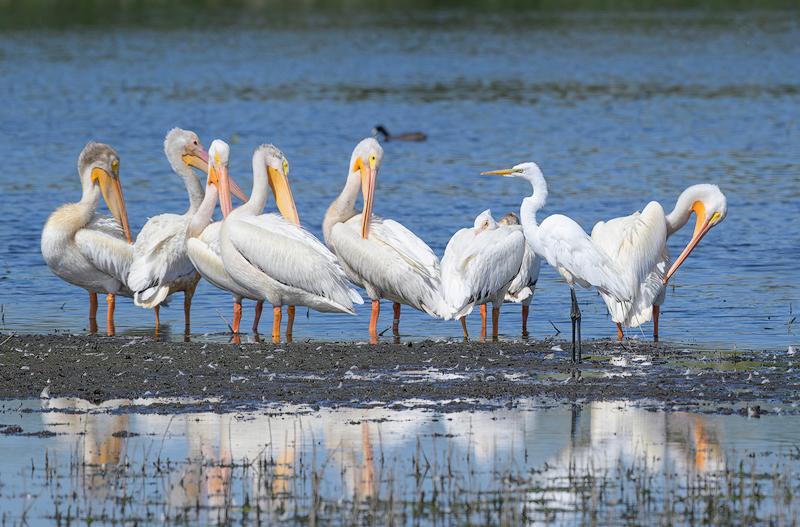
On a more cheerful note, I HAVE visited Lower Klamath Refuge several times recently and conditions appear to be good. Watered units viewable from the auto tour route include 6 and 3. Nesting and hatching was happening throughout the month. My personal sightings of chicks/juveniles included Eared Grebes, Western Grebes, Pied-billed Grebes, Black-necked Stilts, White-faced Ibis, Wilson's Phalaropes, Black-crowned Night Herons and Black Terns. While I didn't see if they had chicks, I did spot a pair of Common Gallinules that appeared to be nesting. Also spotted were Redhead, Mallard, Gadwall and Ruddy ducklings. The ever-present American Coots are also doing well. Our beloved nesting pair of Bald Eagles successfully fledged two chicks this year. Some species, such as Great Egrets and American White Pelicans, are beginning to "stage" in large groups in preparation for fall migration.
| | "Two Babies, One Fish" ©2025 Loree Johnson Photography. With two hungry young chicks riding on this Western Grebe's (Aechmophorus occidentalis) back, only one can have the fish. Photographed at Lower Klamath National Wildlife Refuge, California. | | "Reflections of Parenthood" ©2025 Loree Johnson Photography. An Eared Grebed (Podiceps nigricollis) with two newly hatched chicks riding on its back. Photographed at Lower Klamath National Wildlife Refuge, California. | | "Juvenile Black Tern" ©2025 Loree Johnson Photography. A young Black Tern (Chlidonias niger) in flight. Photographed at Lower Klamath National Wildlife Refuge, California. | |
Refuge personnel are acutely aware of botulism risks after last year's disastrous outbreak at Tule Lake and are doing everything within their power to minimize the likelihood of a repeat this year. I understand it is a difficult job and there are no guarantees so let's all hope mother nature gives the birds a break this year.
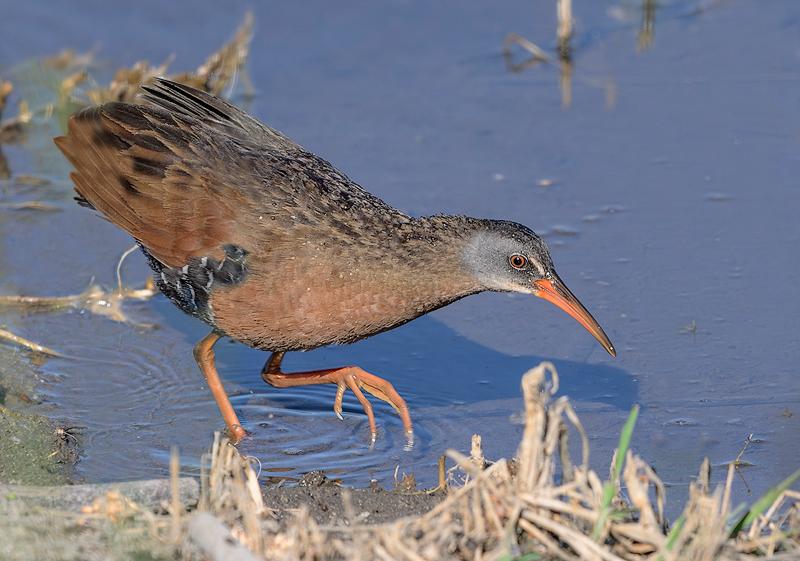
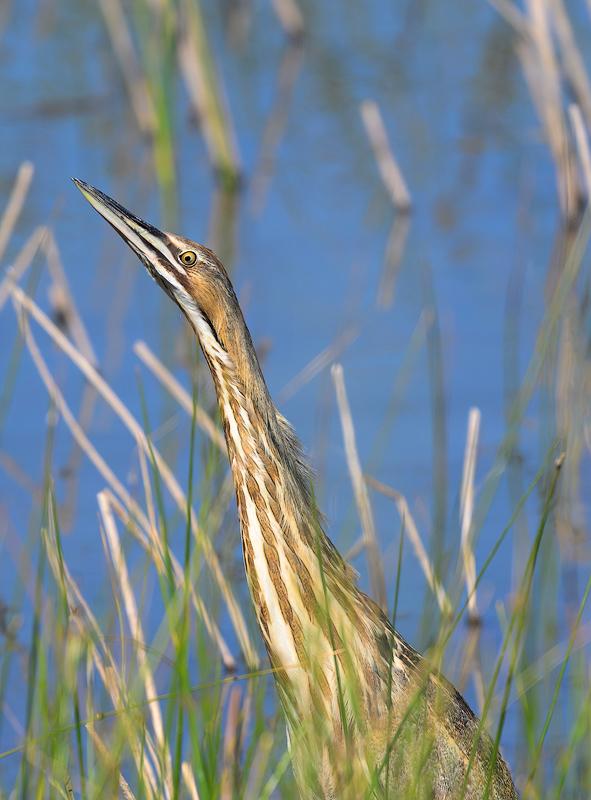
I have also made several recent visits to Butte Valley Wildlife Area (Meiss Lake) and am happy to report good conditions there, as well. Sightings include an American Bittern, Virginia Rails, Soras, Wilson's Phalaropes, Eared Grebes, Pied-Billed Grebes, Clark's Grebes, Spotted Sandpipers, Greater Yellowlegs, Ruddy Ducks, Cinnamon Teal, Gadwalls, Mallards and of course, American Coots. The Great Horned Owl that nests there successfully fledged three chicks again this year. While the wetland units inside the access road have minimal water, Meiss Lake is surprisingly full for this time of year and is teeming with bird life.
| | "Prowling Virginia Rail" ©2025 Loree Johnson Photography. With a dragonfly hatch in progress, this Virginia Rail (Rallus limicola) searches for emerging nymphs. Photographed at Butte Valley Wildlife Area, Siskiyou County, California. | | "American Bittern" ©2025 Loree Johnson Photography. This American Bittern (Botaurus lentiginosus) was doing what they do best, blending in to the marsh vegetation. Photographed at Butte Valley Wildlife Area, Siskiyou County, California. | | "No More Space" ©2025 Loree Johnson Photography. This Pied-billed Grebe (Podilymbus podiceps) has five babies. Three of the chicks are on her back and the other two would like to be. Photographed at Lower Klamath National Wildlife Refuge, California. | | These species lists are not comprehensive, just highlights of my personal sightings. I encourage you to get out there any enjoy the abundance that exists, even in these "dog days" of summer. Happy birding! | | "Just Trying to Fit In" ©2025 Loree Johnson Photography. In a group of American White Pelicans (Pelecanus erythrorhynchos), one Great Egret (Ardea alba) blends with the crowd. Photographed at Lower Klamath National Wildlife Refuge, California. | |
Species Spotlight - Wilson's Phalarope
(Phalaropus tricolor)
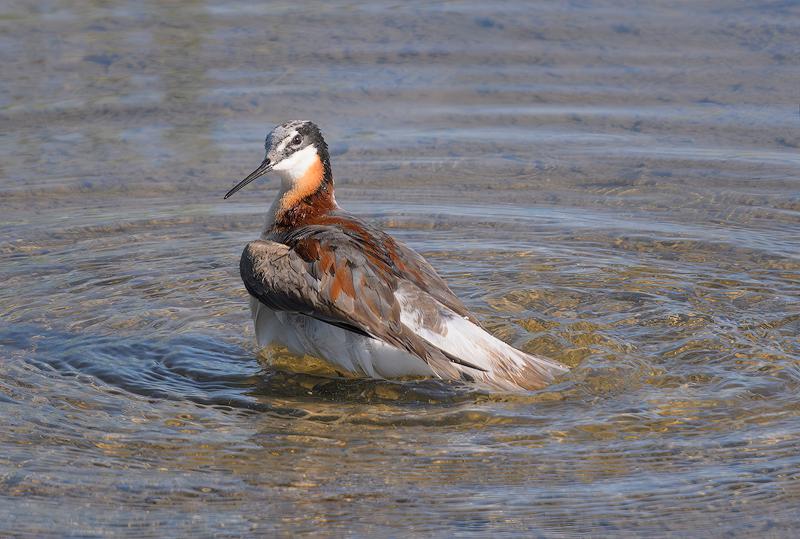
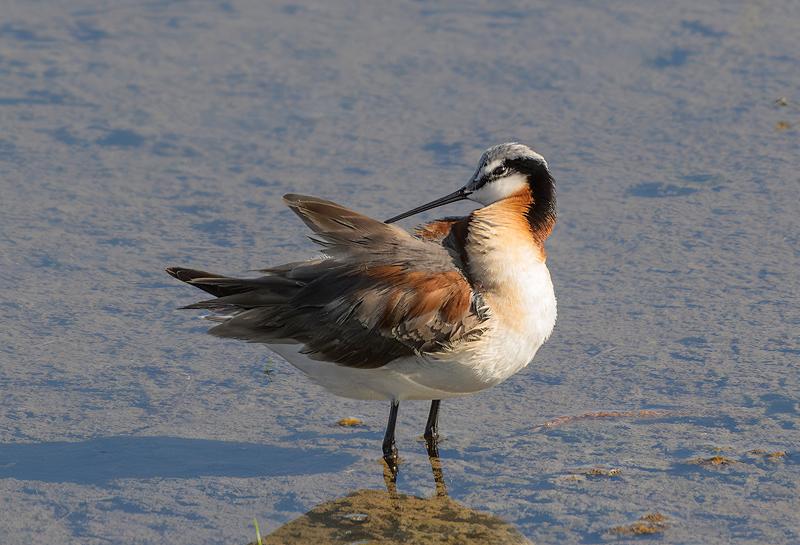
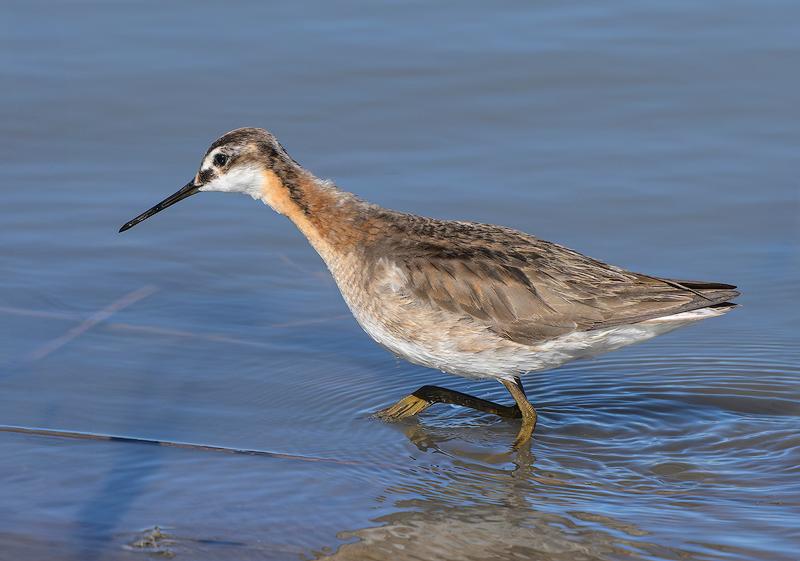
| | Wilson's Phalarope Bathing - Photo by Loree Johnson | | Elegant and dainty describes this tiny sandpiper. In breeding plumage the female has a handsome black "racing stripe" through the eye and down the long, slender neck. Males have a quieter coloration and both sexes have a thin, pointed bill. Non-breeding plumage is gray and white. | | Wilson's Phalarope Preening - Photo by Loree Johnson | | Phalaropes feed by picking small food items like insects and seeds from the surface of the water. Their movements are active as they dart and jab and spin in tight circles in order to stir up food to be eaten. It is this spinning motion that aids in identifying them. | | Wilsons Phalarope Stalking - Photo by Loree Johnson | | |
Female phalaropes are more brightly colored and guess what? It is SHE, the female, who does extravagant aerial displays in order to attract a mate. If the male does not appear impressed, she chases him down and mating occurs. It is HE who makes a simple ground nest by scraping out a slight depression on the ground and lines it with grasses. She lays four eggs. He incubates them and raises the kids. She is free from all parenting duties and may even find another male to mate with. Or she may just hang out with the other females all relieved of family chores. Every species has their unique breeding style that results in making babies and keeping the species alive. This style is sure to bring a smile to the face of most women!
–Shannon Rio, Klamath Bird Observatory
| | New events are added as I receive them on the website event calendar at the link below. | | |
Because I believe this newsletter is more interesting and informative when it includes the knowledge and perspectives of others, my request for guest articles will be ongoing. If you enjoy reading it, I hope you will consider contributing.
Articles needn't be long and technical. In fact, short, easy to read stories that inform and engage the community are ideal.
If you find yourself with a story to tell about our avian neighbors, their habitat, or something related, simply reply to this newsletter and let me know what you want to write about.
| | |
Do you know someone who should see this newsletter? Someone who cares as much as you do about the birds of the Klamath Basin? Maybe someone in a position to bring about change? Please forward this to one or more of your contacts and help our voices grow!
Did someone forward this to you and you want to receive future monthly newsletters?
| | | | |